There are people whose careers look coherent only after you find the bass guitar. Kevin Ames is one of them. On paper, he is a San Francisco go-to-market operator with more than 18 years in post-sales leadership. He has built customer-success organizations, led teams and worked the long corridor between a software demo and a customer who actually stays. Elsewhere on the internet, though, another Ames appears: younger, often under stage lights, usually holding down the low end while somebody else leaps around. The two versions are not opposites. They are the same job in different clothes.
Today Ames is listed as Founding GTM at Lovable, the Stockholm-born company that lets people create applications by chatting with AI. The product compresses work that once demanded a small technical army into a conversation: describe the screens, data and logic; inspect what appears; refine it; publish. The spectacle is in the making. Ames’s professional territory begins a beat later, where possibility becomes practice and somebody has to turn astonishment into adoption.
The career after the applause
Software companies are naturally infatuated with beginnings. They ring bells for launches, publish clips of miraculous prompts and celebrate the first transaction. Customer success deals in the less photogenic middle: onboarding, confusing permissions, unused features, renewal dates, the delicate moment when a buyer wonders whether the promise has arrived. It is operational work with an emotional weather system.
Ames calls himself a “customer journey architect.” The phrase risks sounding ornamental until he explains the materials. He works across product, finance, operations, marketing and engineering. He focuses on net revenue retention, customer satisfaction and adoption. He talks about programs, tools and systems that follow a customer from onboarding through renewal. Architecture, in this version, is mostly doors: where one team hands a person to another, where information enters, and where it gets lost.
“I’m a ‘customer journey architect’ who specializes in designing and executing holistic go-to-market strategies that drive long-term revenue growth and customer retention.”Kevin Ames, on his professional focus
One early artifact in his public record is a customer-success pilot for enterprise support, dated November 2013. Its brief is plain: improve engagement, reduce churn, support sales and identify expansion opportunities. The vocabulary is now standard enough to vanish into a quarterly review. At the time, many software companies were still working out whether customer success was support with better lighting or a new operating discipline. Ames has remained inside that question as the function matured.
At LinkedIn Learning Solutions, a former colleague says Ames led the first relationship-management team in the division’s history. The team mixed internal and external hires and had to build its own connective tissue. The recommendation is unusually warm for LinkedIn, a website where praise often arrives shrink-wrapped. Ames, the colleague wrote, hired well, coached steadily and helped the group begin quickly enough that work friendships outlasted the org chart. Another colleague, from Asana, remembers him as collaborative, skilled at connecting different teams’ goals, authentic and open to growth.
Those observations matter because Ames’s own account of leadership is more method than mystique: lead from the front, empower teams to be customer-obsessed, use data for advantage. Nothing there requires a heroic pose. The leader is in the arrangement, not above it.
The useful discipline of keeping time
Ames’s music site is a charming act of resistance to polished executive identity. He calls it his “self-indulgent music page,” then opens a vault containing roughly 25 years of performances, albums and miscellaneous band moments. There is a group named 3 Ring Simian. There is another called Sideshow Fiasco. One available Sideshow Fiasco track is titled “Fart Song,” which is perhaps the strongest available evidence that Ames can survive a serious meeting without becoming a serious person.
The archive is not a side-hustle landing page. It is closer to a garage with carefully labeled boxes. Photographs catch crowded rooms, rehearsal spaces, a LinkedIn event and the familiar musician’s geography of cables, amps and half-seen bandmates. Ames appears at the bass, the instrument charged with making everyone else’s freedom intelligible.
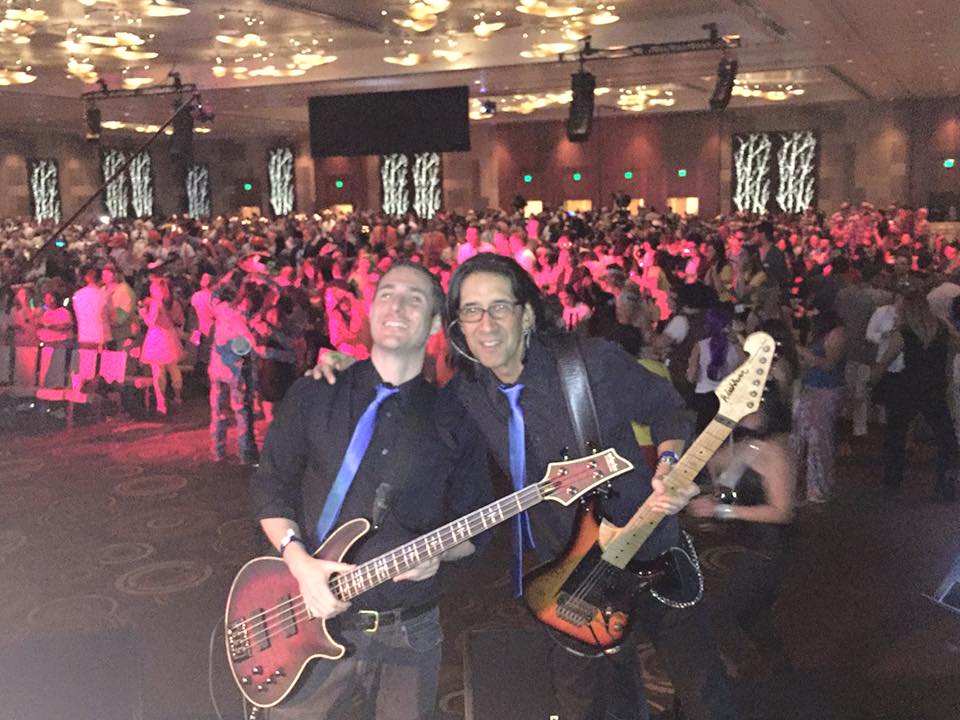
It would be tidy to claim music taught him everything about business. Reality is rarely so obliging, and Ames has not made that claim. Still, the parallel earns its keep. A bassist listens laterally. The job involves structure without fuss, timing without hurry and a willingness to make another player sound better. A post-sales leader also lives by cues. A customer hesitates. A product team ships. A seller moves on to the next account. Someone has to hear the change before the room loses the beat.
Even Ames’s career language has an ensemble quality. He describes collaborating across functions rather than owning a single immaculate funnel. His colleagues praise cohesion and connecting dots. These are modest verbs in a business culture addicted to conquest, but they describe the work that prevents speed from becoming noise.
A bassist knows the glamorous truth about momentum: somebody has to keep it from falling over.
When minutes replace months
Lovable makes this old discipline newly urgent. Its current product can generate a working interface, database and logic from a plain-language prompt. It can add authentication and hosting, connect outside tools and publish the result. The company says people have built 60 million projects on the platform. In August 2026, it announced a $400 million Series C at a $13.3 billion valuation.
Ames greeted the news with the cheer of somebody still inside the race: “It’s been a crazy ride and we’re just getting started.” In another comment, he offered a more revealing line: “Who says you can’t sprint a marathon?” It is funny because it sounds impossible. It is useful because hypergrowth companies attempt it anyway.
The paradox is the job. A product that builds faster creates more customers, more kinds of customers and more things those customers can misunderstand. Lovable now speaks not only to solo makers sketching prototypes but to businesses building internal tools, managing data and governing what gets published. The customer journey no longer resembles a funnel. It resembles a city map drawn while the streets are moving.
The scale sharpens another distinction in Ames’s résumé. Go-to-market is often treated as a synonym for selling, as though the market were a door and the only question was how hard to knock. His history points to a wider definition. A market is also the experience after entry: the first successful project, the first moment of confusion, the first reason to return. When the product can serve both a founder and an enterprise team, those moments multiply. Someone has to find the pattern without sanding away the differences. That is less like delivering a pitch than arranging a set list for an audience you are still getting to know.
That puts operators like Ames near the center of the experiment. AI may narrow the distance between wanting software and having it. It does not erase the distance between having software and trusting it. Adoption is not generated in a single prompt. Neither is retention. Those outcomes accumulate through comprehensible onboarding, reliable handoffs and the feeling that somebody anticipated the difficult second question.
Ames’s 18-plus years in post-sales give him a view of technological change from the customer’s side of the counter. Products change their interfaces. The human questions keep returning. What have I bought? Who will help me? Does this fit the work I already do? What happens when the demo ends?
The next move is still a human one
There is no grand founding myth here, and that is part of the appeal. Ames’s story is about the people who make a company’s promise survivable. He has done it through customer-success pilots, new teams, cross-functional programs and the slow accumulation of professional trust. He has also spent decades standing slightly to the side of a stage, translating rhythm into forward motion.
The AI era has produced a great many claims about replacing work. Ames occupies work that is hard to replace because its substance is attention. Data can show where adoption drops. A system can flag a risk. A model can produce the next screen. Someone still has to notice what the room needs, align the players and decide when to push.
That may be why the two halves of his public life fit so neatly. Customer journeys and bass lines are both invisible when they are working. You notice them when they disappear. Ames has built a career in that understated zone, arranging the conditions for other people to move. Lovable happens to be moving very quickly. The tempo is new. The craft is not.