The modern software demo has acquired the manners of a stage illusion. Type a sentence. Wait a moment. An application appears. Buttons work, pages connect, data moves. The audience has barely settled into its chairs before the rabbit is already regarding everyone from the hat. Collin Thigpen's job begins around the moment the applause gives way to questions.
At Lovable, where he works in founding go-to-market and strategic sales, those questions come from large organizations. Can the quick thing become a durable thing? Who controls it? How does it connect to the systems already humming in the basement? What happens when the person with the idea is not an engineer, and the company still needs engineering standards? A product built for immediacy meets an institution built for deliberation. Somewhere between them sits a sales conversation, wearing a sensible jacket.
Thigpen arrived prepared for that particular awkwardness. His public career record crosses five distinct chapters of enterprise technology: data quality at Experian, business applications at Oracle, cloud at Google, collaborative design at Figma, and now software created through conversation at Lovable. Read as a list, it is a résumé. Read as a sequence, it is a compact history of how software moved closer to the people using it.
“Take a crack at building something yourself.”Collin Thigpen, inviting GTM teams to a Lovable hackathon
A career measured in shrinking distance
Thigpen studied business administration at the University of New Hampshire's Peter T. Paul College of Business and Economics from 2003 to 2007, with a period at Bond University in 2006. His early work included business development at Pine Street Investments and sales development at Breckenridge Grand Vacations. By 2014, he was an enterprise account director at Experian. The setting was less glamorous than prompt-built apps, but the central problem was already visible: new technology is only useful when it can survive contact with a customer's existing world.
The route to conversational software
Enterprise accounts and data quality
Applications sales
Key accounts, then enterprise sales leadership
Senior enterprise sales
Founding GTM and strategic sales
A recommendation from that Experian period supplies one of the few public anecdotes about how he works. John Lay, then dealing with an address-quality problem at Camping World, recalled that the company's systems lacked the interfaces needed for the proposed product. Thigpen did not leave the incompatibility on the conference-room table like a dead fish. He worked across Camping World and its software vendors to find what Lay called a quality, cost-effective solution.
Lay's description is modest and therefore revealing: personable, reliable, detail-oriented, interested in the best solution for everyone involved. Those are unfashionable virtues in a business culture fond of announcing that everything has been disrupted. They are also exactly the virtues required when the new world must plug into the old one without setting off the alarms.
Cloud, canvas, prompt
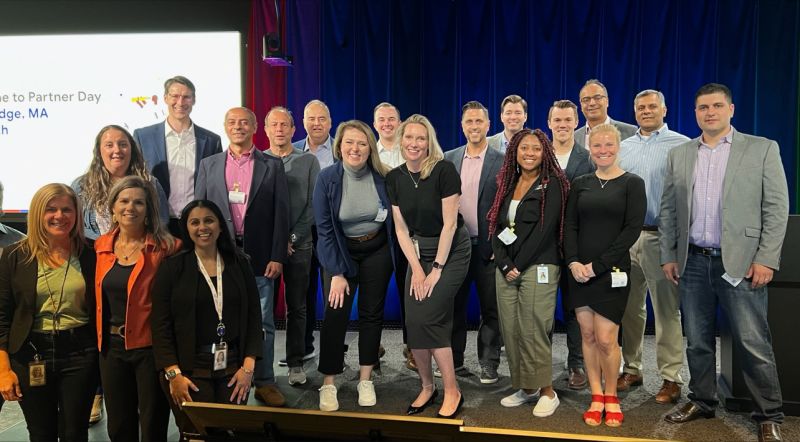
After Experian came three years selling applications at Oracle, followed by more than five years at Google. He began there as a key account executive in 2018 and later led enterprise sales. A 2023 Google Cloud partner-day post placed him among the team gathering technology partners in Cambridge, Massachusetts, around a familiar goal: move with urgency while solving the difficult problems customers cannot wish away.
Then came Figma in 2024. The move matters because Figma is a product people often meet from the bottom up. Designers and teams begin using it; an organization later decides how to buy, manage and spread it. The salesperson does not introduce an abstract machine. Often, the affection is already in the building. The task is to turn enthusiasm into a relationship sturdy enough for procurement, security and thousands of seats.
There is a consistent narrowing of the gap across these jobs. Experian sold the quality of information moving through a company's systems. Oracle sold the applications those systems ran. Google sold infrastructure flexible enough to host the next generation of work. Figma put many more people into the product-development conversation at once. Lovable asks what happens when still more of them can make the working artifact. Each transition moves the enterprise seller closer to the user's first impulse, while leaving the final decision distributed among finance, security, technology and leadership. Thigpen has not escaped complexity. He has followed it toward a simpler front door.
Lovable pushes that pattern further. Its users do not merely explore the product; they make products with it. By August 2026, the company said people had created more than 60 million projects, that Lovable-built apps received more than 900 million visits a month, and that employees at nearly two-thirds of the Fortune 500 had used it. Those figures describe reach, not necessarily enterprise contracts. For a GTM team, the distinction is the whole assignment.
The product is already inside the building
Relative bars visualize three different measures and are not a shared scale. Company figures reported August 2026.
The sales meeting becomes a workshop
Thigpen's public activity at Lovable suggests that the pitch has become participatory. In the summer of 2026, he hosted a go-to-market hackathon in San Francisco with Google Cloud. His invitation promised a discussion of how Lovable, Google and others were rebuilding GTM processes and tooling with AI. Then came the important clause: attendees could take a crack at building something themselves.
This is a canny response to a product that is difficult to understand at arm's length. A slide about conversational software remains, regrettably, a slide. Building a small internal tool changes the quality of the questions. The attendee stops asking whether the category is real and starts asking where the data should come from, who should have access and whether the scrappy first version deserves a second afternoon. The abstraction becomes an object. Sales, in this setting, is less an argument than a guided encounter.
The encounter still needs boundaries. After Lovable announced a $400 million Series C at a $13.3 billion valuation in August, Thigpen emphasized three priorities for the enterprise segment: security, the ability to route work to the best model, and deeper connections to an organization's existing stack. His post pointed to the company's AIUC-1 security certification and more than 100 native connectors. The message was upbeat, but its nouns were sober: security, independence, integrations. Enterprise enthusiasm prefers its wonder with documentation.
Speed acquires a chaperone
The clearest expression of Thigpen's current work may be Lovable's partnership with Perficient. Announced in May 2026, it made the consulting firm Lovable's first enterprise implementation partner. Perficient brought industry knowledge, integration and change-management experience; Lovable brought a platform intended to compress application development from months to days. A Perficient colleague publicly thanked Thigpen among the Lovable team members who helped make the relationship happen.
Partnership announcements can be ceremonial things, all handshakes and well-behaved verbs. This one exposes a genuine tension. Letting business teams build software may shorten a backlog, but it does not abolish governance. Rapid prototypes still meet legacy systems, regulated data and organizational politics. If the platform lowers the barrier to making an app, the company must raise its ability to decide which apps should advance and under what rules.
The geography adds another layer. Thigpen is based in Boston; Lovable keeps its center of gravity in Stockholm and has been expanding in London, Boston, San Francisco and New York. The company sells a borderless premise, but enterprise work remains local in the practical sense. Buyers want a person who understands their calendar, their market and the unlovely details of how decisions get made. A Boston operator at a Swedish company is therefore less a curiosity than a piece of the operating model: global product, regional conversation, shared implementation.
The product can compress the build. The organization must still learn how to decide.The enterprise problem behind the prompt
Thigpen's career has trained him on both halves. Oracle represented structured enterprise software. Google represented vast cloud infrastructure. Figma showed how a beloved collaborative product travels upward through a company. Lovable begins even closer to the individual impulse: I have a problem, so I will describe a tool. The distance between desire and prototype has collapsed. The distance between prototype and dependable institution has not.
What comes after the reveal
There is a temptation to cast AI software creation as a contest between builders and gatekeepers. Thigpen's work points to a less theatrical arrangement. The people closest to a problem gain the ability to make something. Security teams, engineers and implementation partners help determine whether it deserves to live. Sales connects the groups early enough that each can alter the outcome.
His own public voice is mostly about teams, customers and what they might build next. It is not an archive of grand personal doctrine. Even the line he used after the Series C was directed outward: he could not wait to see what the team, customers and community would make over the next 12 months. That preference suits a go-to-market operator. The work appears in other people's tools, their internal workflows, and eventually their confidence that a strange new capability belongs in ordinary business.
The rabbit, meanwhile, is still in the hat, and now it has requested access to Salesforce. Somebody has to ask why, check the permissions, call the implementation partner and keep the room interested. For Collin Thigpen, the most consequential part of the magic trick is what happens once everyone believes their eyes.