The bright trucks were parked near Fenway, each side washed in the pink-to-orange gradient of a software company announcing itself to Boston. Jeff McSweeny took a picture. His caption paired a playful “I spy” with “Lovable in Boston!” It was a small joke attached to a large campaign, and a colleague answered with a better one: given how much McSweeny was doing for the local team, perhaps he was driving the trucks too.
The exchange is revealing because it compresses his job into a street scene. Lovable began in Stockholm and sells a remarkable promise: describe the software you want and watch it take shape. McSweeny, its Boston-based Founding CSM, works at the other end of that promise. His domain is the human aftermath. Someone has to gather the customers, steady the excitement, field the awkward questions, and help a prototype become something people can use after the catering is gone.
Customer success has the misfortune of sounding like a department invented by a spreadsheet. In practice, especially at an AI company, it can resemble stage management, translation, coaching, and the occasional controlled experiment. The product runs in the cloud. Conviction still travels person to person.
Before the prompt, there was the attempt
McSweeny attended the University of Delaware from 2011 to 2014. His campus affiliations form a pleasantly balanced pair: the Blue Hen Golf Club and the Blue Hen Investing Club, leisure and capital, a fair preparation for the rhythms of technology sales. The more useful clue to his later career arrived in a 2019 podcast conversation with his longtime friend CJ Finley.
The two looked back on years of private experiments. They had built blogs. They had hosted mastermind groups. They had tried to pursue a product patent and failed. The episode framed friendship as infrastructure for entrepreneurship, the thing that keeps a person moving through the less photogenic parts of making something. Their conclusion was to invest in themselves and keep going.
A failed patent is an unusually good credential for work around generative software. It teaches the difference between an idea and the machinery required to carry it into the world. It also punctures the myth that making begins with certainty. Long before McSweeny worked for a platform that could produce an application from a paragraph, he knew what it was to have the paragraph, gather friends around it, and discover that reality had objections.
The useful route was not a straight one
A job made of other people’s questions
Before Lovable, McSweeny worked in customer success at Outreach. A former customer later described him as her partner in keeping the sales platform optimized and aligned with her team’s goals. It is not a cinematic achievement. It is better: a concise description of the work. Enterprise software earns its keep through alignment, a noun that usually means dozens of conversations nobody remembers to photograph.
His professional certificates trace the same practical curriculum. Customer journey mapping. Strategic negotiation. Scrum. Inbound marketing. Smartsheet. None announces a grand theory. Together they suggest an operator interested in how people move through systems, how teams agree, and how work gets organized after everyone has agreed that it should.
At Lovable, that foundation meets a product whose output can feel almost indecently fast. A user types an intention in ordinary language. The platform builds. The first reaction is often delight, but delight has a short half-life inside a company. Soon enough, a product leader asks whether the prototype can connect to existing data. Security wants to know who can see it. An executive wants a business case. The builder wants to change three things before lunch.
This is the last mile of AI, and it is paved with follow-up questions.
These are Lovable company figures, not personal performance metrics. They describe the scale of the environment in which McSweeny works.
The room where the future has to compile
One public glimpse of McSweeny’s work came through an internal Smartsheet hackathon facilitated with Lovable colleague Skyler Talley. The premise was simple enough to fit on a whiteboard: what could the team build if nothing stood in the way? Within hours, participants had made functional prototypes; some connected directly into Smartsheet. A vice president of product reportedly looked at the result and asked whether it could go to production.
The tempting part of that story is the speed. The important part is the setting. The builders were not isolated hobbyists. They were product people inside an established enterprise, surrounded by the expectations and dependencies that make “just build it” such an amusing instruction. McSweeny’s presence placed customer success inside the act of creation, close enough to watch where enthusiasm caught, where it stalled, and what help changed the result.
A workshop of this kind is half laboratory and half permission slip. It gives capable people a reason to suspend the normal queue of approvals and discover what their own judgment can produce. The software shortens the distance between idea and artifact. The facilitator shortens the social distance between “I wonder” and “let’s try.”
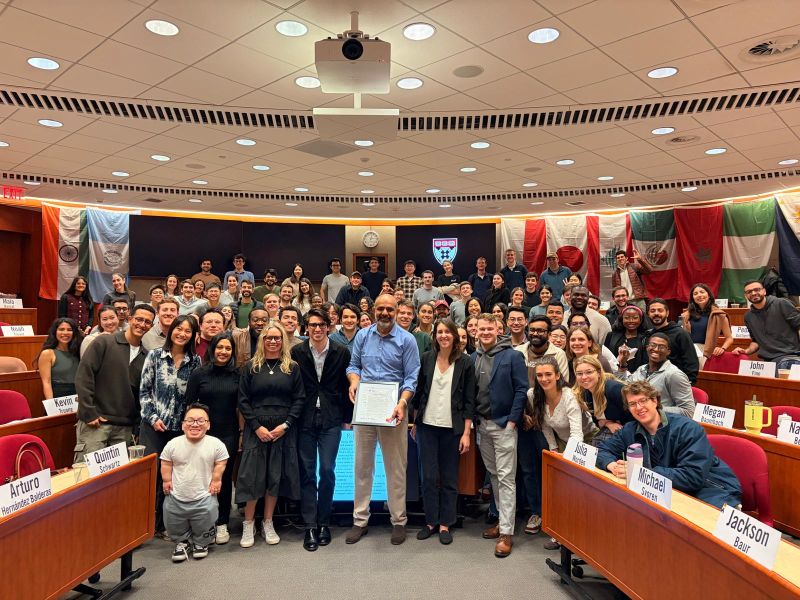
In 2026, McSweeny also joined colleagues at Harvard Business School for an in-person discussion of a case about Lovable. Roughly 1,000 MBA students considered what happens as software rises to a higher level of abstraction and more people can build by describing what they want. The case authors argued that once software becomes cheaper to make, the scarce goods move elsewhere: toward judgment, taste, execution, and knowing what deserves to exist.
Those are product questions, but they are also customer-success questions. A tool can multiply attempts. It cannot decide which attempt matters to an organization. It can make a screen appear. It cannot, by itself, make five departments agree that the screen should survive. The faster the artifact arrives, the more obvious the remaining human work becomes.
Boston as a verb
McSweeny’s public activity around Boston suggests that local presence is part of the job, not merely a line beneath his profile photo. He helped with a community build event that drew more than 100 participants and was organized with Anthropic and Stripe. He turned up in the city’s builder circuit. When Lovable arrived on the streets during Boston Tech Week, his post was less corporate proclamation than delighted sighting.
There is something appealing about a Swedish AI company becoming tangible beside Fenway Park. The international story of software is often told as frictionless scale: launch once, serve everywhere. McSweeny’s work supplies the missing verbs. Host. Explain. Invite. Listen. Return. A global product acquires local meaning through repeated encounters, usually in rooms smaller than its valuation.
In August 2026, Lovable announced a $400 million Series C at a $13.3 billion valuation. McSweeny marked the news by recalling his decision eight months earlier. Joining had felt like the beginning of a special journey, he wrote, and “that ‘this feels crazy’ feeling never left.” The line carries both exhilaration and useful disbelief. Hypergrowth is numbers from the outside and vertigo from within.
He ended with the company’s favored phrase: “It’s only Day Zero.” Startup language is fond of making the calendar kneel before ambition. Yet for a customer-success operator, Day Zero has a concrete meaning. Every new customer begins there. So does every new team inside an existing account, every prototype that has not earned trust, and every room of people wondering whether the tool applies to them.
The human part scales differently
McSweeny’s public record is not sprawling. There is no library of keynote speeches, no autobiography, no mythology polished by a public-relations machine. What exists is a coherent set of scenes: two friends remembering the things they tried; a customer crediting him with attentive partnership; enterprise teams building in a day; students debating what remains scarce; a packed community room; bright trucks beside a ballpark.
The thread is not code. It is participation. McSweeny seems most legible in relation to other people: a friend, a customer, a classroom, a team. Even the family recommendation visible on his professional profile praises his work ethic, positive attitude, and devotion to teamwork. Such qualities can sound ceremonial until a company is moving faster than its processes. Then the colleague who can hold a room together becomes infrastructure.
AI companies are busy teaching machines to carry out more of the work. The best reason to watch someone like McSweeny is to see which work remains stubbornly social. People need examples they recognize. They need permission to experiment without looking foolish. They need a partner who can translate product behavior into organizational consequence and who notices when a brilliant demo has produced a worried silence.
Near Fenway, the trucks did their job. They made Lovable visible. McSweeny’s job begins a moment later, when somebody looks at the name, imagines a possibility, and asks the first real question.