The most versatile piece of software on a financial trading desk may be the person sitting in front of it. A security identifier appears in one window. Someone copies it into another. A client record needs checking. Someone opens a third. The applications are sophisticated; the connection between them still has fingers.
That is the opening for interop.io, a company selling the ability to make separate applications behave like colleagues. Its software coordinates what users see and what their tools know, allowing a selection in one application to inform another. The commercial premise is pleasantly unglamorous: expensive professionals should spend less of their day transporting information across their own screens.
Financial services supplies a receptive audience. Banks, investment managers and software vendors depend on specialized systems accumulated over years. interop.io’s customer roster includes Citi, JPMorgan, Broadridge, AllianceBernstein and BNY. The company’s proposition is to improve the working environment around those systems while retaining useful applications. Now it wants AI assistants to participate in that environment, too.
A merger built around the messy middle
interop.io arrived in June 2023 through the merger of Glue42 and Finsemble, two businesses already addressing desktop interoperability. Glue42’s Leslie Spiro became chief executive; Finsemble’s Dan Schleifer became president. The combination also brought in Tick42’s professional services operation, led by Susan Walters.
This was an assembly of existing technology and expertise. At announcement, the combined firm reported more than 170 employees, including 110 people in research, development and implementation. The practical appeal was a broader offering: connected desktops, browser workflows and the supporting work required to deploy them inside financial institutions.

The professional services component matters. A product can publish an interface; someone still has to understand the customer’s terminology, permissions and daily routine. interop.io offers architecture advice, custom adapters, data translation and user-experience design. It can help a firm decide which applications belong together before engineers make them communicate. Much of the expertise is in knowing where an apparently simple handoff becomes a complicated business process.
500 applications, one shared framework
A published Tier 1 bank case makes the scale tangible. The project began with Finsemble in 2020 and grew from a departmental implementation into a broader platform. According to interop.io, more than 500 applications were integrated, benefiting approximately 10,000 users. Some legacy tools no longer had active development teams.
One published customer deployment. These are adoption figures, not a measured productivity gain.
The team adapted existing internal application interfaces for standards-based interoperability, then added facilities for combined interfaces and runtime dependency management. Old applications could join new web applications in the same framework. The sequence is useful: establish the shared platform, bring existing software aboard, then develop richer experiences around it.
It also explains why the bank expanded. A successful implementation in one department gave it a basis for building different experiences elsewhere. The repeatable lesson is to prove a workflow locally before widening the program. A functioning example gives the next department something more persuasive than an architectural diagram.
A separate global custodian case moves the story away from the trading screen. Operations teams were coordinating time-sensitive processes through email and chat. interop.io describes replacing those exchanges with actionable notifications linked to small browser applications. Tasks could be routed, deferred and retried, with a clearer record of what happened.
The design included a useful wrinkle: several people could receive a notification, while only one needed to act. Supported processes included reconciliation approvals and corrections to trade-blotter anomalies. Browser delivery avoided a desktop installation for participants. The appeal here is control over ownership and follow-through, especially when several institutions must cooperate on the same task.
The machinery behind the handoff
io.Connect is the central platform. Its browser version works inside standard browsers without an endpoint installation; its desktop version provides native integration on Windows and macOS. Workspaces organize related applications, preserve layouts and let users resume a familiar arrangement of tools. Adapters connect applications such as Bloomberg, Fidessa, Excel, Outlook and Salesforce.
io.Bridge extends connectivity across machines and environments. That distinction matters when a modern browser application needs information from a native or legacy tool running elsewhere. The broader product architecture lets firms choose components according to their deployment constraints. A browser-only experience and a deeply integrated native desktop need different plumbing, even when they support the same business task.
io.Manager supplies centralized administration: application definitions, layouts, user preferences, configuration and diagnostics. It is optional; io.Connect can run without that backend. Buying it means a team need not construct all those shared management services itself. Production support includes reviewing logs and crash reports and monitoring active sessions.
io.Insights addresses another question: what happens after people start using the connected environment? It collects information about applications, machine resources and workflows, following OpenTelemetry standards. Customers can feed that information into their own storage and visualization tools, including Prometheus and Grafana. The point is to observe a journey across applications, where a single application’s dashboard has only part of the story.
Together, those layers explain the business model. The company sells commercial enterprise software and implementation expertise. A 30-day trial offers a route into evaluation. For a buyer, the relevant cost calculation includes licensing, integration work, support and the internal engineering time required to maintain the resulting environment. Counting the software bill alone would miss much of the decision.
A common language, a commercial business
Financial Desktop Connectivity and Collaboration, or FDC3, gives participating applications common ways to exchange context and request actions. The standard belongs to the FINOS community. In June 2023, FINOS confirmed FDC3 2.0 certification for specific versions of both predecessor companies’ products.
A shared standard makes the commercial contest more interesting. Customers can ask for compatible applications without requiring every supplier to invent a separate private language. Vendors then have to compete on deployment, tooling, support and the experience surrounding those messages. Certification is evidence about a particular implementation and version, rather than a blanket guarantee that every possible workflow will succeed.
HERE Core, which combines the former OpenFin Workspace and Container products, occupies nearby territory. It also offers layouts, notifications and FDC3 interoperability, built on Chromium and Electron. interop.io emphasizes its combination of browser-native delivery, native desktop support and connections to legacy environments. These are architectural choices a buyer can evaluate against its actual application inventory.
The other alternative is internal engineering. A firm can build its own connections and workspace infrastructure. The commercial question is how much of that shared machinery deserves permanent ownership by the customer’s developers. interop.io’s pitch leaves room for bespoke business software while supplying reusable infrastructure underneath it.
Partnerships widen the number of useful connections. A June 2024 alliance with Genesis Global focused on bringing Genesis-built applications into interconnected workflows. FactSet’s June 2025 collaboration added interoperability around its Portware execution management system. In May 2026, DXC Technology and interop.io announced a partnership targeting energy and commodities firms, including links among trading, risk and operational systems.

Its employer materials promise flexible working, training and room for experimentation. The developer community adds a more visible expression of knowledge sharing: tutorials, troubleshooting discussions and examples drawn from customer questions. For a business selling integration, helping other developers understand the platform is part of making the product useful.
AI arrives with an invoice
interop.io launched io.Intelligence in September 2025. The initiative combines products, engineering and consulting for AI copilots operating across enterprise applications. Its stated direction keeps people involved and works within existing permissions. The underlying commercial insight is straightforward: customers who have connected their applications already have some of the infrastructure an assistant needs to take useful action.
An April 2026 release expanded the offering with io.Assist, a ready-made assistant interface; AI Web, an SDK for custom experiences; and AI Server, the backend for agent execution and conversations. Customers can begin with the supplied interface and customize later. This separates what a user sees from the services that run the agent.
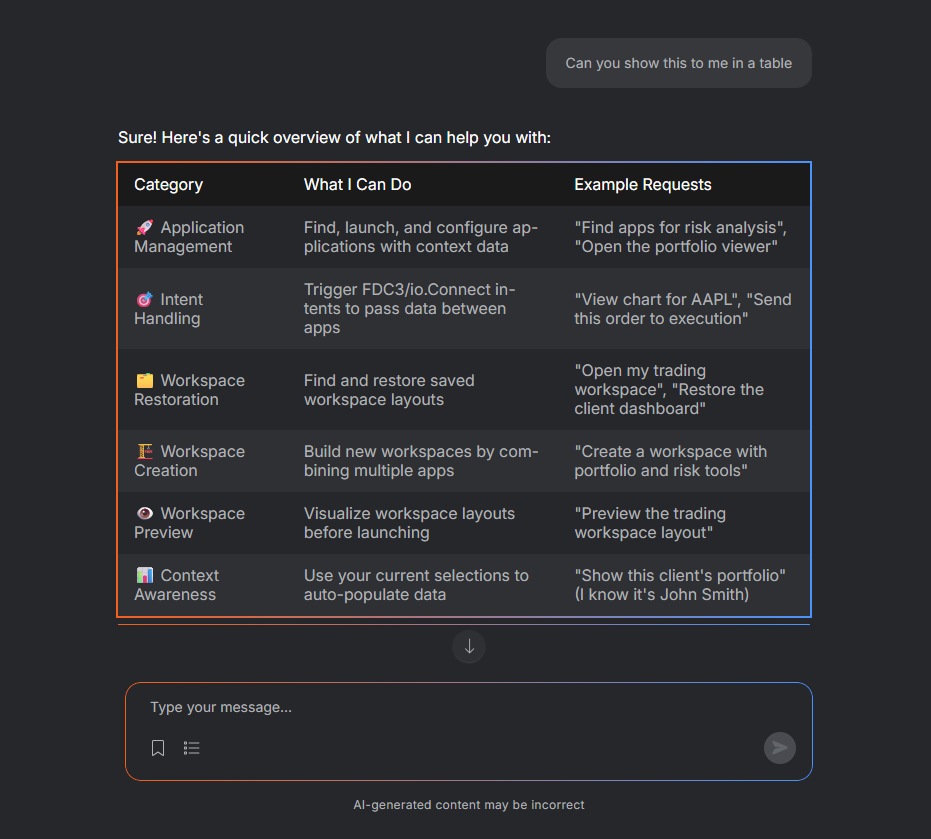
Implementation brought a less photogenic lesson. In a 2026 developer talk, consultant Ivan Pidov described an assistant alongside a Power BI-based business application. Tests with mocked data worked; real tables made requests heavy and slow. A large prompt, repeated data and a looping tool call helped consume roughly $1,000 in two hours.
The corrections were concrete: filter and aggregate data inside tools, supply relevant knowledge selectively, and cap usage per application and user. That bill was model consumption during implementation, not the price of an interop.io contract. Pidov also described a three-day hackathon that brought technical staff, domain experts and stakeholders together to produce a working prototype.
Another company walkthrough found that exposing many small FDC3 actions to a model produced inconsistent tool selection and missed steps. The proposed remedy was to group capabilities into meaningful workflows and describe them clearly through MCP, the Model Context Protocol. An instruction such as analyzing a client portfolio gives the model a more useful unit of work than an uncurated menu of tiny actions.
The condition is consequential: connectivity alone does not make an agent reliable. A deployment needs carefully designed tools, clear metadata and representative testing. A bank with ambiguous actions and poorly bounded data access has preparation to do before adding automation. Making more systems reachable can increase the number of ways an ill-designed workflow goes wrong.
The next click matters
By July 2026, Spiro was drawing attention to the person reading the AI’s answer. A response might mention an instrument or client while leaving the reader to locate it manually in another application. He advocated click-to-sync: selecting an item in the answer would bring the relevant working applications to that context.
“The model needs context to respond well. The user needs context to keep working.”
Leslie Spiro · CEO · July 2026
It is a fitting ambition for this company. The financial desktop has plenty of information and plenty of windows. What interop.io sells is the possibility that the next window already knows why you opened it.