In 2021, Leslie Spiro did something mildly inconvenient for a technology chief executive: he explained that one of his product’s innovations had ancestors. The clickable alerts in Glue42, he wrote, recalled notifications he had seen on a Reuters system in 1987. His own company had delivered related functionality for Reuters in the early 1990s. The family resemblance was hardly a scandal. He wanted it acknowledged.
A notification that opens the right application can save somebody a little work. By the time a sales presentation gets hold of it, that small convenience can acquire an extravagant creation myth. Spiro preferred to discuss the engineering: routing, implementation, usefulness. There was enough to be proud of without pretending the past had been invented that morning.
“It is important to acknowledge the earlier ideas,” he wrote. His argument allowed room for imagination and craft while refusing to confuse them with historical amnesia. It also offers a useful introduction to his career. Spiro has spent years returning to the spaces between applications, where a perfectly respectable piece of software can still leave its user stranded.
Before there was anything to glue
Long before becoming co-founder and CEO of interop.io, Spiro helped build the machinery through which financial professionals saw and acted on information. He co-founded SD&C, the business that delivered Reuters’ first Windows-based workstation. At Dealing Object Technology, he jointly created the RTT real-time market-data platform. He also co-founded EasyScreen, a derivatives-trading system that went on to float on the London Stock Exchange.
These were different businesses, but they occupied related territory: market information, trading tools and the working environment around them. A price has to arrive somewhere. An application has to present it. A person has to decide what to do next. Spiro’s later interest in the whole desktop becomes easier to understand against that background.
His career record places him at Reuters as a consultant in 1987 and at SD&C as a co-founder in 1989. It also records an MBA at London Business School between 1987 and 1989. The combination is apt for someone whose subsequent work would keep asking an engineering question with a commercial consequence: what actually helps the person using this?
A bank supplies the problem
Glue42’s origins lay in a particular customer’s difficulty. In 2012, JPMorgan wanted a platform to integrate the applications on its wealth-management desktop. Spiro’s account was that existing vendors could not supply the required connection between older applications and newer ones. His team was engaged to build what became Glue42 Enterprise.
That beginning gave the business a concrete assignment. Large institutions already owned software that mattered to their work. Replacing everything would be a rather elaborate way to avoid making two windows cooperate. Connecting the useful parts offered another route.
Spiro later acknowledged that Glue42’s early commercial challenge had been marketing. Attention had gone into architecture and technical innovation, and establishing a market position had proved harder. It is a revealing admission from a founder selling integration: a product can connect applications successfully while its own message still needs work.
Customer use remained central to his account of development. In 2022, he said roughly half the features on the roadmap came from the field. The desktop was supplying instructions, provided the company listened closely enough.
The user has more than one window
By 2017, Spiro was making a broader argument about enterprise software. Consumer web development often considered each application separately. Inside a company, developers could know much more about the people using their software, the tasks they performed and the other programs running beside it. That knowledge ought to change the design.
He called the approach UX Integration. The unit of attention became the person’s activity across several applications. A button in one could open another, already carrying the relevant information. Client names would cease travelling around the office by copy and paste.
The idea had an everyday extension. At Bulgaria Web Summit in 2017, Tick42 launched Glue for Office, connecting web applications with Word, Excel and Outlook. The demonstration addressed the familiar coexistence of browser software and Microsoft Office. Users could keep working in applications they already used while web systems handled storage, validation, auditing and access controls. Spiro’s product pitch had room for the spreadsheet that refused to retire.
Illustrative workflow. The connection carries the context, so the person can carry on.
Sofia, and room to learn
The organisation behind this work had its own geography. Tick42 was founded in 2010 by the UK-based Spiro and Bulgarian technologists Stoyan Damov and Lubo Konstantinov, who had already worked together. By May 2021, the company described a team of about 110, with more than 85 based in Sofia.
In a joint discussion with Telerik Academy, Spiro, Damov and Susan Walters described an approach that gave junior developers a place in the business. Less experience could mean fewer fixed habits and more willingness to learn the company’s way of working. Their partnership with the academy dated to 2017.
Their plans also allowed technical staff to advance without having to become managers, and to move between engineering and people-management responsibilities. That is a concrete expression of how the business wanted careers to work. A good developer did not have to acquire a team simply to acquire a future.
When the rival became a colleague
In June 2023, Glue42 and Finsemble merged to create interop.io. Spiro became CEO; Finsemble’s Dan Schleifer became president. Two firms that had competed for customers now had to make the same argument from the same side of the table.
The discussions had begun about nine months earlier, with technology due diligence starting in late 2022. Glue42 had been heading towards another funding round. Spiro described the combination as an alternative that brought complementary strengths in technology, management and geography. In his telling, the client list doubled overnight.
He also dwelt on what happened when the teams met. People got along, he said, because they cared about the experience clients had using the technology. For a company whose business depended on cooperation between separate systems, cooperation between separate groups was a reasonable place to begin.
Customers had already seen the combination
The merger’s logic was visible from the other side of the buying process. Prospective customers, Schleifer explained, often reduced their choice to Glue42 and Finsemble. They liked different elements of each. Putting the firms together offered a way to combine those elements instead of requiring a choice between them.
Spiro pointed to shared culture, a similar view of interoperability and commitment to customers. The technical work was supposed to preserve continuity for existing users while the organisations brought their capabilities together. An integration company’s own integration would be an unusually public test of its judgement.
The new platform’s central product was io.Connect. Its remit covered coordinated front ends and workflows across applications, with the controls enterprises needed for deployment. The merger also brought Tick42’s professional-services business into the organisation under Susan Walters. Building the connection and helping a customer use it remained closely related jobs.
A common language, with several owners
Alongside the commercial products, Spiro has participated in the financial industry’s work on open standards. His FINOS biography records involvement in FDC3 and the Desktop Services programme, as well as a seat on the OpenMama steering committee. His Finextra writing about OpenMama was already discussing open-source market-data technology in 2012.
FDC3 establishes shared ways for applications to exchange context and request actions. A program can communicate what the user is looking at so another can respond. Agreement on those messages helps separately built applications cooperate. It gives the space between windows a vocabulary.
In an FDC3 for the Web webinar with engineer and maintainer Juliana Langston, Spiro returned to the process behind that agreement. He stressed that participation shapes a standard. Participation was open beyond FINOS membership. Langston’s demonstration showed the practical ambition: an application able to work across browser and desktop environments without a rewrite for each one.
“The standard is shaped by those who show up.”
Leslie Spiro · FDC3 for the Web webinar
Balloons after the due diligence
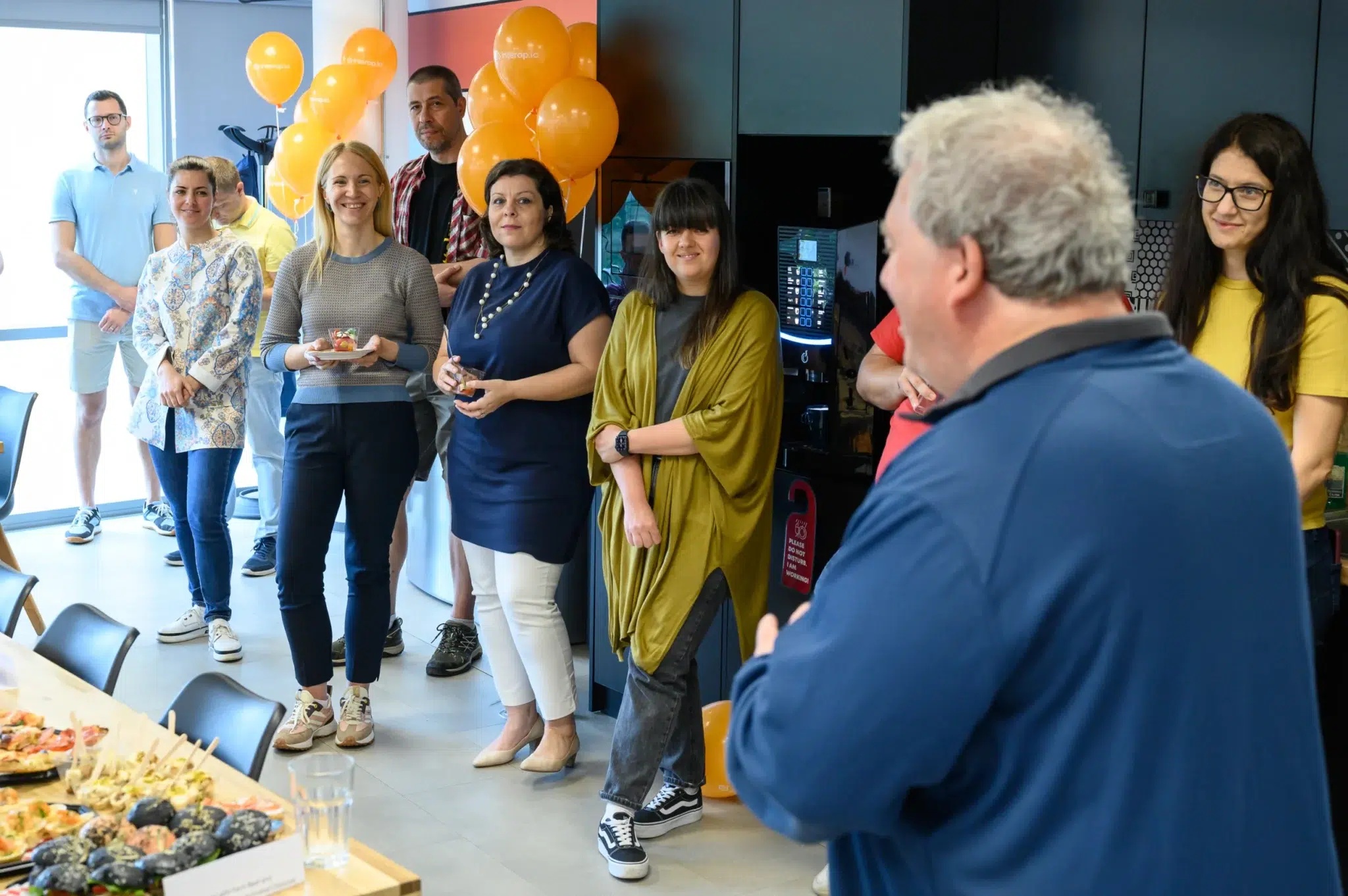
A year after the merger, Spiro wrote about a new website, a refreshed brand and an office celebration in Sofia. The photographs offered a welcome change of subject from application architecture: colleagues, food and orange balloons. Even interoperability has to stop for a sandwich.
His anniversary message described the company finding its identity as a combined organisation. Reliability and sincerity appeared among the qualities he wanted the brand to express. Those are quietly demanding promises when your software sits between other people’s systems.
The emphasis on relationships continued. At the company’s 2025 New York client forum, Spiro opened proceedings by stressing partnership across teams, clients and end users. His public work kept returning to the people required to make technical cooperation useful. A standard can define a message. It takes a working relationship to decide which message somebody needs.
The next window is an AI chat
By July 2026, Spiro was examining a new version of the old desktop problem. An AI reply could identify something worth investigating, yet leave the reader to locate it manually in the applications already open nearby. A capable answer could still be an awkward place to work.
His proposed interaction was click-to-sync: select an instrument or client in the answer and let the relevant applications move to that context. He distinguished asking AI to carry out a task from receiving support while doing the work yourself.
“The model needs context to respond well. The user needs context to keep working.” The two sentences put a person back into a discussion often dominated by what a model can ingest.
The past has another appointment
Spiro had given the argument a playful musical introduction in December 2025, publishing a LinkedIn article titled “Bob Marley has some advice on how to fix Microsoft Copilot.” Its subject was Microsoft’s own history of connecting applications and what that history might offer its AI assistant.
The joke fits the career. After Reuters workstations, derivatives systems, desktop integration and a merger with a competitor, Spiro still finds something worth examining in the handoff. An application may be finished according to its developer. The person using it may have half a job left.
His version of progress makes room for both experiences. Build the new capability. Remember the older work. Then watch what happens when somebody tries to use the thing beside something else. For Leslie Spiro, the interesting part of the desktop keeps occurring at the border.
Keep the windows open
More from Spiro, his colleagues and the work.
Visit interop.io ↗Leslie Spiro on LinkedIn ↗Read: Technology, History and Truth ↗Read: Bring Context to the User, Not Just the Model ↗Watch: TradeTech Europe interview, Paris 2019 ↗Watch the TradeTech interview on Vimeo ↗Watch: FDC3 for the Web with Juliana Langston ↗Read: Spiro and Schleifer on the merger ↗Browse Spiro’s early OpenMama writing ↗