A help desk ticket is a peculiar piece of modern office furniture. It begins as a request, becomes a number, acquires a priority, and then spends an uncertain portion of its life waiting for a human being to move it one square to the right. Jake Stauch has spent enough time with enterprise IT teams to see the absurdity. The employee does not want a ticket. The employee wants access to an app, a laptop configured, an answer found, an approval gathered. The ticket is merely the bureaucratic shadow cast by the work.
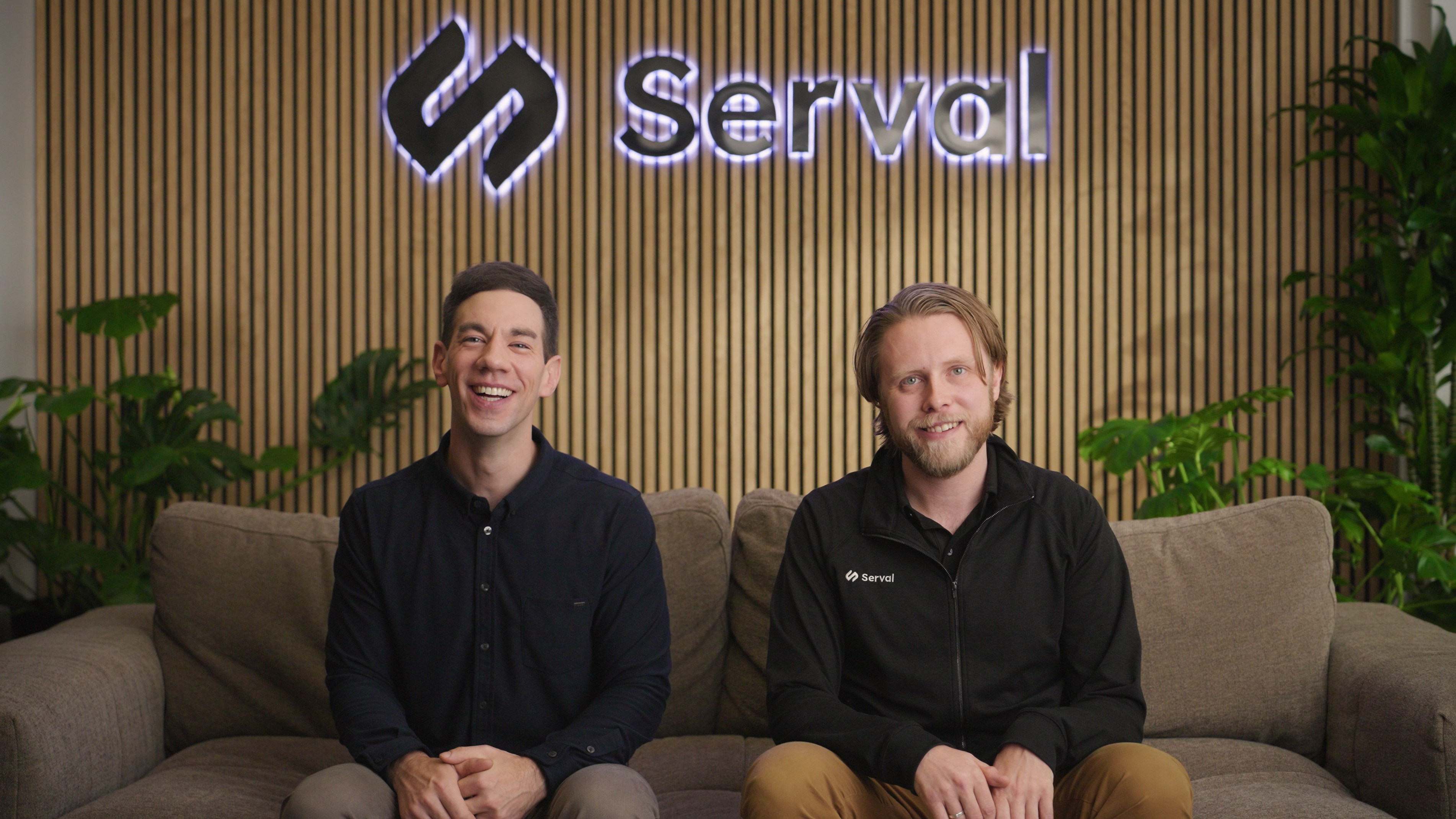
Serval, the San Francisco company Stauch co-founded with Alex McLeod in 2024, is built around collapsing that shadow. An employee asks for something in ordinary language. The system identifies what is needed, follows the rules an administrator has approved, calls the right tools, records the action, and, when all goes well, resolves the request. Its ambition is not to make the queue friendlier. It is to make much of the queue unnecessary.
That distinction explains why Stauch talks less like a chatbot impresario than a product manager with an allergy to unfinished business. “We want to make it easier to automate something forever than do it manually once,” he has said. It is a severe standard. Most workflow software asks an administrator to pay a setup tax in advance: drag a block, connect an arrow, configure an exception, discover a second exception, and eventually produce a diagram resembling a subway map designed during an earthquake. If the task is quicker to complete by hand, automation loses before it begins.
“We want to make it easier to automate something forever than do it manually once.”Jake Stauch
The founder before the ticket queue
Stauch's route to enterprise service management began in a rather more cinematic place: a virtual glider controlled by concentration. He studied neuroscience at Duke University, then left before completing his degree to build NeuroPlus. The company paired brain-sensing hardware with games designed around attention and self-control. In one early flight game, focus kept the glider aloft; distraction introduced a dragon with poor bedside manners.
The premise earned Stauch a place on Forbes' 2018 30 Under 30 list in Games and put him at the intersection of hardware, software, and human behavior. It did not become the enduring company he had hoped to build. What it supplied instead was a founder's first complete education: an ambitious technical idea, a real product, and the unromantic discovery that invention and a durable business are separate achievements.
He joined Verkada in 2019 and spent roughly five years there, eventually serving as Director of Product. His remit included product lines in video security, environmental sensing, and alarms. More important for what followed, he worked close to enterprise IT buyers. Verkada sold physical-security systems, but customers kept volunteering a neighboring complaint. Their help desks were slow, manual, and stubbornly difficult to automate.
The question hiding the company
When Stauch began exploring a startup, he conducted more than 100 customer conversations. The familiar prompt - what is your biggest pain point? - produced tidy, unhelpful answers. Known pains tend to have known workarounds. He found a more revealing question: if you could hire someone to handle part of your job, what would you ask that person to do?
Now people described the work they had learned to tolerate. They provisioned software accounts, chased managers for approvals, answered repetitive questions, onboarded employees, offboarded them, and translated plain business rules into sprawling low-code diagrams. None of these chores necessarily qualified as a crisis. Together they formed an occupation inside the occupation.
Serval's answer depends on a subtle separation of powers. One agent helps administrators create automations. Another help desk agent responds to employees and can use only the tools that administrators have approved. The first can generate code from natural language, test it, and present the workflow for review. The second is capable of reasoning, but its authority has borders. Intelligence may improvise; permission does not.
This is the sober center of the product. In enterprise software, an exciting agent without access controls is simply an exciting way to schedule a difficult meeting with security. Serval keeps approval steps, role boundaries, and auditability close to the action. The system can feel conversational to the employee while remaining legible to the administrator responsible for what it does.
A block that isn't there
Stauch tells a useful story about a finance approval rule. In ordinary language, it was one sentence: route an expense to a sufficiently senior manager, but handle the top of the hierarchy differently. In a traditional workflow builder, that sentence became hundreds of nodes, connectors, conditions, and error branches. The person who built it deserved admiration. The artifact deserved an exorcist.
Serval changes the source of truth. The code is real; the visual block is a representation of what the code does. An administrator can ask for a change in natural language rather than hunting through a maze of connectors. Advanced users can inspect the code. The visual layer is allowed to explain without being forced to embody every mechanical detail.
“The block is not real. It's just a visual representation of what the code's doing.”Jake Stauch
There is a pleasing symmetry in Stauch's two founding chapters. NeuroPlus tried to turn an internal human signal - concentration - into action on a screen. Serval turns expressed intent into action across workplace systems. Both ideas reduce the distance between what a person means and what software can do. Both also collide with the same hard requirement: the interface may be magical, but the machinery must be dependable.
Growth, with the wiring exposed
Serval announced a $47 million Series A led by Redpoint in October 2025. Less than two months later, it announced a $75 million Series B led by Sequoia, a reported $1 billion valuation, and $127 million raised since August. In the 90 days around those rounds, the company said revenue grew 500 percent and headcount more than tripled. Its customers had begun using the product outside IT, in HR, finance, legal, security, and engineering. Some replaced incumbent ticketing systems altogether.
Funding makes the arithmetic loud, but Stauch's most revealing habits are smaller. He says he sits in every customer Slack channel and often sends a message daily. Serval uses Serval for its own office requests, including snacks. Employees nominate exceptional former colleagues in a channel called Dream Team Draft, and internal automations carry those names into long-term recruiting efforts. The company is not shy about making itself the laboratory.
His description of the culture is unusually direct. The team aims to remain flat. People are expected to arrive productive and comfortable with ambiguity. Stauch has said Serval is not designed around extensive training, neat career ladders, or abundant mentorship. Kindness and self-sufficiency are presented together, without pretending the combination will suit everyone.
Stauch repeats this hiring mantra as a design constraint. A smaller, talent-dense company can change direction faster when models, interfaces, and customer expectations keep moving.
The logic connects staffing to software. Stauch expects AI companies to reinvent themselves more frequently than earlier software businesses did. A giant organization is difficult to turn; a compact one can absorb a new model or product direction without convening a small parliament. “People remain the biggest moat you can have,” he has said, a conspicuously human claim from a founder selling automation.
The work after the work disappears
Automation stories can become bloodless very quickly: percentages rise, handling times fall, and a slide deck acquires a green arrow. Stauch frames Serval's aspiration differently. Every profession contains a gap between the work people imagine and the work that fills their calendar. The firefighter meets paperwork. The IT specialist who loves technology spends a morning manually granting access to someone else's new AI tool.
He wants Serval to narrow that gap by removing repetitive tasks that were never the reason someone took the job. It is an important measure because it asks what returns when the ticket disappears. Time is not automatically meaningful. A cleared queue is only useful if the people behind it can do work requiring judgment, taste, conversation, invention, or care.
The irony is tidy. Serval's agent may be tireless, but Stauch worries most about hiring people. Its product writes workflows, while its founder spends his days in customer channels and recruiting conversations. The company automates the routine so that its own humans can remain close to the difficult, shifting things that do not yet fit a process.
A ticketing system records requests. Stauch is betting that the next system will understand, govern, and complete them. Should that bet hold, the most noticeable feature may be an absence: fewer numbers to copy, fewer approvals to chase, fewer little tabs quietly aging in the browser. Enterprise software rarely gets to be poetic. Vanishing at the right moment may be its chance.