The first time an artificial voice sounds convincingly human, it performs a small magic trick. A paragraph enters a text box. A voice comes out carrying pace, emphasis, perhaps even a sigh. The room leans forward. For two minutes, the future appears to have excellent diction.
Then somebody from procurement clears a throat. The spell acquires a security review, an integration map, a success metric and an owner. The voice that sounded effortless now has to survive a customer’s actual day. That is the point at which Geoff Chang’s work becomes visible.
Chang is a founding go-to-market operator at ElevenLabs, the AI audio company that began in 2022 with text-to-speech and widened its work into transcription, dubbing, music, sound effects, APIs and conversational agents. His role sits between invention and use. It is a territory crowded with people who speak different professional dialects: researchers, developers, executives, creatives, account teams and customers who have no desire to reorganize their business around a demo.
The usual caricature of go-to-market work is a megaphone pointed outward. Chang’s public writing suggests something closer to a stethoscope. He is interested in where systems wheeze, where a handoff sticks and where a customer’s apparently simple request conceals three departments and a database. His LinkedIn headline reaches for plumbing. The joke works because pipes are unromantic and essential. Nobody applauds one until it stops working.
The demo ends; the work begins
One revealing subject in Chang’s writing is not a product. It is a kind of colleague. Writing about forward-deployed engineers, or FDEs, he called them “the lifeblood of the Engineering + GTM Team.” The title can sound vaguely military, as though somebody might arrive at a client meeting by parachute. The real job is subtler. These engineers work close to customers, carrying technical depth into conversations where the problem is still changing shape.
Chang describes an FDE as someone able to listen at an executive level and build at a developer level. They enter when an enterprise solution needs an expert perspective, when the problem is large and fuzzy, or when a team needs help seeing a blind spot. The description contains his theory of deployment in miniature. The frontier is rarely a clean line between possible and impossible. It is a room where several smart people are using the same nouns to mean different things.
This is not sales as theater. It is discovery performed under commercial pressure. A voice agent may need to connect speech recognition, generation, reasoning, telephony, a customer database and a set of rules nobody thought to write down because everybody in the company already knew them. The technical diagram is only half the map. The rest lives in habits, exceptions and sentences that begin, “Usually we do it this way, unless...”
Chang seems comfortable in that unfinished sentence. His posts use jokes and bright metaphors, but they keep returning to observation. Listen closely. Find the not-so-obvious blind spot. Bring an expert into the messy room. The tone is buoyant; the method is almost forensic.
“Creatives & AI are not mutually exclusive. They are symbiotic. Co-dependent, even.”Geoff Chang, after Adobe MAX 2025
The solar house before the synthetic voice
Long before the voice models, there was a solar house. Chang attended Chapman University from 2012 to 2015. During that period, he volunteered at the U.S. Department of Energy Solar Decathlon in Irvine, California, where university teams designed and built solar-powered houses meant to be efficient, affordable and livable. His duties were concrete: organize materials, help transport goods and assist teams with the physical work of construction.
It would be too tidy to claim that one volunteer stint foretold an AI career. It does, however, reveal a recurring scene. Ambitious technology arrives with a beautiful premise. Then someone must move the materials, coordinate the humans and make sure the object works outside the diagram. A solar house has to be a house. A synthetic voice has to work inside somebody’s business.
There is little public autobiography beyond those points. Chang does not turn his feed into a memoir. His subject is work, usually the work performed by groups. He names collaborators. He points toward engineers, partner teams and sellers learning to close complicated agreements. The pattern matters. Frontier companies can make every announcement sound like the natural consequence of a model’s brilliance. Chang keeps showing the people standing around the model, making it fit.
Creative work is not a prompt
At Adobe MAX in October 2025, Adobe announced ElevenLabs as its first outside audio partner for Generate Speech in Firefly. The integration put ElevenLabs voices beside Adobe’s own model, allowing creators to produce voiceovers and adjust qualities such as emotion, pacing and emphasis. Adobe colleagues publicly thanked Chang and other ElevenLabs team members for helping move the partnership forward.
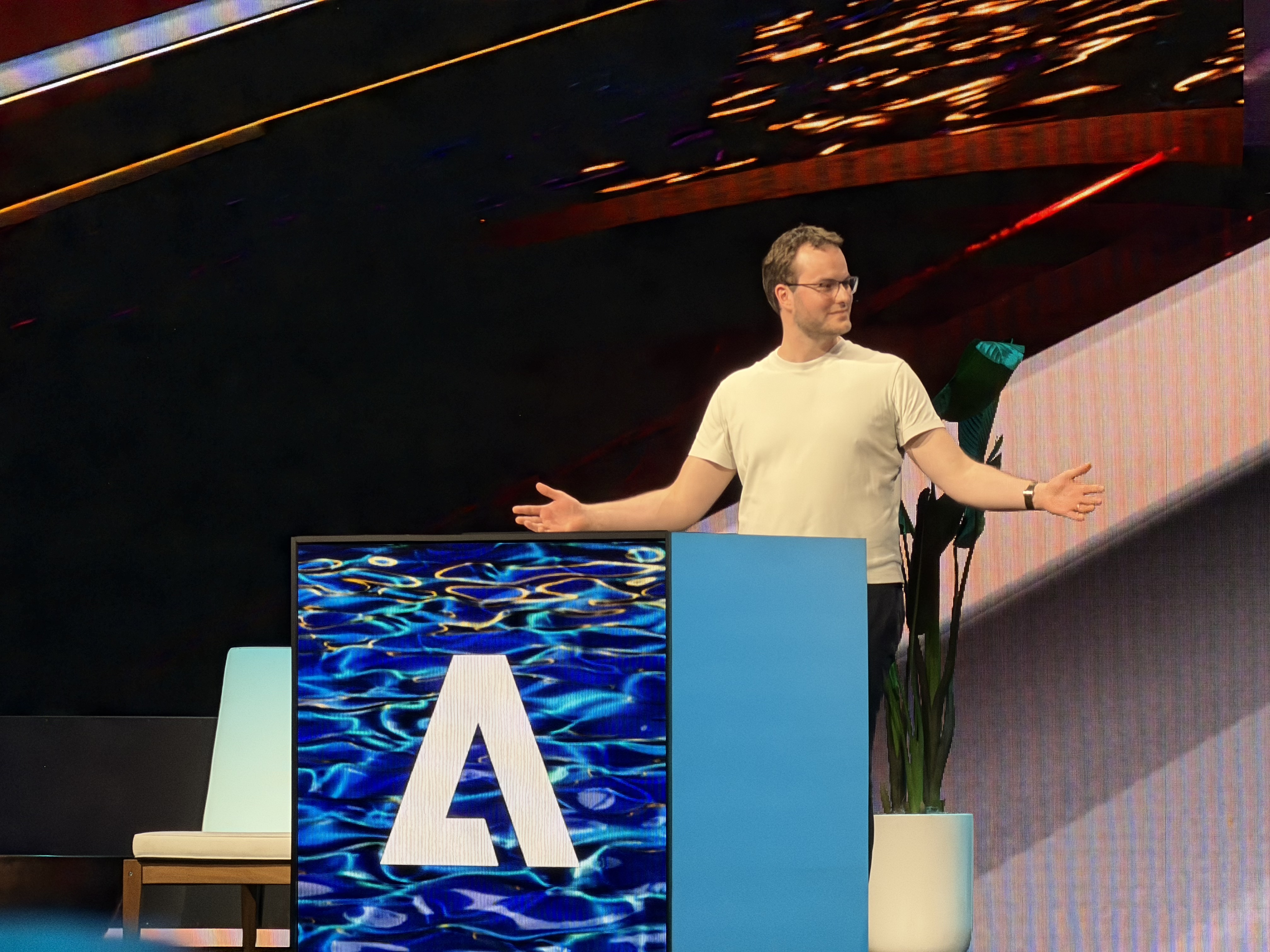
Chang’s response was not a victory lap about replacing labor. He wrote about how much labor creative work hides. Creatives translate vague thoughts into usable concepts. They organize mental chaos, defend theoretical returns, absorb suggestions about making the work better, prettier or cheaper, and remain composed while their brainchild is gently disassembled in a meeting. Then they do it again.
It is a funny list because it is painfully recognizable. It also places the human contribution somewhere a benchmark cannot reach. Generation is one moment in a longer act of judgment. A useful model can remove friction, offer options and give an idea a voice. It cannot decide what the work ought to mean for this audience, in this context, under these constraints. Chang’s phrase for the relationship is symbiosis. The human is not ornamental. The machine is not merely decorative. Each changes what the other can do.
That view matches his go-to-market instincts. The creator and the enterprise customer are different, but both resist being reduced to a use case. They arrive with history, preferences, tools and forms of expertise that are invisible to outsiders. Meeting them where they work is not just good manners. It is product intelligence.
A company learning to hear
ElevenLabs’ scale has changed quickly around Chang. The company says it closed 2025 with more than $330 million in annual recurring revenue. In February 2026 it announced a $500 million Series D at an $11 billion valuation, with plans to invest in ElevenAgents, creative products, foundational research and locally embedded go-to-market teams across several continents. These are company figures, not personal trophies. They explain the weather in which Chang works.
Growth makes translation harder. A small team can carry context in its head. A global one needs processes that preserve context while customers multiply, products widen and the consequences of a mistake become more expensive. The company’s agent tools now emphasize testing, monitoring, integrations and version control. Those may lack the immediate charm of a voice that laughs on cue. They are the features that let a voice enter a serious operation without turning every update into a small act of faith.
Chang’s public persona remains notably human amid that machinery. He is fond of the cheerful aside, the plumber emoji, the wizard metaphor and the mischievous compliment to a team that is, in his estimation, unusually good “for now.” Humor is useful in translation work. It relaxes the border between disciplines. It allows a technical idea to travel without arriving in a crate marked jargon.
There is also a consistent ambition beneath the jokes. Chang’s profile describes a concern with agency and human interaction in AI. The wording is broad, but his examples make it practical. Agency looks like a creator retaining judgment. It looks like an enterprise team understanding what changed in an agent. It looks like a customer able to shape the system rather than quietly submitting to its defaults.
The central irony of conversational AI is that speaking is only its visible half. A convincing voice can still fail to understand. A fast response can still be the wrong response. The more natural the interface feels, the less patience anyone has for a machine that misses the point. That makes listening, in all its technical and human forms, a competitive requirement.
Chang works on that less theatrical half. He helps move between the sentence a customer says, the problem the customer means and the system a technical team can actually build. It is patient work in an impatient industry. It rarely fits in the demo. But if voice is going to become an ordinary way of interacting with technology, the future will depend on people willing to hear the complicated thing behind the simple request.
The machine gets the line. The audience gets the magic. Somewhere in between, Geoff Chang is checking the pipes.