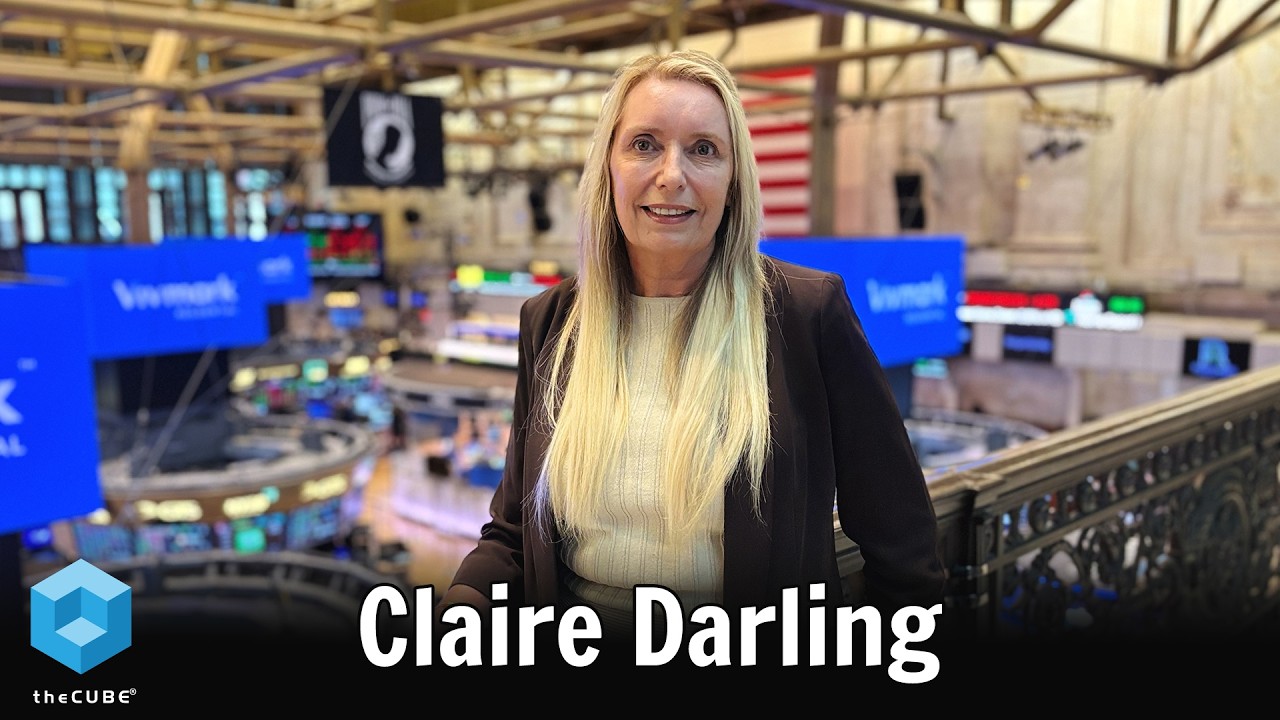
Claire Darling arrived at the New York Stock Exchange with a declaration designed to make a room of marketers sit a little straighter: the customer data platform era was over. The line had the useful impertinence of a good category claim. It also carried the weight of her résumé. Darling has spent more than three decades inside enterprise software, where products are elaborate, buying committees are crowded, and yesterday’s breakthrough has a habit of becoming tomorrow’s checkbox.
Now the chief marketing officer at Uniphore, she was in New York to introduce Marketing AI, a system built to do more than gather customer records. Her argument was that marketers have become excellent collectors and rather less automated interpreters. People still sift the signals, decide what to try, launch the work, inspect the results, and begin again. Darling wants software to shorten that loop: build a predictive model around an individual customer, simulate likely outcomes before money is spent, learn from what happens, and preserve human oversight.
It sounds like a technological proposition. In Darling’s hands, it is an organizational one. Her career has been a long campaign against the notion that marketing is the colorful department waiting at the end of the product line. She has argued instead for marketing as an operating discipline: close to data, accountable to growth, and entangled with product, sales, customer success, and the market’s own vocabulary.
AI isn’t layered onto your existing calendar-driven campaigns, but becomes the operating system itself.Claire Darling, describing the Agentic Marketing OS
A résumé written in software eras
Darling’s first technology-marketing years reach back to Aldus and Adobe, companies that helped put publishing tools on ordinary desks. She later worked at BEA Systems and TIBCO, moved through VMware during the formative years of virtualization, and held a corporate marketing role at CA Technologies. Then came ServiceNow, whose great category trick was to make “workflows” feel less like plumbing and more like the way a modern company ought to run.
The logos trace an accidental history of enterprise computing: creative software, middleware, virtualization, cloud workflows, software for professional firms, cybersecurity, workplace systems, revenue technology, and enterprise AI. The recurring assignment was not simply to make the product attractive. It was to decide what kind of thing the product was, which problem deserved to organize the story, and how marketing would help the company grow around that definition.
The operating brief keeps expanding
At Intapp, Darling gave the philosophy a title. In a conversation about account-based marketing at law firms, she said a modern CMO had to become a “Chief Change Agent.” The provocation was aimed at professional-services firms where marketing could still be treated as support. Her prescription was blunt: show how the function drives growth, use its proximity to data, and earn a place in strategy by carrying a portion of the result.
In 2020, she took that thinking to Skybox Security as CMO, leading marketing across North America, Europe, the Middle East, Africa, and Asia-Pacific. The appointment arrived when companies were improvising digital selling under pandemic restrictions. Darling spoke then about highly targeted, data-driven marketing. The words sound conventional now, which is the fate of ideas that win. At the time, the operational change was immediate: fewer inherited field habits, more measurable digital motion.
The revenue seat comes with a number
Darling joined Clari in June 2024 with a charter that joined category work to go-to-market mechanics. Clari sells a platform for the revenue process, so vague talk about marketing influence would have been especially awkward. The function had to shape reputation and create pipeline while speaking fluently to the chief revenue officer, the revenue operations team, and the chief information officer.
Uniphore’s account of her Clari tenure says she repositioned the company for renewed growth and built a revenue-centric pipeline architecture that produced sustained double-digit annual recurring revenue growth. Her own farewell named the machinery beneath that line: differentiated thought leadership and communications, global demand generation, account-based motions, customer-value programs, and AI teammates used in daily operations.
The farewell was revealing in another way. Darling thanked team leaders one by one. She praised the people who built awareness, the group that changed pipeline creation, and the colleagues who made AI agents useful. She described her partnership with go-to-market leaders through the phrase “no light between us.” Corporate language is often used to conceal seams. This phrase did the opposite. It made the desired condition visible: no gap where responsibility could disappear.
You gave me space to think big and try bold new things.Darling thanking Clari co-founder Andy Byrne
Former colleagues echo the pattern. Recommendations on Darling’s public profile describe simple priorities, protected focus, direct feedback, and questions tied to data. They also describe freedom to experiment. That pairing matters. Permission without direction produces theater; direction without permission produces obedience. Her reported preference is a team that knows the destination well enough to take an intelligent detour.
Her work outside the executive chair reinforces the operator’s angle. Since 2021, Darling has been a limited partner and advisory board member at Stage 2 Capital, a venture firm organized around go-to-market execution. She also lists memberships in Athena Alliance, Chief, and the Empowered CMO Network. These are networks built around executive practice and women’s leadership, less a trophy cabinet than a set of rooms where operating knowledge circulates.
The campaign calendar meets the live loop
Darling calls her emerging model the “Agentic Marketing OS.” The distinction is between attaching AI to the existing list of chores and redesigning the list itself. A campaign calendar starts with dates. A live loop starts with signals. It continuously joins what customers do, what the company knows, what its models predict, what a team decides, and what the market returns.
Darling’s live-loop logic
At Uniphore, the product language is specific. Digital twins model individual customers rather than a segment average. Domain-specific small language models supply context without sending every task to a larger, more expensive model. Simulation lets a marketer test a hypothesis before buying media or launching a program. A self-learning cycle folds the result into the next decision. Sovereignty and control are meant to keep the enterprise in command of its data, models, and intellectual property.
The appealing part is the sequence: predict, simulate, decide, execute, learn. Marketing has long done each verb, but usually across separate systems and meetings, with human beings acting as weary connective tissue. Darling’s wager is that AI can carry more of that connective work while people retain judgment, taste, accountability, and the authority to stop the machine from confidently pursuing a foolish idea.
There is also a self-interested elegance to a CMO selling marketing software to CMOs. Darling is both operator and intended user, which gives the pitch a useful vulnerability. If the system cannot improve her own organization, the audience will notice. Her public commentary therefore stays close to operating questions: where buyers are researching, how brands appear in answer engines, whether compute costs make sense, what teams should hire for, and how to predict outcomes before committing a dollar.
A category is a promise with plumbing
Category creation can be dismissed as an exercise in inventing a grand noun. Darling’s record suggests a less theatrical definition. A category works when the company’s story, product, customer need, and revenue motion agree with one another. The language opens the door, but the operating system must be waiting behind it.
That helps explain why her career can move from virtualization to workflow software, cybersecurity, revenue platforms, and business AI without feeling random. The durable skill is translation under commercial pressure. Enterprise software rarely explains itself. Darling turns technical capability into a claim a buying committee can carry from one meeting into the next, then builds the pipeline process that tests whether the claim survived the trip.
Her latest claim, that customer data alone is no longer an advantage, will meet resistance. It should. Useful category ideas create an argument before they create consensus. The important question is whether the alternative delivers: individual prediction that respects enterprise control, simulation that changes spending decisions, and agents that improve work rather than merely make more of it.
Darling has said she wants to keep building category-defining brands, meaningful revenue impact, and teams capable of unusual work. Uniphore gives her all three problems at once. It also gives her a public test of the thesis she has been refining since the CMO became a change agent: marketing earns a larger mandate by accepting a harder measurement.
The next version of the department may indeed look like a living operating system. It will still need someone to decide which signals deserve attention, which predictions deserve trust, and which story deserves to travel. The machinery is getting faster. Darling’s career is a reminder that clarity remains stubbornly human.