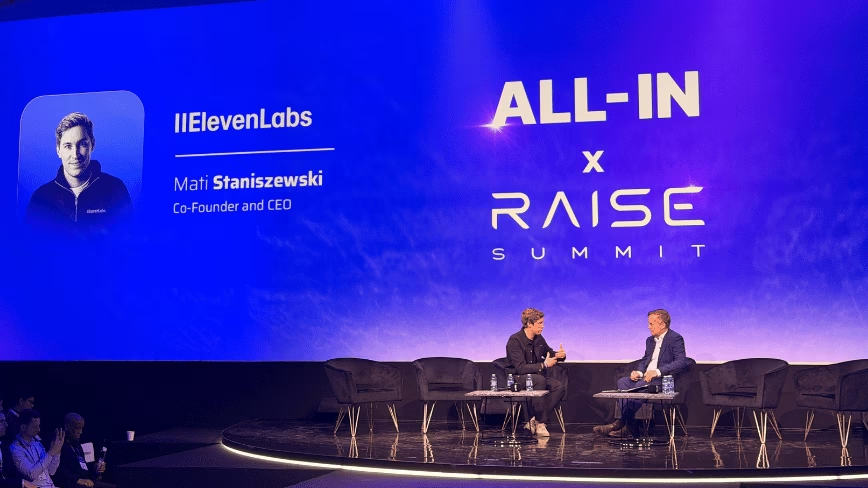
You're on a bit of a heater, huh? That was how Jason Calacanis opened, and the founder across from him didn't flinch. "It's the best time to be building," came the reply. Inside the RAISE Summit at the Louvre — a room more accustomed to Rembrandts than revenue ramps — the All-In Podcast staged two consecutive interrogations of the AI-native age. First up: Mati Staniszewski, co-founder and CEO of ElevenLabs, the voice company that went from a research curiosity to roughly $600 million in annual revenue in less time than it takes most startups to find product-market fit. Then: Max Junestrand, the young founder of Legora, who is quietly detonating the trillion-dollar legal-services market. Both men had the same message, delivered in different accents: the old rails are cracking, and the people building on new ones are moving faster than anyone expected.
The framing was aggressive from the first minute, and deliberately so. Calacanis wanted the competition question up front. If you were designing a global system from first principles today, the ad copy that opened the segment insisted, you wouldn't bolt intelligence onto fifty-year-old infrastructure — you'd build for the intelligent era from day one. It was a pitch for a payments platform, but it doubled as the thesis for the entire hour. Everyone on that stage had built for the intelligent era from day one. The question was whether they could stay there.
The Fastest Curve in Software
Staniszewski laid out the numbers without drama, which somehow made them louder. ElevenLabs started in 2022. The first year was pure research and product — building, in his words, "the first text-to-speech model that finally could sound human," released at the beginning of 2023. Then the curve bent in a way that defies the usual SaaS gravity.
Six hundred million dollars in revenue. Calacanis called it "just extraordinary," and then pivoted immediately to the hard part: with valuations soaring and investors "showing up at your doorstep, quite literally," how do you actually run the company? How do you keep a culture intact when money is being thrown at you and every rival wants your talent? Staniszewski's answer was structural. The company, now around 600 people, combines research and product under one roof — building, as he described it, "a communication platform for AI" that spans generating speech, transcribing speech, and orchestrating speech for interactions. That breadth, he argued, is why the revenue grew: each new function unlocked a new slice of the customer journey, from marketing and localization through voice-agent customer support to proactive sales and training.
The most striking retention stat wasn't financial. "From the first 10 people we had zero attrition," he said. "Everybody is still at the company." In an industry defined by poaching wars and nine-figure signing packages, keeping your founding research and engineering core fully intact is a flex more meaningful than any valuation headline. He credited his co-founder — "an incredible researcher himself" — with helping assemble a team "truly excited about solving audio, solving interaction."
The Company With No Product Managers
Then came the moment that made the room lean in. Calacanis, walking through how AI has changed management, floated the punchline himself: "You fired them all, right?" The PMs. Staniszewski's reply was flat and total. "We don't have any PMs." He never did. Not once.
The logic is a window into how AI-native companies are structured. The ideal product manager, Staniszewski argued, "can code, can understand the customer, can understand design" — a person expert in all three at once, which barely exists. So ElevenLabs optimized instead for people who are expert in at least one of those fields and strong in another, and then let AI collapse the gap. The company runs on small five-to-ten-person teams organized around industries — telco, financial services, healthcare — and, in a twist, embeds engineers everywhere, even where you'd never expect them.
These embedded engineers have two jobs. The first is obvious: build automations and bring software into the team. The second is quieter but arguably more important — governance. They make sure people are actually adopting AI, and they provide a security check on everything deployed. Staniszewski framed it as a Goldilocks problem. "If you're not using a lot of the co-working software, then you're probably in the wrong spot. If you're using too much of it, that is also a flag." The danger, he noted, is that people who were never technical can now create software but can't necessarily review whether it's doing the secure thing behind the scenes. Calacanis put the risk more bluntly: "It's fantastic that everyone can build software until you put it into production and you have a leak" — or the person who built it leaves, and a forgotten script quietly rots in production.
When Talking to a Machine Stopped Feeling Insane
The conversation turned to a cultural inversion neither man could have predicted five years ago. Calacanis described the old horror of phone trees — the arduous, painful voice jail that made you mash the zero button and scream "operator." Now, he confessed, the polarity has flipped so hard he feels guilty talking to a human. "I am so sorry I'm wasting your time with this," he said of human agents, while praising AI's precision and fidelity — and, crucially, the ability to interrupt it without apology. No small talk. No guilt. Just speed.
Staniszewski agreed a step change had arrived, "especially in the last six months," driven by enterprise sales teams and a product that finally combined reliability, model orchestration, and the integrations to deliver the right experience. His prediction: a "golden era for consumers" where you open a website, call an agent, and it already knows your history. The interface itself, he said, will "shift from reactive to proactive" — help arriving before you even ask.
There was a delightful detour into hardware. Calacanis evangelized foot pedals paired with the dictation app Whisper Flow (which, Staniszewski confirmed, runs partly on ElevenLabs on the back end). Press the pedal, unleash a one-to-two-minute stream of consciousness, release, and let the LLM sort it out. "It has changed everything. Everything," Calacanis insisted, having identified "three and a half dorks" in the audience already using pedals. Staniszewski's own obsession was the Plaud wearable recorder, and the tantalizing idea of capturing the signal from conversations that "otherwise disappear."
One of the most human observations came out of financial-services deployments. Working with companies like Revolut and Klarna on payment reminders and debt collection, ElevenLabs found something unexpected: people are more honest with a machine. "People would naturally feel ashamed of telling the real situation," Staniszewski said, but with AI "people are much more open to share what actually happened." The emotional block of confessing to another human simply dissolves. People are also snappier — quick, blunt, cutting to the point — which forced the company to reshape its interaction model around a bot you're allowed to interrupt.
Voice Is Identity — and a Battleground
The segment's most charged material was about impersonation. Calacanis revealed that someone had cloned his voice using the This Week in Startups archive and ElevenLabs to build a whole channel of bulldogs telling jokes. Flattering, he admitted — but also a legal minefield. The exchange spiraled into a running comic bit about Calacanis threatening to take "5% of 11 Labs stock" in exchange for Trump impersonations and White House visits, and a mock-argument with an imaginary "angry French developer" who "cannot smoke in the Louvre." Beneath the comedy was a serious point: your voice is IP, and cloning it for commerce is a genuine problem.
Staniszewski laid out ElevenLabs' three-part safeguard doctrine. One: trace everything generated, so the company can act when needed. Two: moderate at both the voice and text level, flagging and blocking anything commercial or scam-like. Three — and this is the generous move — offer a free detection tool so anyone can upload a sample and learn whether audio is AI-generated, not just for ElevenLabs but for open-source models too. When Calacanis's own team tried to clone his voice to fix a botched ad read, the system stopped them cold: you cannot clone Jason's voice. The protections work on the boss too.
The flip side is opportunity, and it's lucrative. ElevenLabs built a marketplace where voice actors authenticate their voice, license it, and earn money — "over $22 million back to the community of talent," Staniszewski said. Hourly voiceover workers can now record for an hour, create a voice, and license it across languages and dynamic contexts. And the marquee partnerships are dazzling: a collaboration with Matthew McConaughey to carry his voice across Spanish, Italian, and Portuguese with the emotion intact; Gordon Ramsay screaming at you interactively in a MasterClass kitchen ("raw scallops, raw!"); and, in gaming, an interactive Darth Vader that Fortnite players could talk to live — built with the James Earl Jones estate and Disney after the late actor licensed the voice for all time.
But the work Staniszewski called "probably our most important" had nothing to do with celebrities. It was restoring voices for people who lost them to ALS and throat cancer. He cited U.S. Congresswoman Jennifer Wexton, who lost her voice and used a recreated one to deliver a speech. And then the story that visibly moved the room: a woman who lost her voice before she could get married, whose family redid the wedding and the vows so they could hear her say them — for the first time. "You could feel the emotions," he said, "because the voice is such a connecting thing."
Partnering With the Companies That Want to Kill You
Calacanis didn't soften the endgame. Anthropic's Dario Amodei, OpenAI's Sam Altman — "they want your business. They've been pretty clear about it." And ElevenLabs uses their frontier models inside its product. Is Staniszewski enabling his own demise? His answer rested on two pillars. First, being a platform means being model-agnostic: customers pick Anthropic, OpenAI, Google, or open-source, and build their agent orchestration on top without locking to any single vendor. That's a feature, not a bug.
Second, the research moat. ElevenLabs keeps out-competing the giants on voice — text-to-speech, speech-to-text, turn-taking, music — and Staniszewski explained why in a line that cut against the prevailing "just add GPUs" narrative.
Beyond architecture, he pointed to data — specifically the unglamorous work of labeling it. ElevenLabs built an internal team of over a thousand contractors to label audio assets, turning a sea of unlabeled sound into training gold. Add a fully verticalized product understanding of each industry's workflow, plus an ecosystem of integrations and templates, and you get a defense the frontier labs can't easily replicate. He acknowledged that some companies are "continuously trying to figure out how to distill and use the data," and that ElevenLabs has mechanisms to slow — if not fully stop — it. On building its own models, he was measured: the company won't chase knowledge work or coding, but "any interaction" is territory it wants to own. And, competitive to the core, he added it's "just great to be in the arena and compete with those guys, and every so often show that we can do it and do it better."
The Second Act: Legora and the End of the Billable Hour
If ElevenLabs is remaking how machines speak, Legora is remaking how lawyers work — and Max Junestrand arrived with numbers just as steep. "Sustained 50% quarter over quarter for the last seven quarters," he said, claiming Legora had just become one of the fastest enterprise companies with a direct sales motion to go from one to $100 million–plus, "beating Sierra with one quarter." The market he's attacking is almost comically lopsided. Legal services run about a trillion dollars a year, hugely fragmented. Yet software into legal tech is only around $40 billion.
Junestrand's thesis is that software will grow into the service revenue, especially because legal is supply-constrained: demand for legal help vastly exceeds the available lawyers. Calacanis brought the vivid anecdotes. A startup that hit a million in revenue, closed multiple funding rounds, and employed a couple dozen people — with no corporate lawyer. How did they review contracts? "ChatGPT, bro." The cap table? "ChatGPT, bro." HR? "Same thing, bro." Even IP assignments, done because first-time founders "asked ChatGPT." Calacanis mock-lamented turning into an out-of-touch uncle. "It's going to be a fun diligence target one day," he warned.
The economic critique of law firms was sharp. The billable-hour model, Junestrand explained, works by overcharging for associates and effectively undercharging for partners — because the only way firms know how to price a partner's genuinely valuable half-hour ("bet-the-company litigation," avoiding a pitfall worth tens of millions) is to inflate associate rates. Calacanis noted a recent bill at $1,800 an hour; at Kirkland & Ellis, partner time "can go up to $4,000 an hour." And Kirkland, Junestrand pointed out, turns around $10 billion a year with four or five thousand lawyers — partners netting between $5 and $10 million each annually. Into that fortress walks AI, carrying "existential threats and existential opportunity."
Forward-Deployed Lawyers and the Incentive to Close Fast
Legora's counter to incumbent anxiety is a role borrowed straight from Palantir's playbook. "In the same way that Palantir has forward deployed engineers, we have forward deployed lawyers," Junestrand said — legal engineers who sit beside Kirkland partners and help them transform "from a pre-AI to a post-AI world." He argued the shift dwarfs the document-management revolution of the PC era; those were "mild productivity gains," while this "can do a lot of the work," reshaping even what it means to be a junior lawyer.
The incentive misalignment at the heart of legal work got a memorable airing. Legora has acquired four businesses this year, running diligence in-house with its own tool; the fastest deal closed in 12 days from LOI to close. Why so fast? Because, as Calacanis framed it, the founder's motivation is to close, while the lawyer's motivation is to avoid getting sued and to bill as much as possible — which means, explicitly or not, dragging it out. AI hands leverage to the impatient.
Then there's the global dimension. Attorneys are famously localized — U.S. certification is state-by-state, and a non-compete that's unenforceable in California is very much enforceable in Boston. Legora's data sits on two layers: a firm's own precedent and organizational data, and the brutal, painstaking work of gathering every case, statute, and regulatory update across jurisdictions worldwide. Junestrand described a general counsel in California landing a first customer in South Africa and getting an "80% accurate response immediately" instead of playing telephone through a chain of foreign lawyers. That data, he argued, "has really never been structured before" — an enormous inefficiency in society, waiting to be captured.
The Tyrannosaurus in the Rearview Mirror
Calacanis invoked LexisNexis and Westlaw — the legacy juggernauts sitting on decades of scanned case law — as the "Tyrannosaurus Rex in Jurassic Park" glancing nervously at their pursuers. Junestrand's read is that incumbents struggle to pivot: they can't get the talent, don't work the hours, and are "so political in their organizations that it's just hard to move." The early bet that whoever owned the data would win, he said, is proving wrong. Legora is instead partnering with content providers in smaller jurisdictions like Germany, France, and Spain, while the U.S. remains a peculiar duopoly — Westlaw even holds a kind of monopoly arrangement with the American government to report cases. "You guys are very good at capitalism," Junestrand teased. "Sometimes too good."
Crucially, legal AI is the opposite of a power law. You can't ship the top 80% of case law; a litigator at an elite firm going after a billion-dollar case needs every case, which still means physically shipping books to India, scanning them, and capturing page citations. But the payoff, Junestrand argued, is that agents — especially "following the release of Opus 4.5 and 4.6" — can now do "really intelligent case strategy," combining witness statements and cases into genuine end-to-end work. AI moves from augmenting to doing, and the lawyer's job becomes orchestrating agents, much as coders now do.
On models, Junestrand was emphatic and contrarian: he doesn't believe in fine-tuning or building general legal-intelligence models — "total waste of time and money." He believes in narrow models for narrow use cases, like the "tabular review" feature where 100 documents times 100 prompts equals 10,000 API calls, and a fine-tuned extractor slashes cost and latency. As for the frontier labs bundling legal offerings, he was unbothered: a rival's markdown-skills legal product mostly "drives a lot of initial usage," users hit its ceiling, "and then you call us." Free pipeline. And on the stakes of getting it wrong — data leakage in litigation for national-secrets weapons manufacturers and governments hosting contracts on the platform — his summary was four words that could serve as the motto for this entire era of enterprise AI.
By the end, the through-line was unmistakable. Whether the product is the sound of a human voice or the substance of legal judgment, the winners are the ones building for the intelligent era from the first line of code — moving at a tempo the incumbents structurally cannot match, treating trust and safeguards not as friction but as the moat, and betting that the interface of everything is about to change. Two founders, one Louvre stage, and a shared conviction: the legacy tax is optional now, and the future belongs to whoever refuses to pay it.
Reported by YesPress Newsroom from the All-In Podcast conversation recorded live at the RAISE Summit, the Louvre. All quotes and facts are drawn from the published transcript. Watch the full episode on YouTube →