The awkward thing about a software idea is that the person who has it often cannot build it. A marketer knows where the campaign process jams. A nurse knows which screen wastes time. A founder knows what customers keep requesting. Then comes the queue: explain it, budget it, find someone to make it. Lovable, the Stockholm company founded by Anton Osika and Fabian Hedin, has made a business out of shortening that queue.
- Describe a website or web app; Lovable generates a working starting point.
- Its early launches struggled until the promise became more useful and the branding clearer.
- Founders and business teams use it for prototypes, internal tools and customer-facing products.
- The useful habit: build a small piece, test it, then ask for the next one.
The terminal had the wrong guest list
In 2023, Osika created gpt-engineer, an open-source experiment in generating software with AI. It attracted tens of thousands of GitHub stars. For a developer, that is an appealing invitation: here is a tool, go explore. For someone who has never used a terminal, it is rather like being invited to dinner and handed the keys to the restaurant kitchen.
The commercial web version, GPT Engineer App, tried to close that gap. Attention did not automatically become adoption. Lovable’s own account describes two failed launches: too many assumptions about what users wanted, a name that communicated poorly, and a product people treated as a “fun tool.” The team adjusted the product, listened to feedback and prepared a more deliberate launch.
In November 2024, the platform arrived as Lovable. The change involved more than a friendlier name. People wanted to make complete products. Backend integration with Supabase supplied capabilities such as authentication. Product Hunt materials, outreach on X and partner marketing made the revised promise easier to see. A demo could now lead somewhere.

A pretty screen cannot remember a customer
Open Lovable and the starting gesture is conversation. Describe what you want, inspect what appears, and ask for changes. You can make a landing page, an inventory dashboard or a booking application. Visual editing helps with the small decisions that are tiresome to describe in prose. GitHub synchronization gives the generated code a path into an engineering workflow.
The distinction between a screen and an application matters. A screen can look convincing while forgetting everything after a refresh. Lovable Cloud, introduced in September 2025, brought databases, authentication and storage into the product. Lovable AI arrived alongside it to put AI features inside the apps themselves. The company sells the machinery around the generated interface, too.
Its expertise lies partly in coordinating that machinery. Lovable says it evaluates models on complete builds and routes different work to different models. A model good at debugging may behave differently from one good at design. The builder wants the application to work; choosing a winner from a model leaderboard is another chore.
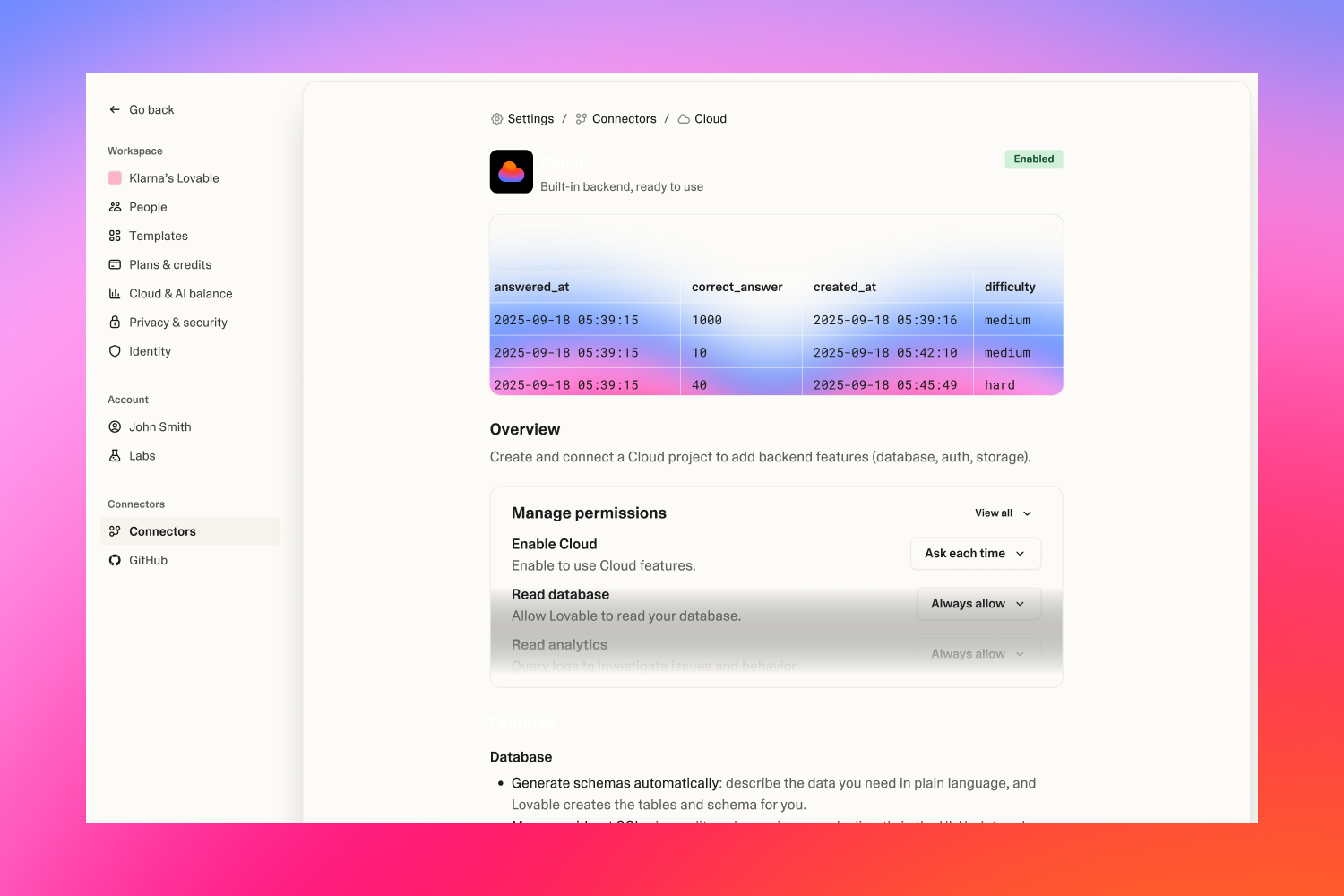
This puts Lovable in the same shopping conversation as Bolt, Replit Agent and Vercel’s v0, which also offer conversational routes to applications. Its appeal is the combined journey from an instruction to an editable, hosted product. That is a proposition, not proof that it fits every project. The right choice still depends on the stack, the people maintaining it and the controls they need.
The weekend that changed the meeting
Consider Nursa, the healthcare staffing company. In Lovable’s customer account, product leader Nenad Ivanovic tried the same prompt across more than ten platforms. One weekend produced an MVP for nursing schools: scheduling, student and administrator portals, and credential tracking. CEO Curtis Anderson saw it, thought about the implications during a family trip, then encouraged adoption across the company.
“If one person could build that in a weekend, what was the rest of the company capable of?”
Curtis Anderson, CEO of Nursa
The next detail deserves equal billing: Ivanovic spent another two weeks preparing Nursa Study for enterprise use. Later, engineers asked for working prototypes they could inspect in code. The lesson is practical. A prototype can shorten the argument about what to build. It does not automatically finish the work of making a product dependable.
The meter keeps running
Entry is free. As of October 2026, advertised monthly subscriptions start at $25 for Pro and $50 for Business, each with 100 monthly credits. Workspaces support unlimited members. The meter follows consumption, with credits covering building, Cloud and app AI beyond included grants. A subscription price is a starting budget; a busy application may need more.
Lovable’s pricing examples make the abstraction tangible: a button-color change costs 0.50 credits; a landing page with generated images costs 1.70. Those are examples, not fixed quotations for your project. Complexity affects the bill. Repeatedly asking for a broad redesign can spend capacity without clarifying what users need.
There is a useful cost lesson from the company itself. In February 2025, Lovable publicly said it had reached $17 million ARR with $2 million spent. That historical claim describes its own spending, not a promise about anyone else’s economics. Small beginnings can be cheap; maintaining a growing service is a different calculation.
A bigger company, a more ordinary test
The financing curve tells you how investors read the opportunity. A $200 million Series A in July 2025 was followed by $330 million in December and $400 million in August 2026. Valuations rose from $1.8 billion to $6.6 billion to $13.3 billion. These are financing snapshots, not customer outcomes.
Valuation at each round. Bar lengths share the same scale.
The product is moving deeper into business infrastructure. September 2026 brought integration for running apps inside a company’s Microsoft tenant. October added European routing for supported Enterprise AI requests. That setting has exclusions and is separate from storage residency. Procurement questions are becoming part of the product.
For a reader, the experiment is smaller. Choose one repetitive task, use sample data, and build a flow someone can click through. Lovable’s own guide recommends incremental changes and testing that one user cannot access another user’s private information. Specialist architecture or sensitive workflows require corresponding expertise. The prompt gets you started. The evidence comes when another person uses what you made.
Keep building. Keep asking.
Explore the product, the people and the longer conversations.