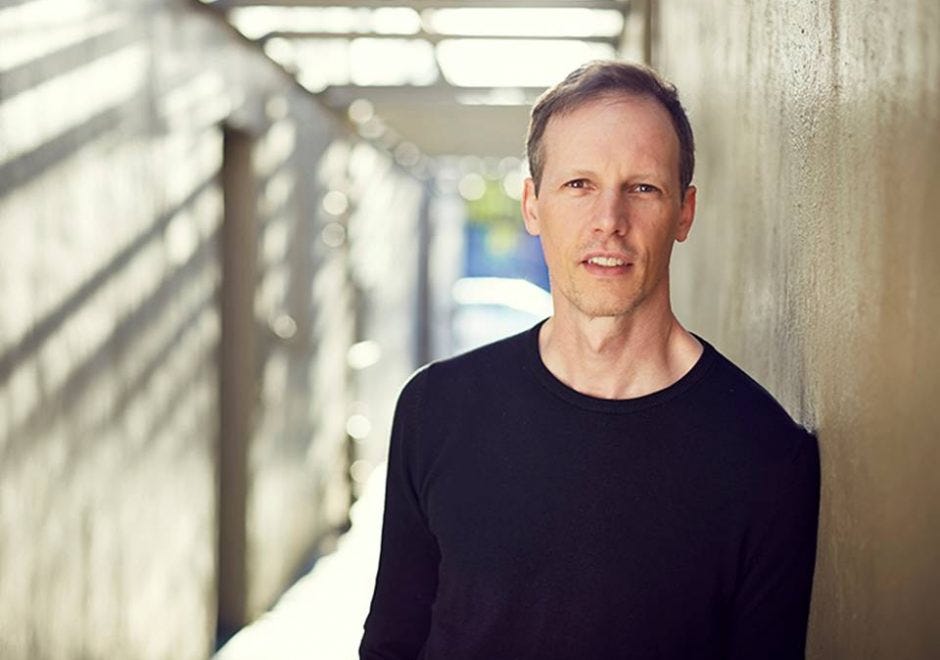
Glassblower. Billionaire. Federal Reserve Chair. Pick all three.
Jim McKelvey walks into rooms where people know his name from very different things. In payments, he's the co-founder of Square - the company that handed credit card acceptance to everyone who'd ever been shut out of it. In St. Louis art circles, he's the master glassblower whose studio became one of the premier glass arts centers in America. At the Federal Reserve Bank of St. Louis, he chaired the board. At Redbud VC, he mentors founders who build from the Midwest out. At Washington University, his name is on the engineering school.
None of this started with a plan. It started with a $2,000 faucet he couldn't sell.
In 2009, a customer came into McKelvey's glass studio wanting to buy an American Express. McKelvey couldn't accept it. The sale vanished. The frustration didn't. He called Jack Dorsey - a man he'd known since Dorsey was 15, whom colleagues had nicknamed "Jack the Genius" - and described a problem that had no good solution. By the end of the year, they'd built Square: a small card reader that plugged into a phone's headphone jack and made it possible for anyone, anywhere, to accept a credit card.
By definition, the first person to do it is always unqualified.
- Jim McKelveyWhat followed was 18 months of what McKelvey would later call "intermittent failure." Not failure. Intermittent failure. The engineering mindset: it doesn't work yet. Square took a year and a half to actually work. Then, once it did, Amazon arrived with its own card reader, slashed prices below what could ever be profitable, and prepared to eat Square alive. McKelvey's response? Ignore them entirely. Don't match their pricing, don't respond in kind, don't change anything. Just keep building for customers.
On Halloween 2015, Amazon killed its competing product. It turned out their discount math was always unsustainable. McKelvey later described what he'd discovered as an "Innovation Stack" - a theory about how genuinely new companies survive precisely because copycats can't replicate the full set of innovations that made the original work.
The Innovation Stack - Explained
The glassblowing was never a hobby McKelvey picked up to seem interesting. He was a glassblowing instructor before he was famous for anything. He co-founded Third Degree Glass Factory in St. Louis in 2002 - one of the country's main centers for the craft. His industrial glass designs are in the permanent collection of the Museum of Modern Art in New York and the Smithsonian in Washington. He wrote "The Art of Fire: Beginning Glassblowing," which became the most widely read glassblowing textbook in the world. His Twitter handle, @2000F, is the temperature of molten glass in Fahrenheit. He didn't choose this detail ironically.
The same quality runs through everything McKelvey touches: he doesn't separate the things he cares about. Engineering, art, finance, community - they're all the same problem to him, approached with the same tools. The undergraduate glassblowing elective he took at Washington University changed how he thought. He's been recommending students step outside their major ever since.
In 2016, McKelvey donated $15 million to Washington University's engineering school. In 2019, the university renamed the entire school after his father: the McKelvey School of Engineering.
LaunchCode began in 2013 with a straightforward premise that sounds radical: if you can pass the test, you get a tech job. Guaranteed. No degree required. No traditional credentials. McKelvey co-founded it after watching people around him - unemployed friends, people coming out of difficult circumstances - get shut out of an industry that needed their talent. LaunchCode partners with companies to place graduates in paid apprenticeships. The guarantee has held for years.
In 2016, McKelvey started Invisibly - an attempt to rewire the economics of online content, giving users a way to pay for what they read without surrendering their data to advertisers. It's the kind of project where the answer doesn't exist yet, which is, by his own description, exactly the kind he seeks out.
He was named an Independent Director of the Federal Reserve Bank of St. Louis in 2017 and became its Chair in 2022. He doesn't fit the usual profile for that role either. He's been public about drawing inspiration not from tech industry peers, but from unemployed friends, homeless individuals, people returning from incarceration - anyone navigating a system that wasn't built for them.
Now, as an Operator Advisor at Redbud VC - the Columbia, Missouri-based early-stage fund that closed a $25M Fund II in 2026 - McKelvey does what he's always done. He finds people building something no one has built, somewhere no one is looking, and he bets on them.
Words Worth Remembering
"If I could choose between $4 billion or getting entrepreneurship into consciousness, I'd do the latter."
"Ignoring your enemy is a really good strategy if you're an innovative company."
"Solving one problem usually creates a new problem that requires a new solution."
"Doing something that has never been done before is terrifying."
"Do something that has never been done."
"Engineers don't work on stuff that's successful; they work on stuff that is not successful yet."
From UCSD Pascal to the Federal Reserve
- 1965Born October 19 in St. Louis, Missouri
- 1986Published handbook on UCSD Pascal and Apple Pascal - one of three textbooks he'd write
- 1989Co-founded Mira with WashU engineers; a 15-year-old Jack Dorsey interned that summer
- 1990sIBM contractor; glassblowing instructor; founded Disconcepts (CD-cabinet manufacturer)
- 2002Co-founded Third Degree Glass Factory in St. Louis
- 2006Published "The Art of Fire: Beginning Glassblowing" - the world's most widely read glassblowing text
- 2009Lost a $2,000 glass sale because he couldn't accept Amex. Co-founded Square with Jack Dorsey.
- 2011Square card reader inducted into MoMA's permanent collection. Also in the Smithsonian.
- 2013Co-founded LaunchCode - nonprofit guaranteeing tech jobs to graduates
- 2015Amazon killed its Square-competitor on Halloween after failing to out-price them
- 2016Founded Invisibly; donated $15M to Washington University engineering school
- 2017Appointed Independent Director of the Federal Reserve Bank of St. Louis
- 2019Washington University renames its engineering school: the McKelvey School of Engineering
- 2020"The Innovation Stack" published - WSJ bestseller
- 2022Named Chair of the Federal Reserve Bank of St. Louis
- 2024+Operator Advisor at Redbud VC, Columbia MO - betting on Midwest founders
Three Anecdotes That Explain Jim McKelvey
The Bike in San Francisco
McKelvey was nearly killed in a bicycle accident in San Francisco when a driver's quick braking stopped his bike just in time. He credits this near-miss as one of the defining moments in how he thinks about luck - and argues that much of his success traces back to accumulated good fortune, not genius. For someone who has built seven companies and run the Federal Reserve, the humility is real.
The Genius Intern
McKelvey has known Jack Dorsey since Dorsey was 15 years old. Colleagues called teenage Dorsey "Jack the Genius." When Dorsey came to McKelvey and said "let's start a company," McKelvey said yes. Their first company together, Mira, built document imaging software. Their second company together changed how the world pays for things.
The Glass Elective That Changed Everything
McKelvey was a computer science and economics student at Washington University when he took a glassblowing elective on a whim. It transformed how he thought about problem-solving, creativity, and constraint. Decades later, his glass art sits in MoMA and the Smithsonian. He tells every student he meets: take the class that makes no sense for your career. That's the one that matters.