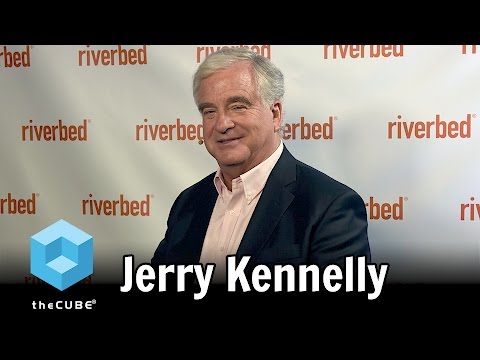
A reporter once asked Jerry Kennelly why he wouldn't sell Riverbed to Cisco. His answer - "If you invented fire, why would you sell it? Fire changed the world, and that's something you couldn't put a price on" - became, by one journalist's account, "perhaps my favorite CEO quote of all time." It also told you everything you needed to know about how Kennelly ran a company for sixteen years.
He co-founded Riverbed Technology in May 2002 with Steve McCanne, a Berkeley computer science researcher who became the company's engineer and CTO. They started with a shared frustration: corporate networks were slow, and nobody was fixing the right problem. While competitors were selling expensive new hardware to throw at congestion, Kennelly and McCanne decided to optimize what was already there.
The company was originally called NBT - Next Big Thing. Only in Silicon Valley is "next big thing" considered an understated name. It became Riverbed in 2003, and the product line got its names from McCanne's passion for fly fishing: the flagship WAN optimizer became SteelHead, named after the steelhead trout. Products named after fish, built to move data at the speed of light. Kennelly, the finance executive, became the front man for a company run on an engineer's metaphors.
"WWW used to stand for world wide wait. When Riverbed exploded onto the scene in 2002, we had a technology that cut time and bandwidth. We could make the packet travel seem instantaneous."- Jerry Kennelly
The first SteelHead shipped in April 2004, to Environment Canada. Revenue that year was $2 million. By 2006, it was $90 million. By the time Riverbed's NASDAQ IPO opened trading on September 21, 2006, analysts were running out of superlatives. The offering was, as more than one reporter noted, "nothing short of a smashing success."
Revenue projections for 2007 sat at $225 million. The market cap would eventually touch nearly $6 billion in 2011. Cisco, Juniper, and Citrix all rushed competing products to market by late 2005 - which, in Silicon Valley, is the clearest possible signal that you've built the right thing. Kennelly's team had over 40% market share and showed no interest in sharing.

