A scholarship usually rewards the student who has already learned how to win. Jeff Green helped finance one that looked harder at the students who might disappear. At California State University Channel Islands, the question was practical: could money, renewed over several years and paired with advice, help a first-generation student reach graduation? For an advertising executive whose working life revolves around deciding where a dollar goes, this was familiar territory with a different destination.
In 2023, the university described a finding that complicated the usual scholarship ceremony. Students with grade-point averages below 3.0 who received scholarships had outperformed students with higher GPAs who received none. The program Green supported that year targeted incoming students with GPAs between 2.50 and 3.25. The polished trophy cabinet could wait. Someone needed to pay next semester’s bill.
That choice offers a useful way into Green’s story. He is the co-founder, chairman and chief executive of The Trade Desk, a business built around helping advertisers buy digital media. He has spent years arguing that the rules of a marketplace matter as much as the enthusiasm of its participants. His philanthropy brings that argument to a campus. His company’s recent difficulties bring it back to his own desk.
The English major enters the auction
Green was born in Salt Lake City and grew up moving between states as his father bought and sold businesses. He taught himself to code and build computers. At Brigham Young University, however, he studied English literature, graduating in 2001. The combination is more revealing than the familiar idea of a technology founder who simply loved machines. He was interested in what people did with them, and how a business might persuade people to try something unfamiliar.
One early job put him on the buying side of digital advertising during the dot-com bust. There was room to make a creative guess, run a campaign, and discover whether the guess survived contact with the numbers. He also obtained a securities broker license in his twenties and briefly worked on the investment side of an insurance company. The stock market supplied another example of people assigning prices to uncertain futures.
In 2004, he founded AdECN, an online advertising exchange. Microsoft acquired it in 2007. Green stayed with the business inside Microsoft before leaving in 2009. Buying and selling advertising through an exchange had given him experience with the machinery. His next company would concentrate on the people bringing money to that machinery: the buyers.
With Dave Pickles, Green co-founded The Trade Desk in 2009. The pair had worked at Microsoft. Their new company made software for agencies and advertisers to plan and purchase digital campaigns across publishers and devices. In September 2016, it went public on Nasdaq. Green had gone from building an exchange to running a listed company whose fortunes depended on how well buyers could use the wider advertising market.
A buyer needs somewhere to stand
The phrase “demand-side platform” does little to improve a dinner party. Its purpose is easier to understand. An advertiser has a budget and a particular audience in mind. Publishers and streaming services have advertising space. Software helps evaluate the available opportunities and decide which ones merit a bid. The Trade Desk supplies that software to the buyer.
The distinction matters to Green because some of the companies selling advertising also control the tools used to purchase it. He has made independence a central part of his pitch. Buyers, in his account, need an adviser whose priorities are aligned with theirs. The argument is both a commercial proposition and a criticism of competitors. An audience can find it persuasive while remembering who benefits if it wins.
He has been quite willing to name those competitors. In January 2025, he argued that Google should leave the open internet advertising business and concentrate on YouTube. It was a pointed position from an executive whose company competes with Google’s advertising tools. Green’s view of a fairer market also happens to describe a market with more room for The Trade Desk.
Budget + audience
Evaluate + bid + measure
Advertising opportunities
Illustrative flow. Buying paths and partners vary by campaign.
He took the same reasoning into television. In November 2024, he disclosed plans for a connected-TV operating system called Ventura, named for the California city where the company is headquartered. He objected to the conflicts that arise when operating-system providers also own content. Extending the company’s work into an operating system made his ambitions unusually tangible: the argument about an open market could eventually reach the television screen itself.
Teaching software to spend carefully
Green’s interest in artificial intelligence predates the recent rush to put a chatbot in every office. The Trade Desk introduced Koa in 2018, using machine learning to help advertisers make decisions and improve campaign performance. The appeal was rooted in a problem he had encountered much earlier: digital advertising generates more possible purchases than a person can sensibly inspect.
In June 2023, the company introduced Kokai. Its announced capabilities included estimating auction clearing prices, assessing the relevance of an impression, forecasting performance and allocating budgets. These are consequential little judgments. Overbidding repeatedly can turn a promising campaign into an expensive habit. Paying for the wrong audience with great efficiency is still paying for the wrong audience.
The launch described access to more than 13 million advertising impressions a second. That figure conveyed the scale of the decision problem, rather than a promise that every opportunity deserved a purchase. Green’s business depends on selectivity. A buyer’s tool earns its keep partly by declining invitations, a useful skill at auctions and, occasionally, at dinner parties.
For Green, the technological argument keeps returning to judgment: what information is available, whose incentives shape a recommendation, and whether the result can be measured. Those questions help explain why education became a focus of his giving. A university has its own difficult allocation decisions, with consequences that last considerably longer than an advertising campaign.
The scholarship with a second act
At Channel Islands, the relationship extended beyond writing a check. The Trade Desk recruited graduates, and employees took part in developing and teaching digital-advertising courses. By the university’s 2022 account, the company had hired 27 alumni. Green had encountered the students as potential colleagues before they became an abstraction in a philanthropic proposal.
His foundation supported peer mentoring and scholarships. A 2020 gift helped fund 15 new peer mentors, alongside support for the program’s staffing. The idea recognized a fairly ordinary obstacle: entering a university does not automatically mean knowing how to navigate one. Another student who knows the place can make advice easier to find and less intimidating to request.
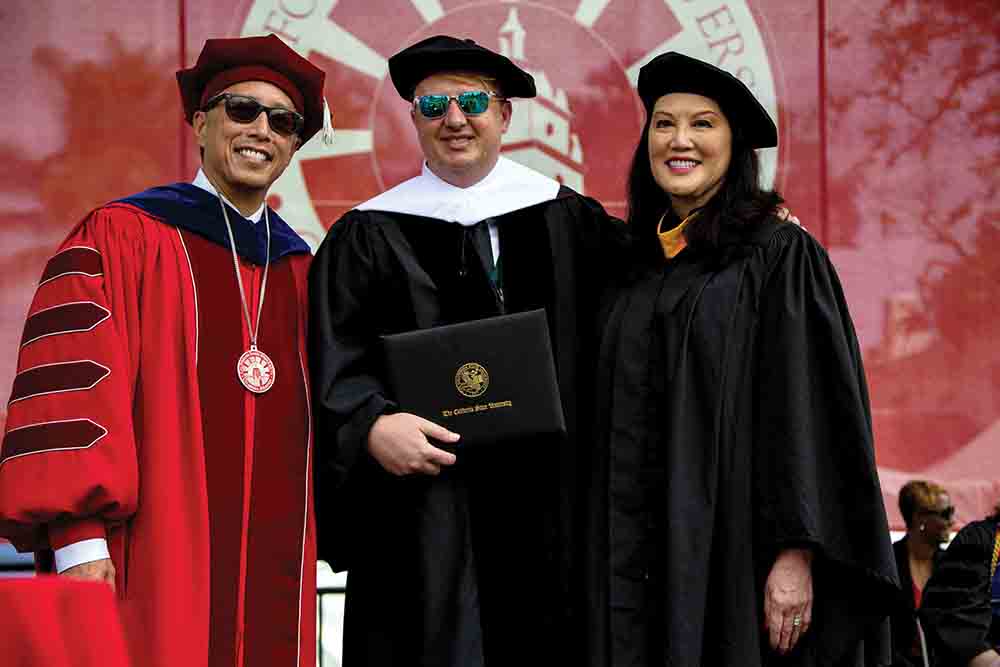
The university awarded Green an honorary Doctorate of Humane Letters in 2022. In the accompanying interview, he emphasized curiosity in the graduates his company hired. That quality connected his roles as employer and donor. A student’s capacity to ask questions mattered to him, as did the circumstances that allowed the student to remain in a classroom long enough to ask them.
The renewable scholarship program gave that concern a budget. In its 2023 form, students received $6,000 in each of the first two years and $4,000 in each of the next two, provided they continued to qualify. Advising, a first-year learning community and career counseling accompanied the money. Support had a schedule, rather than ending when the congratulations did.
Up to $20,000 across four years, subject to renewal requirements.
In September 2026, Channel Islands announced nearly $6 million in support from DataPhilanthropy during the previous fiscal year. Total giving to the university had exceeded $15.6 million. A new commitment of about $5.2 million would support a cohort of up to 250 first-year students for 2026-27. The partnership had grown into a continuing effort to combine financial assistance with academic support and examine the results.
Conviction acquires a price tag
Green signed the Giving Pledge in 2021, setting a target of giving away more than 90 percent of his wealth before or at his death. He also promised time and personal involvement. Education was a starting point for the family foundation’s giving arm, DataPhilanthropy. He wanted to test ideas, learn from the results and expand work that proved useful.
“No-one got here alone.”Jeff Green, 2021 Giving Pledge letter
In that letter, he expected to spend at least another decade at The Trade Desk before eventually directing his drive toward venture philanthropy. It was an aspiration with a long runway. In March 2026, his attention to the company took a particularly visible financial form: he announced that he had bought approximately $150 million of its stock with his own money.
The purchase expressed confidence. The following months made clear how much remained to prove. In September, The Trade Desk cut about 15 percent of its workforce. Green described a reorganization intended to increase focus, ownership and speed. The reductions followed a second quarter he acknowledged had fallen short of the company’s standards. For employees leaving the business, the practical consequences arrived immediately.
That difficult year belongs beside the founding dates and scholarship commitments. Green has spent much of his career asking institutions to organize themselves differently. He now faces the demanding version of his own question: whether his decisions produce the outcomes he expects. At the university and at the company, a theory eventually meets people, money and a result. The open door matters. So does what happens after someone walks through it.
Follow the argument
- Official biography and The Trade Desk · Company profile
- Jeff Green on LinkedIn · X · Essays in The Current
- Read Green’s 2021 Giving Pledge letter
- The scholarship’s 2023 design · The university’s September 2026 update
- Green explains his 2026 stock purchase · September workforce reduction coverage
- Watch: CNBC interview on advertising and competition, June 2023 · CNBC interview on ad-supported platforms, October 2022