A rocket is an excellent way to attract attention and a rather elaborate way to avoid discussing customer service. Jason Andrews has spent much of his career on the less photogenic questions. Who gets a place aboard? How much must they buy? What do they need to know before departure? His early customers sent satellites. At Orbite, the company he co-founded in 2019, the prospective passengers can ask questions for themselves.
The change is considerable. A satellite has never requested a better room. Orbite pairs astronaut preparation with hospitality, bringing Andrews’s aerospace background into partnership with French entrepreneur Nicolas Gaume. The business begins on Earth, where customers can explore spaceflight, undertake training and consider what sort of journey they might eventually make. It is an unusually human next chapter for someone whose earlier companies helped machinery leave the planet and pictures return to it.
An engineer learns the price of admission
Andrews’s interest predates the companies. He recalled attending NASA space camp as a child in a 2015 essay about commercial space. He graduated from the University of Washington in 1994 with a bachelor’s degree in aerospace engineering. There is a pleasing continuity between the child at space camp and the executive developing programs for space-curious adults. The latter have more elaborate accommodation requirements, but the initial attraction is recognizable.
In the 1990s he worked at Kistler Aerospace, which was developing the reusable K-1 launch vehicle. His responsibilities included vehicle performance, propulsion and design integration. These were practical encounters with the work of assembling a launch system across contractors and technical disciplines. Kistler’s vehicle did not become the reusable transportation business its backers imagined. Its employees, however, carried their experience elsewhere.
Andrews later recalled sharing an office for a time with Rob Meyerson, who went on to lead Blue Origin. The detail is a useful corrective to the habit of treating each space company as a self-contained invention. Seattle’s commercial space businesses grew partly through people who had already worked together, argued over designs and learned what an ambitious program actually required.
In 1999, Andrews and Marian Joh co-founded Andrews Space. The company worked on spacecraft systems and components, putting him in the business of building the equipment that other organizations needed for their missions. That position brought a neighboring problem into view. A small satellite can be an economical piece of engineering and still have an expensive difficulty reaching its destination.
A small satellite needs a lift
Andrews founded Spaceflight in 2010 to arrange launches for small and secondary payloads. The commercial idea was straightforward enough to survive explanation outside an engineering meeting: several customers could share transportation. Small spacecraft would take available capacity on a larger mission. The work of making those arrangements useful still involved integration, schedules and relationships with launch providers. Sharing a ride does not eliminate the need to organize it.
For a satellite customer, this changed the purchasing decision. An organization could seek transportation for its own payload without organizing an entire launch. Spaceflight made a service out of the gap between the rocket operator’s mission and the smaller customer’s needs. The satellite could be modest; the coordination required to send it anywhere was less so.
By 2015, Spaceflight had booked an entire Falcon 9 for a dedicated rideshare mission. Andrews was also bringing Andrews Space, Spaceflight and BlackSky together under Spaceflight Industries. Building spacecraft, arranging transport and using the results from orbit could now sit within the same corporate group. It was an expansive arrangement, with plenty of opportunities for one department’s progress to become another department’s urgent meeting.
- 1999BuildAndrews Space
- 2010LaunchSpaceflight
- 2013ObserveBlackSky
- 2019PrepareOrbite
Seattle supplied more than a mailing address. Andrews repeatedly pointed to its combination of aerospace engineering, software talent, big-data expertise and capital. When Spaceflight moved from Tukwila toward Seattle’s software workforce, he joked that his relocation covered about 15 miles while SpaceX had traveled roughly a thousand. It was a small joke with a substantial business argument inside: where the programmers live can influence where the space company goes.
Earth, with a shorter waiting list
BlackSky, founded in 2013, gave that software argument a purpose. Andrews wanted customers to obtain a timely view of a changing planet. At its public introduction in 2015, he described the concept as “Google Earth Live.” The proposed constellation was intended to revisit populated areas frequently, offering imagery on a more useful schedule for people following events rather than simply making maps.
The original proposal called for 60 satellites. That number belongs to the ambition announced at the time. It should be read as a design for the business, with all the financing, manufacturing and launch work still implicit in it. A constellation on a presentation slide has the advantage of perfect weather and punctual rockets. The physical version must negotiate rather more.
On September 26, 2016, BlackSky’s Pathfinder-1 reached orbit aboard an Indian PSLV rocket. Employees watched the launch together at Spaceflight Industries’ Seattle headquarters. A development satellite becoming an object in orbit is a concrete kind of progress. It gives the team something to operate, something to test and a fresh collection of questions that cannot be answered by polishing the presentation.
The imagery business extended well beyond the spacecraft. BlackSky’s platform brought satellite imagery together with other information, including news, social media and ground-based data. Customers needed ways to search, request and understand images. Spaceflight Industries acquired the Virginia software company OpenWhere in 2016. The intended product depended on the machinery in orbit and the software through which someone on Earth could make use of it.
Andrews also saw a role for other imagery providers inside that system. Early descriptions presented their capacity as something BlackSky could complement and distribute. The practical question was how to give customers a useful view, even when the picture came from another company’s spacecraft. A space business could therefore grow by connecting assets as well as owning them.
He received recognition among GeekWire’s 2015 Newsmakers of the Year during this period. By November 2018, his leadership chapter at Legacy BlackSky had ended. The distinction matters to the shape of his story: BlackSky is an earlier company he helped create, while the day-to-day problem occupying his next venture would concern the people contemplating a journey above the images.
The engineer meets the hospitality business
Gaume and Andrews began discussing what would become Orbite through their involvement around Gaume’s Space Cargo Unlimited experiments. Gaume was thinking about hospitality for people who would eventually fly into space. Andrews had long been interested in sending people there. Their experience met at a plausible point in the journey: the preparations before departure.
They co-founded Orbite in 2019 and publicly introduced it in 2020. The pairing brought Andrews’s space-industry connections together with Gaume’s technology and hospitality background. Gaume was explicit that some customers might never take a spaceflight. Training and experiencing the preparations could be an attraction in themselves. That gave the company a way to welcome the curious before every visitor had chosen a destination.
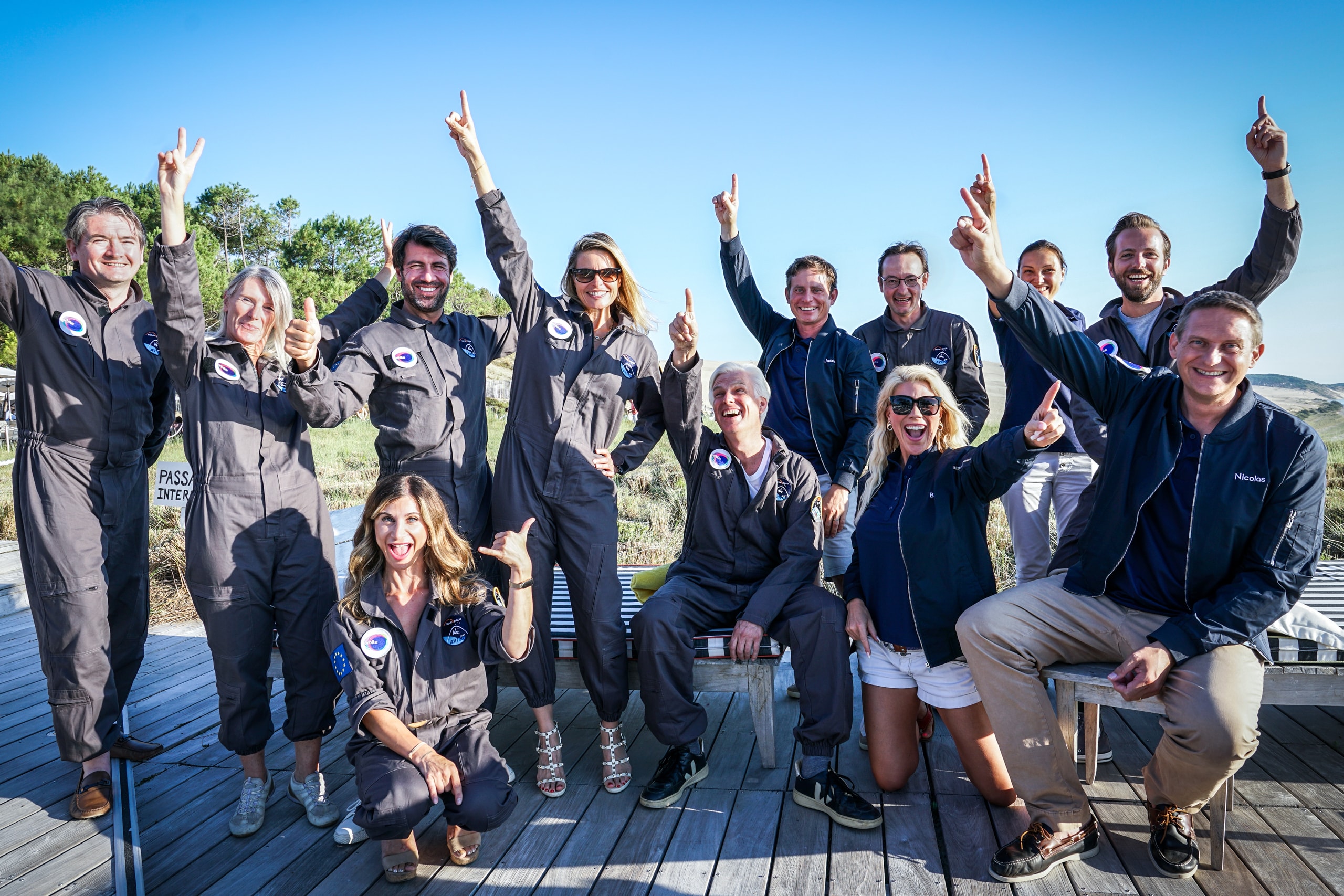
In 2021, Orbite announced its first Astronaut Orientation courses, including programs in France and Florida. The itinerary combined instruction, virtual-reality mission experiences, microgravity and high-G flight activities. There was also a space-food tasting. Future space travelers could discover something of the journey’s technical demands while inspecting a question that civilization has rarely left unanswered for long: what is for dinner?
The early offer limited each orientation to ten guests and advertised a starting price of $29,500 per person. Those were the terms of the 2021 announcement, a measure of the market Orbite was initially addressing. Its version of wider participation began with customers able to pay for a specialized experience, within a commercial spaceflight market still developing around them.
Orbite also announced a collaboration with Philippe Starck on its planned astronaut-training and spaceflight complex in 2021. The choice suited the company’s combination of preparation and hospitality. A place designed for future space travelers must accommodate the instructional machinery and the person who has come a long way to use it. The design commission was a plan for that setting, rather than proof of a completed campus.
A departure lounge for an unfinished future
By November 2023, Orbite had announced orientation, suborbital and orbital training programs. The categories recognized that a short flight and a stay in orbit require different preparations. Andrews described a sequence that put training before flight. For an entrepreneur accustomed to moving spacecraft, the passenger’s route now included learning what the experience would ask of them.
“First you train, then you fly.”Jason Andrews, Orbite training announcement, 2023
A $4 million Series A followed in December 2024, alongside an announced partnership with Accor to support the planned Spaceflight Gateway campus and international expansion. In May 2025, Orbite announced partnerships with Xponential Space to reach Latin American customers and 7Lifestyle to reach its concierge clientele. These arrangements addressed another practical matter: finding the people who might want the service.
Andrews remained focused on those questions in 2026. In a May interview with Balerion Space, he discussed astronaut preparation, mission support and barriers in the private astronaut market. In June, he explained that he and Gaume had founded Orbite with Starship’s potential in mind, expecting greater capacity, more frequent flights and lower costs to change human spaceflight. Those expectations describe the opportunity he is pursuing; their fulfillment remains part of the wager.
The career has an intelligible progression. Andrews helped build spacecraft, arrange their rides and deliver information from them. Now he is working with people who may want to make the journey. Across those businesses, he has kept returning to the practical arrangements that let a customer participate. The universe offers no shortage of grandeur. Andrews keeps finding work in the details of getting there.