Will Marshall was asleep when the picture arrived. It showed a forest in Oregon. Robbie Schingler woke him, and the two could make out individual trees. Their little spacecraft had taken a usable photograph from orbit. Before Planet could become a business built around watching Earth change, it had to produce this rather modest miracle: a picture that was in focus.
They recalled the moment years later, with the pleasure of people who knew how easily it might have gone otherwise. The first workshop had been a garage. An early makeshift clean room involved a greenhouse bought from a retailer and air filters. Aerospace had acquired a faint air of garden furniture. The photograph supplied a much more persuasive argument than the surroundings.
Marshall’s ambition was to make such pictures routine. A flood, a harvested field or a new road through a forest is a matter of timing. A beautiful image taken too late can leave its viewer exquisitely informed about a decision that has already passed. He wanted to shorten that distance between an event and someone knowing about it.
A phone asks an expensive question
He came to the problem by way of physics. Born and educated in Britain, Marshall studied physics with Space Science and Technology at the University of Leicester, then earned a doctorate in physics at Oxford. His research concerned quantum mechanics. Postdoctoral work took him to George Washington University and Harvard. The eventual satellite executive began with questions about how the physical world behaves.
At NASA’s Ames Research Center in California, his work included the lunar missions LADEE and LCROSS, along with research on space debris. He was a scientist working through NASA and the Universities Space Research Association. His career already ranged from the very small to the inconveniently orbital. It offered plenty of room for someone interested in both theory and equipment.
One piece of equipment was disarmingly familiar. Ames engineering director Pete Klupar would hold up a smartphone during talks and ask why its capabilities cost so little compared with a satellite’s. Chris Boshuizen and Marshall took the question seriously. A phone already contained a processor, sensors, a camera and communications equipment. Considerable engineering effort had gone into making those components small.
The resulting PhoneSat project tested whether consumer technology could perform useful spacecraft functions. Marshall and Boshuizen helped lead its beginnings. Three early satellites, named Alexander, Graham and Bell, reached orbit in 2013. A telephone joke had acquired a launch manifest. Their photographs and transmissions demonstrated that ordinary electronics could have an extraordinary commute.
Four kilograms, one planetary ambition
Planet grew out of that willingness to borrow from another industry. Marshall, Schingler and Boshuizen founded the company in 2010. They pursued small satellites made with commercial components, an approach that allowed the hardware to develop through successive versions. Spacecraft could benefit from the rapid improvement of electronics designed for millions of customers on the ground.
There was a business choice inside the engineering choice. Rather than asking one expensive instrument to do everything, Planet would launch groups of smaller instruments. Repeated observations would be their particular strength. The company would sell information about Earth to people whose work depended on understanding it. The rocket ride was a means of getting the camera to its desk.
In March 2014, Marshall took a satellite onto the TED stage. It measured ten by ten by thirty centimetres and weighed four kilograms. Here was an aerospace proposition an audience could judge with its own eyes: the speaker could hold the hardware. Planet had already sent 28 of the small satellites into space. He explained the ambition to photograph the planet daily.
“We can’t fix what we can’t see.”
Will Marshall, TED2014
The sentence is a good guide to his public life. Marshall keeps returning to visibility as a practical condition for action. It also makes a demanding promise. Once you offer people a view of change, they reasonably want that view to be timely, intelligible and useful. The photograph opens a conversation that the rest of the business has to sustain.
By 2017, Planet had achieved daily imaging coverage of Earth’s landmass. When Marshall returned to TED in 2018, the demonstration had changed. The company was introducing Planet Stories, a tool for comparing images across time. Users could watch a neighbourhood appear or follow alterations to a landscape. The tiny box had become a way to examine a sequence.
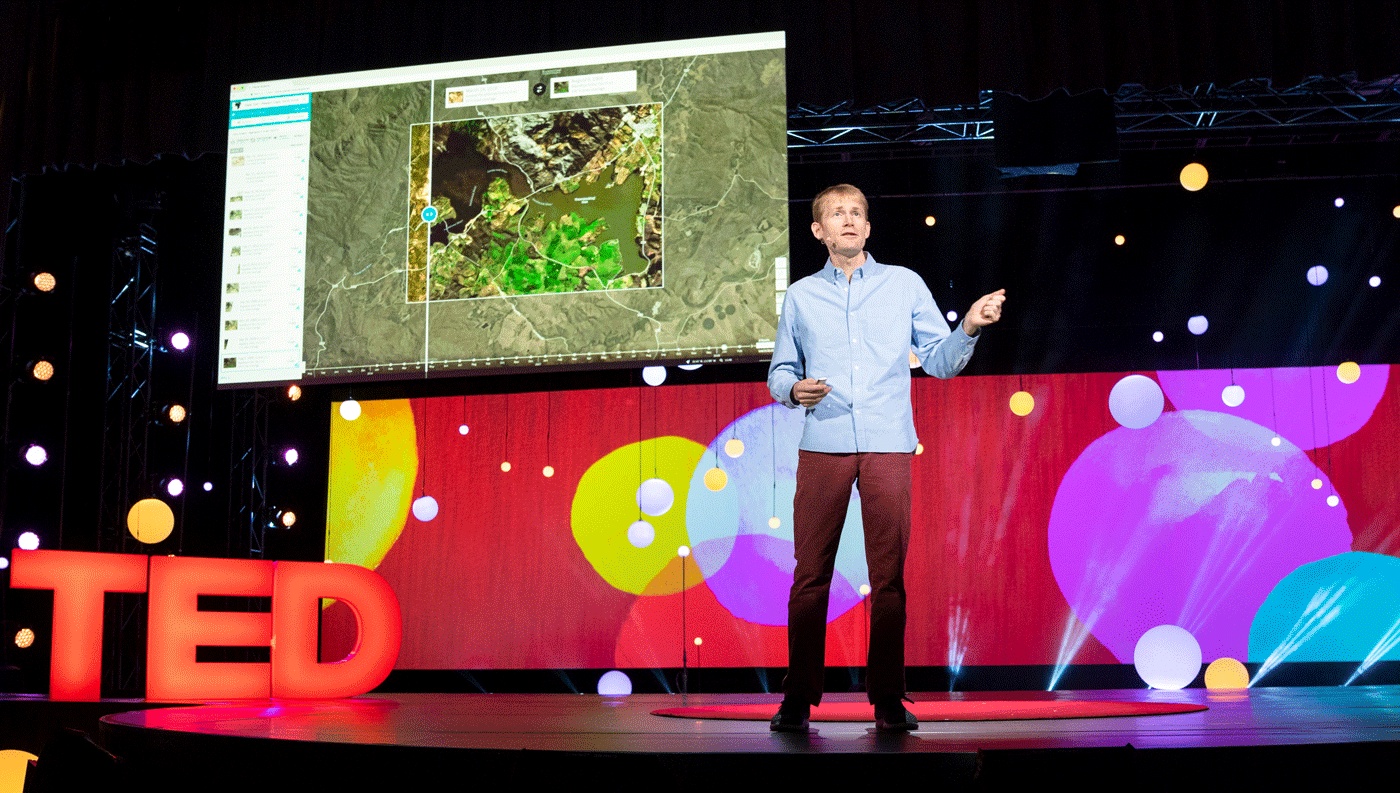
A sequence gives an observer something a single image cannot: a chance to ask when. A construction site has a previous state. A river has a history. The significance lies in the comparison. Marshall’s 2018 vision extended to indexing objects in imagery so that the Earth’s surface could become searchable. Even then, gathering the pictures was only part of his interest.
Doves with complicated assignments
He has argued that useful monitoring needs to run faster than the change being monitored. In writing about a global sensing revolution, Marshall used the example of a spacecraft developing a problem: its instruments must measure what is happening quickly enough for its occupants to respond. Earth, in his telling, is the spacecraft whose instrument panel needs attention.
Forests make the argument concrete. An annual comparison can establish that trees disappeared. More frequent observations can help identify activity while there is still time to respond. Marshall has also pointed to the ability of Earth observation to reveal illegal mining in the Peruvian Amazon and changes to military installations. The same capacity to record change travels across very different assignments.
Planet calls its little satellites Doves. The name carries an aspiration about how information should be used. The customer list, meanwhile, includes government and security organizations as well as commercial and environmental users. That gives the daily archive a complicated public life. An observation can support conservation, commerce or intelligence, depending on the question and the person asking it.
Recognition has come from an unexpected direction for an aerospace founder. In 2024, Marshall and Schingler jointly received the Royal Photographic Society’s Award for Environmental Responsibility. Its remit includes images that improve awareness of environmental issues. A satellite company had entered the company of photographers through what its cameras allowed people to notice. The artistic and engineering worlds briefly shared a viewfinder.
The archive learns to answer
Marshall’s current argument concerns the distance between collecting information and using it. In May 2026, he published an essay called Planetary Intelligence. He proposed combining satellite archives with other observations and AI, describing models that could interpret the physical world. He calls them Large Earth Models. Their intended job is to connect observations to questions about particular places and events.
It is an ambition that fits his earlier work: first make the observation more frequent, then make it easier to understand. But it remains an ambition, with products developing along the way. An account of what a system might eventually do belongs in the future tense. Marshall’s essay ranges well beyond a product specification, into the responsibilities that come with technological capability.
The idea also took him back to Oxford. In June 2026, the university scheduled a Planetary Intelligence lecture at Oriel College’s Senior Library, welcoming its former physics doctoral student. Researchers there already used Planet’s data. The setting supplied a neat connection between the academic training he began with and the practical questions his company now tries to help people answer.
At the ITU’s AI for Good Summit in July 2026, he discussed how daily imagery could support decisions about such changes as an illegal road or wildfire damage. He also emphasized the need to question AI outputs and understand the limits of satellite imagery. A fluent answer still needs examination. An attractive interface does not relieve its user of judgment.
By September, Planet reported that its AI application had entered open beta, allowing natural-language queries of its archive. The company also reported quarterly revenue of $116.1 million, up 58 percent from a year earlier, alongside a $9.4 million net loss. Marshall’s job includes turning the scientific proposition into an operating business, with customers, manufacturing commitments and results that can be counted.
The environmental ambition continues alongside that work. Planet announced Amazon.ia in September 2026, a partnership combining satellite information, science and AI to support conservation across the Amazon. The Bezos Earth Fund provided grants to partner organizations supporting the initiative. Its intended audience includes researchers, governments and local communities. A daily observation matters most when it reaches someone with a decision to make.
Bring a racket
Marshall’s scale of interest can make the ordinary details particularly welcome. Asked in a 2025 interview what piece of gear he could not do without, he chose his tennis racket. Given the available alternatives, that is a pleasingly portable answer. His advice to his younger self was similarly direct: “Carpe diem. You think you’ve got infinite time, but you don’t.”
The impatience in that advice runs through the work. Yesterday’s image can be valuable, but only if you understand its date. An archive can be valuable, but only if you can find your way into it. From an Oregon forest to a question typed into an AI application, Marshall keeps working on the interval between looking and knowing what to do.
Follow the view
Explore Planet and its company profile, read Marshall’s essays, or follow him on LinkedIn and X.