Before Pavel Machalek’s satellite business had a desk, it had a floor. His friend and future co-founder, Jerry Javornicky, would later recall Machalek spending nights down there, coding a demonstration of what became a China Manufacturing Index. A researcher who had worked with NASA’s space-telescope data was trying to make something useful from pictures of Earth. Furniture could apparently wait.
The detail is pleasing because it gives a physical address to an abstract idea. Satellite analytics sounds as though it should begin in a control room, with a wall of screens and someone wearing a headset. This version begins with a programmer, an old friend, and a demonstration. The distance between those two scenes is part of Machalek’s story.
SpaceKnow, the company they built together, would turn orbital imagery into information for people making decisions on the ground. Its economic indexes reached Bloomberg terminals. Machalek’s latest venture takes photographs somewhere else again: underground, into an Arctic archive. Across these changes of altitude, the question remains recognizable. What can a picture tell you, and what must happen for that information to remain useful?
The floor before the orbit
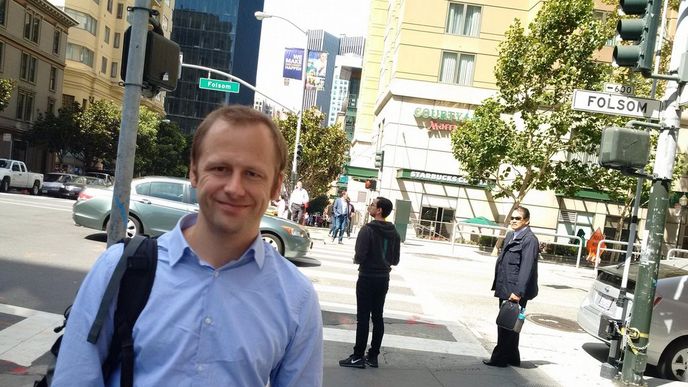
Javornicky knew Machalek from school. When his own software business brought him to San Francisco, he stayed with his friend. Their eventual partnership therefore came with a history longer than a pitch meeting. Machalek had scientific and remote-sensing experience; Javornicky had helped build the email application eM Client. Each had something the other could put to work.
In Javornicky’s account, the demonstration became the foundation for the company because they saw room to do more with satellite imagery. The attraction was practical. Pictures were already being taken. The difficult, potentially valuable work lay in extracting information from them repeatedly, at a scale that a person inspecting images one by one could scarcely manage.
The connection reached back to the English College in Prague. Another school friend, Michal Reinstein, later joined SpaceKnow as chief scientist. Looking back in 2026, he described the appeal of exploring deep learning for satellite data as those techniques began gaining traction around 2014. There was a new technical opportunity, and people he knew were asking him to help pursue it.
That makes the founding story less tidy than the familiar lone-inventor portrait, and more interesting. A working example needed people who could turn it into a product. A product needed someone to buy it. The school friendship supplied a starting relationship; the demonstration supplied a starting argument. Neither alone explains the company. Together, they gave the next conversation something concrete to be about.
Learning to read a planet’s light
Machalek’s route to that floor ran through astronomy. While attending school in Prague, he took courses at the planetarium and later at Petřín. He graduated from the English College in 2000, completed undergraduate astronomy studies at University College London in 2003, and went to Baltimore for a summer internship at the Space Telescope Science Institute. Doctoral study at Johns Hopkins followed in 2004.
His research concerned hot Jupiters, large planets with atmospheres that could be studied through changes in light. A doctorate in this field requires patience with measurements that rarely resemble the lavish illustrations accompanying a space story. There may be a magnificent world involved. The immediate object on the researcher’s screen is a set of observations requiring careful analysis.
In 2008, Machalek was first author of a paper on thermal emission from exoplanet XO-1b. The team used the Spitzer Space Telescope’s infrared instrument to measure the planet relative to its host star in four wavelength bands. Their results supported an atmospheric temperature inversion. The work linked small changes in observed light to an interpretation of conditions on a world far away.
A second first-authored study, submitted in 2009, examined XO-2b. Again, Spitzer observations across four infrared bands were central. The team reported evidence for a weak temperature inversion. These papers make his scientific background specific: he was working on the problem of learning about planetary atmospheres through measurements of thermal emission, alongside collaborators including Peter McCullough.
There is a useful way to read the later career through these studies. A photograph or a light curve arrives as a record. Its meaning depends on a method, comparisons, and assumptions that deserve inspection. That relationship between observation and interpretation persists when the subject changes from a planet’s atmosphere to an industrial landscape. The objects become more familiar. The need to make a defensible connection remains.
A career in observations, interpretation and preservation.
The unglamorous work behind Kepler
By 2010, Machalek was working on NASA’s Kepler mission. His responsibilities included checking photometry and helping keep data products reliable across successive release cycles. Troubleshooting occupied much of his day. When a problem demanded changes to the code, he worked with the Science Operations Center. Space exploration, in this account, involved a substantial amount of looking for things that had gone wrong.
That work sits behind the public pleasure of a discovery. Before a measurement can support an announcement, someone has to establish whether the instrument and processing are behaving as expected. A defect can masquerade as something worth noticing. Routine checks make room for the unusual signal to receive the attention it deserves.
Machalek also described work improving algorithms that searched light curves for planetary candidates, with candidates then passing through further review. His name appears as a co-editor of Kepler’s Data Release 9 Notes, alongside Jessie Christiansen. The document is a small, concrete reminder that a mission’s usable output includes explanations of its data as well as the data themselves.
His recollection of the workplace had a different kind of texture: a windowless room, fluorescent lighting, and a heavy metal desk marked with the Apollo project’s name. Visits to friends at Google offered a colorful comparison. NASA had supplied the badge and the historical furniture. The private sector seemed rather more committed to the décor.
After NASA, he worked in remote sensing at The Climate Corporation. This placed his experience with data in another commercial setting before SpaceKnow. Read as a sequence, the move toward entrepreneurship happened through applications of scientific work: instruments, processing, interpretation, and eventually a service someone else could use.
A second opinion on the economy
SpaceKnow’s central proposition was that economic activity leaves visible traces. Its China Satellite Manufacturing Index examined thousands of industrial areas; its Africa Night Lights Index used illumination as an indicator of activity. These products reached Bloomberg terminals, bringing a different kind of observation into financial workflows. An orbital image could become part of an economic conversation.
The distinction matters. A picture of a factory is an observation of a place at a particular time. An index combines observations into a measure. The work between them includes deciding what to examine, recognizing features, and comparing changes. Customers receive the result of that process rather than a picturesque view from above.
For someone accustomed to making sense of faint planetary signals, the change of subject is striking. The object of interest might now be construction, a port, or an industrial site. The commercial question concerns activity here on Earth. A satellite offers distance from the scene while still leaving the analyst responsible for what the scene means.
In February 2017, SpaceKnow announced a $4 million Series A investment involving BlueYard Capital. Machalek was its CEO at the time. The financing gave the company another resource for developing the business. It also placed the old floor-built demonstration in a different setting: an enterprise with investors, products, and customers expecting useful answers.
“The images are only helpful in context.”
Pavel Machalek, discussing North Korea satellite imagery, 2016
His caution about images was explicit when he discussed North Korea’s nuclear test site in January 2016. Visible construction at a tunnel entrance did not settle the questions surrounding the reported test. Underground activity presented a particular difficulty. Machalek stressed the need for context. The statement is a useful companion to any promise that better pictures will produce better knowledge.
There is room for ambition and restraint in the same business. Automated analysis makes repeated observation more manageable. Interpretation still has to answer to the evidence. Machalek’s career is most compelling at that junction, where a researcher’s habits meet a customer’s desire to know what is happening before the next report arrives.
The photograph after the password
The latest chapter changes the timescale. Eternity.Photos identifies Machalek as its founder and CEO. Rather than extracting a new indicator from an image, the company aims to keep personal photographs available to future readers. It converts pictures to archival film and arranges underground storage. The subject can be a family snapshot whose value has nothing to do with a trading decision.
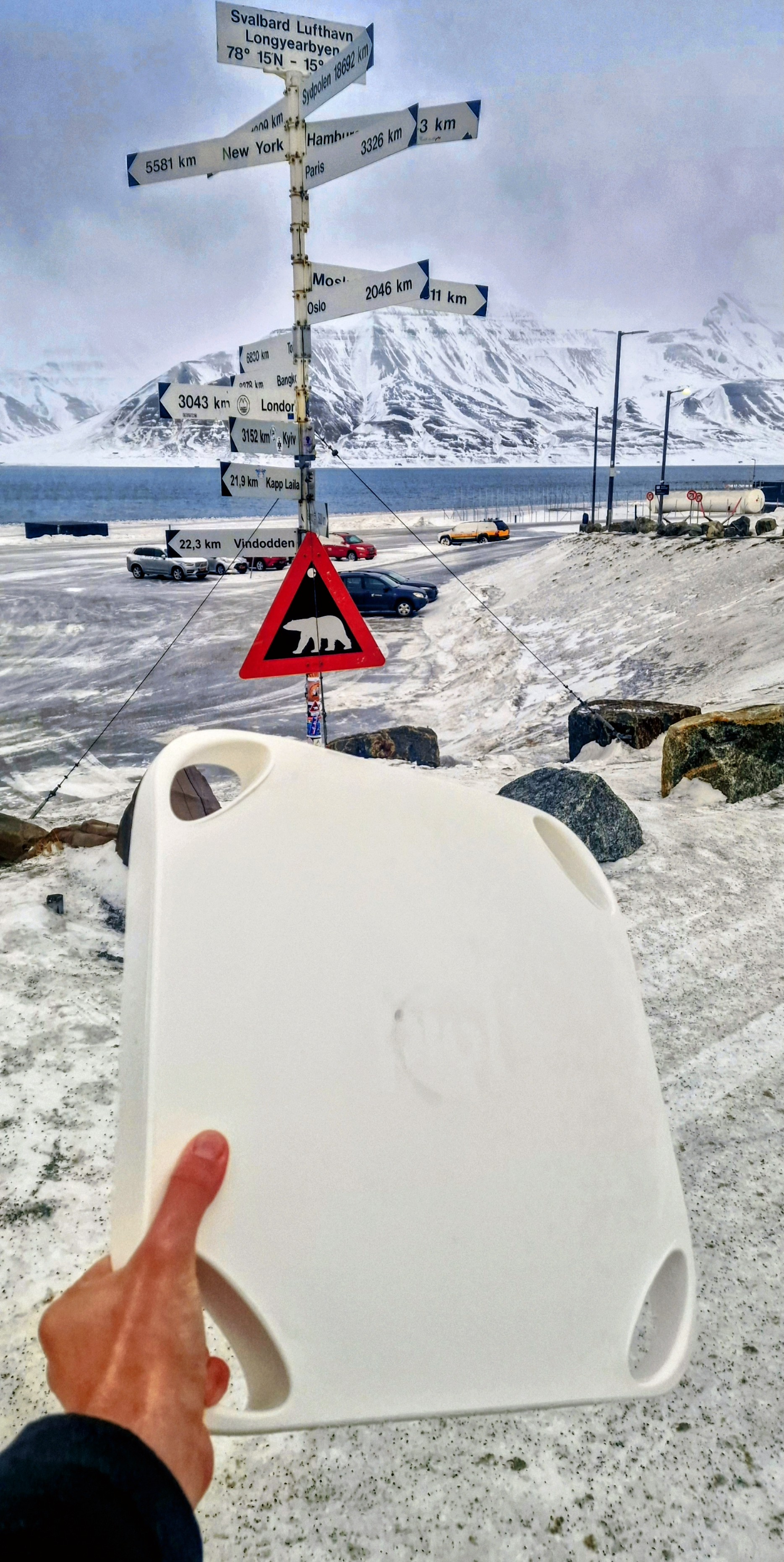
The Arctic World Archive recorded the company’s inaugural collection deposit on February 28, 2026. That gives the venture a documented event beyond its promise. The archive’s account places personal photographs alongside the cultural and scientific collections held in Svalbard. A familiar object, the family picture, enters an unfamiliar setting.
Eternity.Photos markets a preservation horizon of more than a thousand years. That is its claimed design horizon, a statement about intended durability. The deposit belongs to the present. The distinction is essential to understanding the project: photographs have been placed in an archive, while their distant future remains the ambition around which the service is built.
Machalek had also co-founded Spartacus, a data-deletion company. In that sequence of ventures, information can be measured, removed, or deliberately kept. Those are distinct choices, made for distinct purposes. The archival business concerns the pictures people choose to carry forward, and the arrangements needed to give that choice physical form.
In September 2026, the Visual 1st conference program listed him for an interview about preserving photographs over centuries. It is a different question from finding a planetary candidate or assessing industrial activity. Yet it returns to the usefulness of an image: someone must be able to encounter it, recognize it, and understand why it was kept.
Machalek began by studying light from distant worlds. His business career brought pictures into the daily machinery of decisions. Now it asks what a future person might receive from us. A factory yard and a family album are unlikely neighbors in a biography. In his, they share the same practical concern: giving a picture a job it can actually do.