The first useful thing Jerry Javornicky learned about computers was that people wanted them to work. At school, he assembled machines for friends and classmates, connected them to the internet, and solved the untidy problems that gather around new technology. Two days after his eighteenth birthday, he went to an office and obtained a business license. His plan was wonderfully concrete: build servers, repair computers, make a living from the machines.
The plan worked, then failed, then became more interesting. Two years later, Javornicky and three partners started NetGroup. The company lasted three years. He would later describe it as a life school for four people who were not yet entrepreneurs. Failure, in this version, was neither myth nor catastrophe. It was tuition.
From there he joined Adam Paclt. The pair began selling the IceWarp mail server from Paclt's bedroom, a setting with none of the polished inevitability that founder stories acquire in retrospect. They went on to develop eM Client, an alternative to Microsoft Outlook, and AppToCloud.com, a cloud service for medium and large companies. The boy repairing hardware had moved into software, and the software traveled farther than he did.
Build it, understand it, then let it travel
There is a practical rhythm to Javornicky's career. He gets close enough to a system to understand its machinery, helps turn it into a product, then lets other people operate what has matured. By 2018 he said his involvement with IceWarp and eM Client was limited to advice and strategy. Daily roles had passed to partners and managers. He was proud of the companies, but after a decade of email and servers he wanted a different problem.
“For me, the next step was SpaceKnow. And it was a step into the unknown.”Jerry Javornicky
The unknown arrived in San Francisco. There he worked alongside Pavel Machalek, a fellow Czech whose background included research on data from NASA's Kepler space telescope and work at the Climate Corporation. Machalek had a prototype for analyzing satellite data and selling the resulting information to financial institutions. In 2013 the two co-founded SpaceKnow.
At the time, applying machine learning to commercial satellite imagery was an early market. The original question was broad: if they gathered enough images, could algorithms extract something useful? One early answer was the Chinese Manufacturing Index. Instead of asking a factory manager how business was going, SpaceKnow could watch thousands of industrial locations and measure whether physical activity appeared to expand or contract.
Four things the ground can tell the sky
The picture is not the product
A satellite image can be beautiful, but beauty is often operationally useless. A bank analyst may not want to inspect a parking lot. A government analyst may not have time to compare hundreds of ports. SpaceKnow's product decision was to translate the picture into the thing a customer actually needs: a number, a direction, an alert, or a change.
The company developed two related practices. The first was economic analysis, extracting patterns that could support a financial view. The second was automatic recognition of objects and changes: cars, ships, factories, roads, new structures, altered vegetation. Javornicky framed the bottleneck plainly. Satellites were producing more imagery than people could examine. A machine had to become the first reader.
The useful distance from pixels to decisions
A conceptual view of where raw observation becomes client value.
The distinction is the quiet center of the business. SpaceKnow does not need to persuade every customer to become a remote-sensing expert. It needs to deliver a result in the customer's language. A financial user might receive a line on a chart. A construction investor might get notice that groundwork resumed. A maritime analyst might learn that a ship moved even when its public beacon stopped transmitting.
The African Nightlight Index made the translation especially clear. Where official economic reporting was limited or unreliable, SpaceKnow studied whether the illuminated footprint of cities expanded or contracted. Light became a proxy, not a verdict. The method captured Javornicky's instinct for the useful side door: when a conventional statistic is late or absent, look for a physical consequence that cannot avoid appearing somewhere.
That same instinct appears in the way he talks about competition. During the IceWarp years, incumbency did not strike him as proof that a market was closed. Microsoft Exchange held an imposing share, but smaller companies still found customers by offering alternatives. His conclusion was that a product's life cycle depends on more than the presence of a large rival. SpaceKnow carried the habit into another field, entering satellite analytics while its commercial rules, suppliers, and applications were still being formed.
Over time, the inputs improved. Imagery arrived more frequently. Storage and computing became cheaper. Optical pictures could be combined with synthetic aperture radar, which can observe through clouds and darkness. SpaceKnow expanded the number of places it could monitor and the range of events its systems could classify. By 2024, Javornicky described access to data from roughly four hundred commercial Earth-observation satellites and hundreds of algorithms for recognizing materials, objects, and changes.
A company with two kinds of gravity
SpaceKnow was founded in San Francisco, is headquartered in New York, and built much of its technical core in Prague. That arrangement reflects Javornicky's judgment that an American company could reach customers and capital while Czech scientists and developers could build the analytical engine. The geography is not decorative. It is part of the operating design.
The customer map widened too. Financial institutions used satellite-derived indices to compare what companies and economies said with what physical sites appeared to be doing. Government and defense users cared about situational awareness: what changed in a large area, when it changed, and whether the pattern resembled something seen before.
Javornicky is careful about the distinction between evidence and force. “We are not a weapons system, we are a data company,” he said as SpaceKnow's defense work grew. The sentence identifies both a boundary and a responsibility. Better observation does not make a decision, but it changes what a decision-maker can plausibly claim not to know.
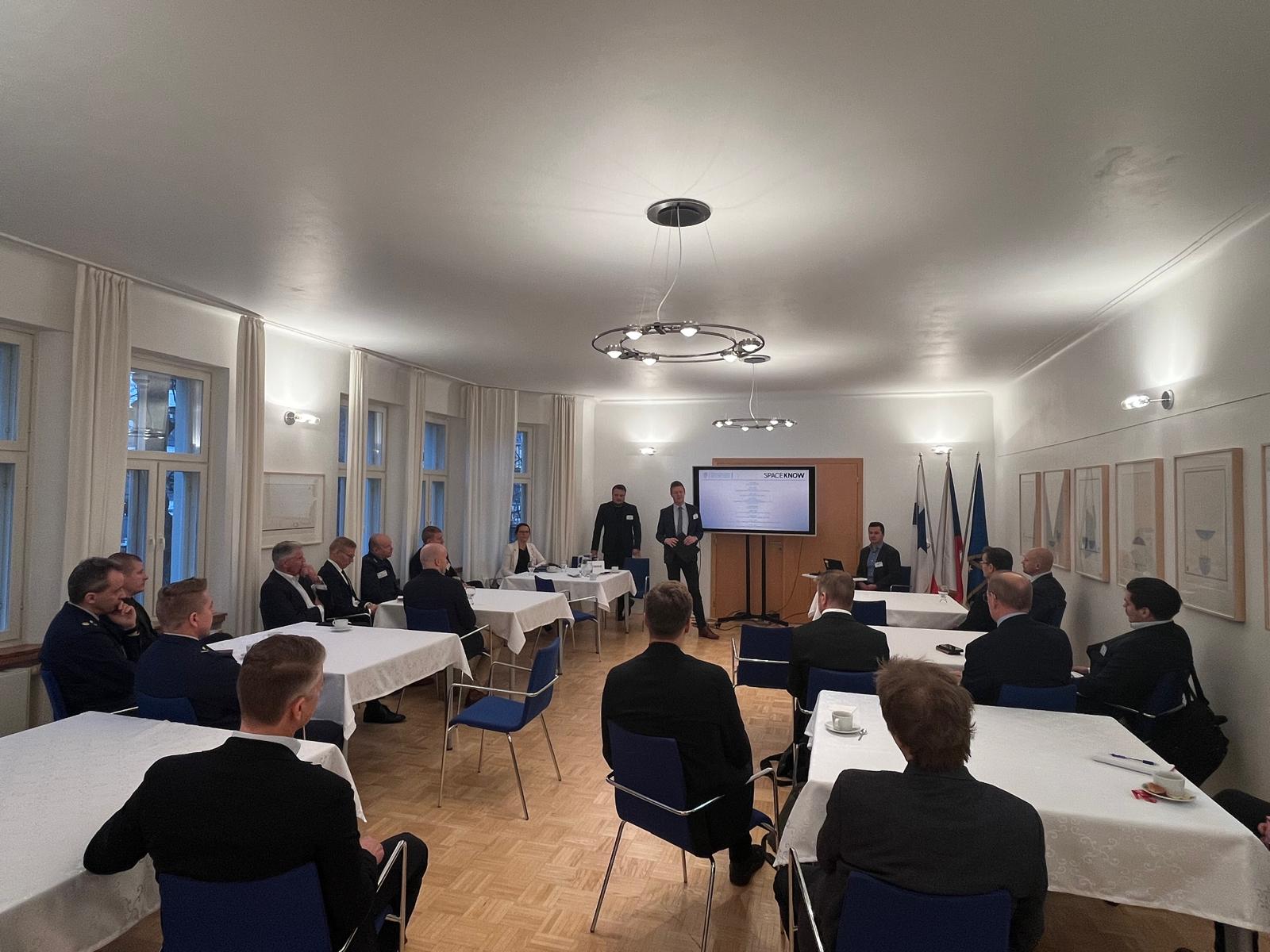
In November 2025, Javornicky and co-founder David Stoppani presented the company's geospatial intelligence work in Helsinki to specialists from security, government, academia, and industry. The setting captured SpaceKnow's increasingly public role: a private software company explaining how automated observation fits alongside national institutions and satellite operators.
That role advanced again in June 2026, when SpaceKnow and Satellogic announced a collaboration. Satellogic contributes high-frequency image collection and a growing satellite constellation. SpaceKnow contributes the analytical layer. The intended result is persistent monitoring for commercial and government customers, joining frequent observation to software that can decide where a meaningful change occurred.
The inventory of Earth
Javornicky's preferred metaphor is search. He has described the ambition as an inventory of Earth and, more playfully, a Google for the planet. The phrase can sound enormous until it is reduced to its parts. Search engines made the expanding internet useful by indexing it. Earth-observation satellites now create an expanding archive of the physical world. The corresponding problem is to index place, time, object, and change.
“We are trying to derive trends and truth based on demonstrable phenomena.”Jerry Javornicky
The emphasis on demonstrable phenomena explains why the same technical system can serve a hedge fund, a construction investor, a flood-response team, and a maritime analyst. Their questions differ. Their shared need is an observable trace. Concrete is poured. Cars accumulate. Water crosses a boundary. A vessel appears where its broadcast record says nothing should be.
It also explains why Javornicky has resisted the temptation to make SpaceKnow a satellite manufacturer. His argument is division of labor: hardware companies solve the physics of instruments and launches; SpaceKnow's advantage lies in software. Owning every layer might look grander. Remaining useful across many imagery providers may be the more durable position.
There are other clues to his appetite for building. He invested in and helped develop DIVR Labs, a Czech virtual-reality studio later sold to EC Investments. A 2022 profile noted a smaller sideline, the Hong Kong Karlín restaurant, which he treated as a hobby. The projects vary in scale and medium, but they share a fondness for experiences that make an invisible system tangible.
The strongest thread, though, runs from that first repaired computer to the latest satellite partnership. Javornicky keeps choosing interfaces between complexity and use. A mail server should deliver a message. A cloud should serve a company. A satellite image should answer a question. The machinery can be elaborate; the value must arrive in plain clothes.
SpaceKnow's eventual index of Earth is still an aspiration, not a finished object. Yet its shape is already visible in the company's daily work: observe repeatedly, compare carefully, alert selectively. The planet never stops editing itself. Javornicky is betting that software can keep the revision history.