Jamie Baxter has spent much of his working life making computers do things. One of his more useful instincts is knowing when to leave them out of it. Before committing a process to software, he wants to see people attempt it themselves, encounter the awkward bits, and try again. A person sending a text message can teach you something that a polished product specification has managed to miss.
Consider the employee who has yet to clock in. At Qwick, the hospitality staffing company Baxter co-founded, the team could start with a simple reminder. Send a text. Change the timing. See what helps. Only after that work did the process deserve a permanent place in the product. The first useful tool was somebody paying attention.
That habit provides a way into Baxter’s career. He helped build a business that reached a million completed shifts. He then returned to restaurants with diner, this time helping operators hear from their guests. Between the two sits a question he keeps making room for: what is actually happening here?
A computer, two floppy drives, and Mrs. Hill
His interest in programming began in Tulsa, Oklahoma, in second grade. A teacher named Mrs. Hill made room for individual interests in her classroom. When Baxter expressed an interest in computers, she helped him learn to program. In his recollection, she may have been learning alongside him. There is something pleasing about a technology career beginning with a teacher willing to give an unfamiliar thing a go.
His parents found the money for a computer with two floppy disk drives. He remembers their support as a meaningful expense in a household living modestly. The machine mattered; so did the adults who treated his curiosity as something worth taking seriously.
By 16, he had started his first company. He would sell two businesses and spend roughly 18 years at Willis Towers Watson before Qwick. His preparation for startup life included a substantial stretch inside an established organization, working with technology products and international teams. The teenage entrepreneur had also learned the demands of a large workplace. Both experiences belong in the picture.
The housekeeping idea that changed rooms
Qwick began in 2017 with a conversation about hotel housekeeping. Chris Loeffler, a hotelier, knew the difficulty of finding and keeping reliable help. Baxter, Loeffler and marketplace specialist Blaine Light founded a company to tackle it, testing the concept in Phoenix-area hotels.
The early version ran into obstacles. Baxter changed direction toward food and beverage, where restaurants, caterers, venues and hotels needed people for specific shifts. The platform launched in 2018. Its usefulness depended on a very old hospitality requirement: someone capable had to arrive when the work needed doing.
His father’s advice supplied a compact way to think about the company’s scope: niche to rich.
Focus mattered. Food and beverage gave Qwick a defined set of customers and working roles to understand. A niche can still contain a great many kitchens.
It also gives a product team something concrete to learn. A bartender, a cook and a dishwasher bring different skills to the same operation. Matching people with work requires understanding those differences. A marketplace may look like a list of available shifts on a screen; the consequences arrive in a dining room at a particular time.
The numbers eventually became substantial. Qwick ranked No. 32 on the 2022 Inc. 5000 and No. 270 the following year. Those are company achievements, shared across a team. For Baxter, they also marked the distance traveled from the first hotel experiment.
A million shifts, accumulated.
Completed Qwick shifts at the same point each year, as shared by Baxter in September 2023.
The code can wait
Baxter’s caution about premature software came with expensive experience. He has described spending millions on software and features that customers did not use. The temptation is easy to recognize. Once a team can build something, building starts to feel like progress. Learning that nobody needed it is a rather costly way to finish the lesson.
At Qwick, he encouraged repeated manual attempts before automation. People close to the work could use existing tools to change a process themselves. Engineering would come later, after the team had learned enough to know what deserved engineering.
The principle also leaves room for ordinary human contact. Baxter wanted people using Qwick to have someone to talk to when a score or decision confused them. In a business built around service, a support conversation is part of the product experience. His account of Qwick’s development process keeps returning to the people doing the work and the people receiving it.
“I consider myself an introvert.”
Jamie Baxter, December 2022
Friday becomes a design question
In April 2022, Qwick began a trial of a four-day, 32-hour workweek for full-time employees, keeping pay unchanged. Most would work Monday through Thursday. Some needed rotating schedules so the business could continue serving customers across the week. The calendar had become another process to examine.
Baxter’s stated aims included greater productivity and creativity. The trial had a decision point in July, when the company would assess how it was working. That made the shorter week an operational experiment with practical obligations attached. Customers still expected the business to answer.
The distinction between employees and people finding shifts on the platform matters. The freelancers already chose their schedules; Baxter said imposing a four-day structure on them would reduce that freedom. There were different arrangements for different kinds of work.
The experiment makes an interesting companion to the company’s business. A platform organized around individual shifts asks people to rethink a familiar employment routine. Inside Qwick, the proposed calendar asked a related question about office work: how much of the established pattern was necessary to deliver what customers expected? The answer would have to survive contact with the working week.
By December, he was writing about the four-day week as something Qwick had implemented. It sits comfortably beside his habit of revisiting a process rather than assuming the familiar version must be permanent. Even a weekly calendar, apparently, could be invited back for another draft.
Seventy pitches, four agreements
The same year brought a less leisurely use of the diary. Baxter made more than 70 Series B pitches as investment conditions tightened. Qwick ultimately secured $40 million. The completed round is easy to put in a headline. Seventy separate efforts to explain the business make for a more revealing picture of the job.
He drew on Don Miguel Ruiz’s The Four Agreements to think through the experience. His account emphasizes telling the truth, avoiding assumptions about another person’s decisions, and managing the sting of rejection. When an investor asks something you cannot answer, he advises admitting it and returning with sound information.
That is a modest prescription for a setting that rewards confidence. It also requires discipline. A founder trying to secure a company’s future has plenty of reasons to reach for a more impressive answer than the available facts permit.
Baxter’s self-description as an introvert adds another detail. He values time alone, yet has written about the importance of the relationships formed through building Qwick. A taste for solitude and a responsibility for people can occupy the same person, though the diary may occasionally object.
described by Baxter
secured in 2022
Permission to leave the ground
As a child, Baxter wanted to be a pilot. His father, who had served in the Air Force, steered him toward computers. The computer career took hold; the interest in flying remained. He earned his private pilot certificate in April 2017, the same year Qwick was founded.
By early 2023, he was describing aviation as one of his main hobbies and saying he was close to completing a commercial license. The confirmed private certificate gives that childhood ambition a concrete adult continuation. It also adds a useful detail to a life otherwise easily reduced to product launches and financing rounds.
Back in Phoenix, his work includes the local founder community. PHX FWD lists him on its advisory board alongside entrepreneurs from other Arizona software businesses. The organization’s premise is straightforward: people who have built companies can help those currently building them. Experience has somewhere to go beyond the next pitch deck.
Back at the table
By February 2025, Baxter had moved on from the Qwick CEO role to a new restaurant venture alongside Upward Projects leader Lauren Bailey. Diner gives guests a reason to share detailed feedback while they eat. Participating offers include 50% off a meal or a free item. The operator gets information about the experience being delivered.
When he announced the app was live in Phoenix, Baxter said more than 130 restaurants had signed up. Guests could talk to Tracy, the company’s AI guide, about food, service and atmosphere. Hospitality’s conversation with software had moved from who would work the shift to what happened during the meal.
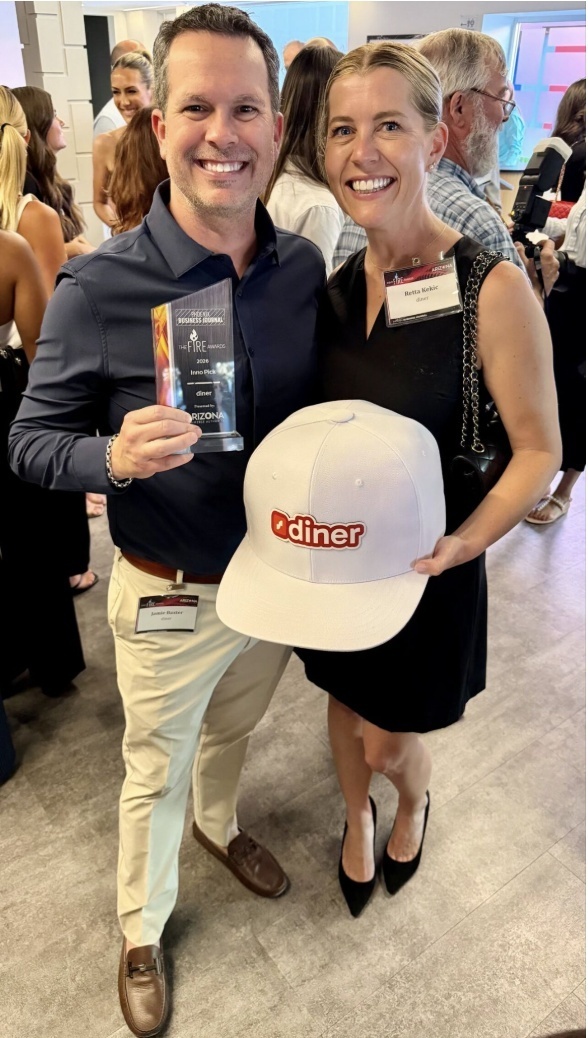
There are familiar colleagues in this chapter, including Retta Kekic and chief product officer Trevor Baker. There is a familiar development instinct, too. Diner’s earliest prototype used Typeform, AI and Google Slides to establish whether guests would participate and restaurants would value what they heard. Custom software followed the test.
By October 2026, diner’s team had grown to 12 from five at the start of the year, with $6 million raised from restaurant-industry investors. The next priorities included faster customer implementation and product expansion. Baxter had returned to the work of turning an early idea into a business that could repeat what worked.
Across these ventures, the continuity is easier to see in the small decisions than the funding announcements. Try the process. Listen to the person using it. Let what happens change the next version. For a founder whose interest in computers began in second grade, there is a certain satisfaction in the fact that so much still starts with paying attention to another human being.