At Lake & Oak BBQ in Atlanta, the brisket took fourteen hours. Finding someone to work could be a less predictable affair. In May 2022, owner Stephanie Williams described posting a job on Gigpro and receiving nineteen interested professionals within fifteen minutes. Outside the restaurant, Sam Mylrea explained a business that was beginning to connect roughly one hundred Atlanta establishments with nearly five thousand people. The contrast was useful: a kitchen could plan the smoking of a brisket down to the hour, yet still struggle to put a person beside it.
Mylrea now leads Qwick, the hospitality workforce business that combined with Gigpro in 2025. His route there passed through investment firms, a social-commerce startup and automotive software. There is a temptation to arrange those occupations into a tidy progression. The more interesting continuity is his attention to what makes people act: sufficient information, an immediate need and a reasonable expectation that the other party will deliver.
In hospitality, those conditions have to come together before the guests do. A promising introduction tomorrow is little help to the dining room tonight.
The investor changes seats
Samuel Mylrea studied accounting and finance at Michigan’s Ross School of Business. His student activities already mixed analysis with organization: he founded SimuMarket, a virtual stock-trading platform used by schools and investment clubs, and led Michigan Interactive Investments and the Michigan Economics Society. The young investor was also building things for other people to use.
His professional investing years included Summit Partners and Oak Hill. He then co-founded dealMobs, connecting local merchants and consumers through social commerce. It was acquired by nCrowd. Finance supplied one vantage point on a business; running one supplied a closer view of its moving parts.
At the end of 2013, PureCars brought him in to help grow and professionalize its operations. The automotive technology company wanted someone who understood finance and growth investing, with operating experience alongside it. He subsequently became CEO. Its problems were specific enough to resist vague answers: dealers had vehicles to sell, budgets to allocate and consumers who researched online before arriving on a forecourt.
Mylrea spoke about turning that browsing activity into decisions. In 2018, he described connecting advertising exposure, vehicle research and eventual purchases. The point was to give a dealer a clearer view of demand while there was still time to adjust inventory and spending. A report becomes more useful when somebody can do something with it before the month ends.
The business grew from $8 million in revenue in 2013 to $180 million in 2019. His tenure included the 2015 sale to Raycom Media and the subsequent 2019 spinout. Those are substantial changes of ownership and scale for one operating chapter. They also placed him inside the unglamorous work of integration, pricing, partnerships and sales processes.
In automotive advertising, he also argued against giving the final click all the credit. Buyers might encounter a dealership across a long sequence of research and advertising before purchasing. Understanding those earlier encounters could change where a dealer spent its next dollar. This was a practical argument about evidence: measuring the easiest moment to see could leave much of the decision unexplained. He wanted the information to influence merchandising, pricing, stock and promotion. That interest in the events around a transaction helps explain the connection to his later work. A completed shift, too, can produce useful information about a relationship that a single application cannot contain.
He was interested in local behavior as well as national reach. Talking about location data in 2018, Mylrea explained that people could spend considerable time researching online while the purchase itself remained local. Service advertising had its own urgency: someone looking for help with a vehicle needed to know who was nearby. Geography and timing could make the same information useful or irrelevant.
Dinner has a deadline
Gigpro brought that sensitivity to another local business. A restaurant, caterer or hotel could post an open shift; available professionals could apply. The transaction was small enough to grasp immediately. A business needed coverage for particular hours. Someone with relevant experience wanted those hours of work. The difficulty lay in making the match reliably, and repeatedly, across an entire city.
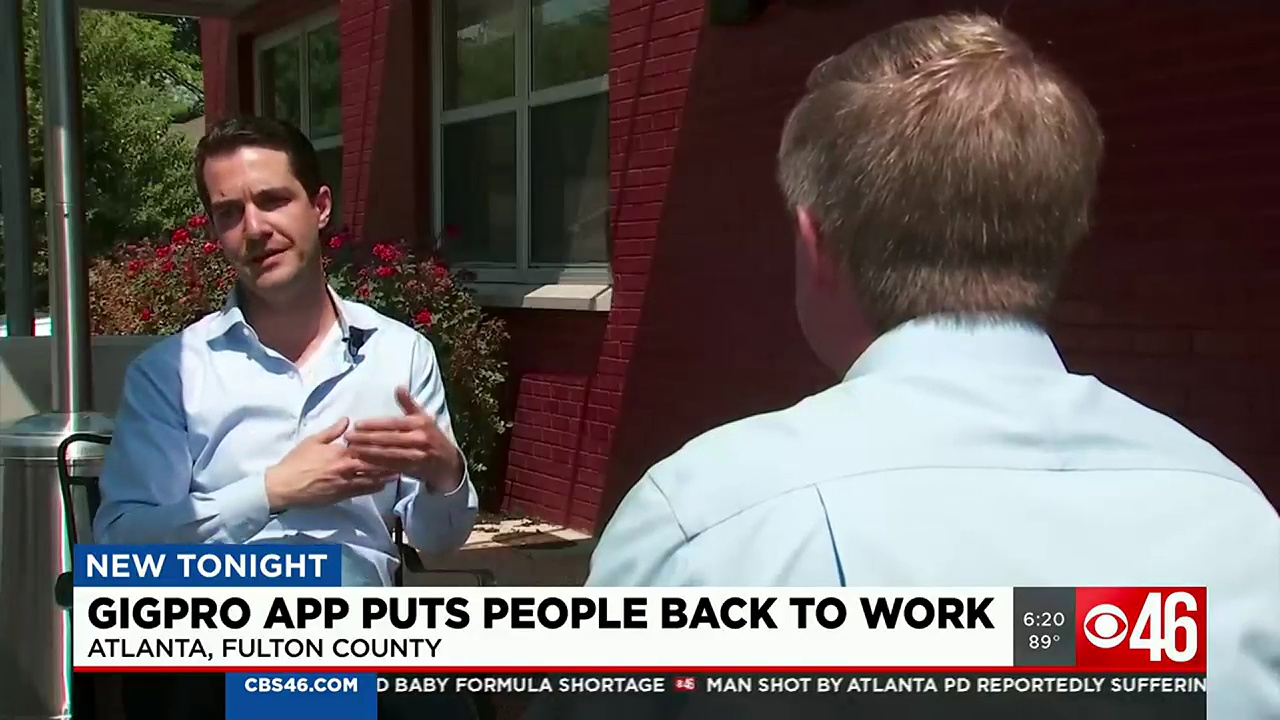
In Atlanta, Mylrea described people using the app for supplemental income. An otherwise free evening could become an event shift. The appeal was concrete: extra money for the ordinary expenses that insist on arriving every month. Williams’s quick response to her posting showed the other side of that arrangement. People were available; the restaurant needed a way to reach them.
Louisville offered another early test. By January 2023, local reporting described nearly three hundred area restaurants and hotels using Gigpro and four thousand positions filled. Common Bond Hospitality’s Mike Wajda said the business had used it for cooks, stewards and bartenders, and was preparing to find housekeeping attendants for a new property. Mylrea’s product was moving through the less photogenic corners of hospitality as well as its dining rooms.
There were limits to the convenience. In discussing on-demand staffing, Mylrea acknowledged that higher hourly offers attracted more interest. An urgent shift still had to be attractive to the person taking it. Software could distribute an offer quickly; it could not make the economic decision disappear. That is a useful restraint on any account of a labor marketplace: the worker has a decision to make, too.
- 01Post the need
- 02Choose the work
- 03Complete the shift
- 04Work together again
When a shift becomes an introduction
By March 2023, Gigpro’s Tampa Bay operation had connected nearly 2,400 users with 72 businesses, covering 3,283 hours of work since its launch there the previous September. Those numbers describe a local network finding its feet. They also suggest why the second booking matters. A familiar professional can arrive knowing something about the room, the menu and the people running it.
Mylrea described repeat relationships between businesses and professionals. Some became permanent employment. At that point, Gigpro did not charge a placement fee for the move. A temporary shift gave both parties a chance to experience the working relationship before committing to more of it. The interview, for once, came with actual work and actual pay.
“we don’t want to stand in the way of any pro progressing in their career”
Sam Mylrea, discussing Gigpro in 2023
That choice gives a useful glimpse of his priorities without requiring a theory about his private character. He was publicly comfortable describing an outcome in which the professional moved into a permanent role. The marketplace had helped produce a relationship that could continue beyond the original arrangement. Its usefulness included that possibility.
Before the cheque, six conversations
The Gigpro financing story contains a different sort of introduction. During the six months before its Series A, Mylrea spoke with six companies already backed by Foundry. He was assessing an investor through people who had lived with its decisions. It was an appropriate exercise for someone whose career included sitting on the capital side of the table.
In his public account, he emphasized integrity, partnership and experience. He valued direct communication and judgment about where a young business should concentrate. The reference calls made an abstract promise of support more testable. A founder can read a great many investment philosophies; asking another founder what happened on a difficult Tuesday is liable to be more illuminating.
Led by Foundry, with Stage 1 Ventures, Stage 2 Capital and Detroit Venture Partners.
The round’s announced purpose was expansion and product development. Foundry described a marketplace operating in twenty-eight cities, giving professionals more choice over shifts and establishments. The investor also highlighted customer service. That detail suited a business serving hospitality: an app that makes introductions still needs people who can help when the introduction goes badly.
Mylrea’s own short description of himself is similarly plain: “I'm passionate about building teams and businesses.” His public posts return to the team, customers and focus. The wording has little interest in personal spectacle. The reference calls offer the more distinctive picture: an experienced investor, now seeking backing himself, doing the quiet work of checking the relationship.
A bigger network, the same evening
On April 7, 2025, Gigpro told customers it was joining forces with Qwick. The announcement promised access to more than forty markets, additional roles and improvements to posting, scheduling and payments. The combined business took the Qwick name. Mylrea leads it as CEO and co-founder, carrying his Gigpro chapter into the larger operation.
Today’s Qwick extends beyond filling a gap in tonight’s schedule. Its offering includes hiring, payroll and compliance, alongside the marketplace. The hiring product uses paid working interviews, with a conversion fee that declines as hours accumulate and reaches zero at three hundred hours. That differs from Gigpro’s earlier no-placement-fee approach. The common idea is that working together can generate evidence useful to both sides.
Qwick’s stated values include humility, decisions informed by data and feedback, and continued product improvement. For Mylrea, the operating challenge now spans a wider set of tasks around the same relationship. Matching someone is one step. Keeping the schedule intelligible, the payment dependable and the next booking straightforward makes the relationship worth repeating.
The scale has changed since the Atlanta interview. The essential test remains easy to picture. A restaurant has a place on the schedule. Somebody nearby has the experience and the time. Mylrea’s business succeeds when they can find each other, agree on the work and finish the evening willing to do it again. The brisket, meanwhile, will take as long as it takes.