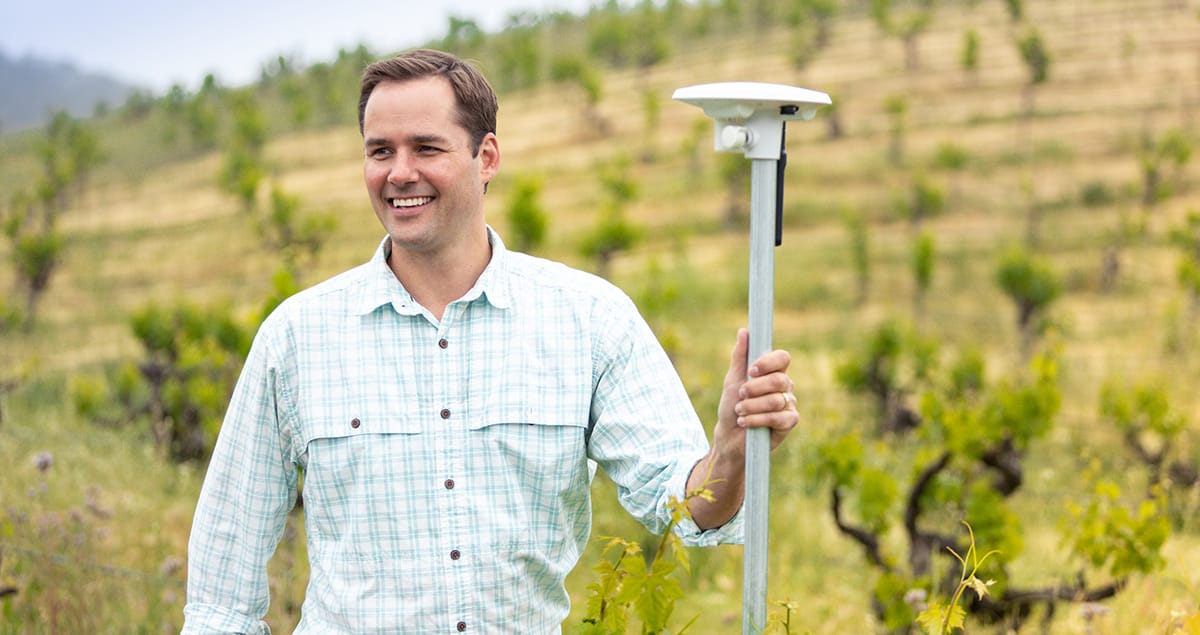
There is a white sensor standing in a vineyard, and James Ethington is holding its pole like a man introducing an unusually competent colleague. The machine is compact, clean, almost comically modest against the scale of the field. It measures the atmosphere above the crop and the conditions around it. Somewhere beyond the frame sit the harder questions: whether to irrigate, how much, and what the decision will cost if the weather refuses to cooperate.
Ethington has spent much of his career closing the distance between a measurement and a useful choice. He is a computer scientist and economist by training, a product operator by experience, and since 2018 the chief executive of Arable, the San Francisco company that blends in-field sensing, agronomic models, and software. His subject is agriculture. His obsession is utility.
That distinction matters. Farms have no shortage of dashboards, forecasts, devices, and logins. What they need is an answer that arrives before the irrigation window closes, grounded in measurements reliable enough to risk a crop on. In Ethington's telling, the problem with agricultural technology is rarely a lack of ambition. It is the failure to make complexity behave.
“Augmenting a farmer's knowledge and experience is key.”James Ethington, on Arable's product philosophy
The education of a product builder
The route to that vineyard began far from one. Ethington attended the Illinois Mathematics and Science Academy, then Duke University, where he earned an A.B. in computer science and economics in 2003. The pairing is revealing: systems on one side, incentives on the other. His early work included web application engineering at STATS LLC, the sports-data company, followed by five years at PricewaterhouseCoopers.
In 2008, he joined a young company called WeatherBill. It had about ten employees and sold weather insurance. The business later turned decisively toward agriculture, became The Climate Corporation, and was acquired by Monsanto in 2013. Ethington stayed for a decade. As vice president of product, he helped build Climate FieldView from concept into a digital agriculture platform deployed on more than 50 million paid acres. During the same stretch, the organization grew from roughly ten people to more than 600.
Scale of that kind is usually summarized with triumphant nouns: growth, reach, transformation. The more useful story lives in the verbs. A product team had to listen, test, integrate, simplify, and repeat. The customer was operating expensive equipment under time pressure while biology, weather, and commodity markets conspired to keep the syllabus lively. A feature that looked elegant in San Francisco still had to work at the edge of a field with an uncertain connection and no patience for theater.
Ethington's later comments suggest that this was his real apprenticeship. He rejects the familiar notion that farmers are inherently slow to adopt technology. When products are genuinely valuable, he argues, agricultural adoption can outrun consumer curves. The sharper criticism belongs on the other side of the transaction: technology companies have often been slow to build great products for farmers.
The prototype with a future buyer
Arable's origin story contains a small premonition. Before founder and scientist Adam Wolf started the company, he presented an early prototype of the Arable Mark at Stanford. A student raised a hand and said a former boss would buy 10,000 of the devices. Four years passed before Wolf learned that the unnamed former boss was Jim Ethington.
The connection eventually became an appointment. Ethington joined Arable as CEO in July 2018. The company was already working across 19 countries, six continents, and 22 crop types. He arrived with experience in turning an agricultural product into a category-scale platform, but he also arrived at a company whose hardware had to stand outside.
His first stated priorities were product iteration, team building, and scaling the route to market. The order is important. Agricultural software can be updated overnight; hardware must be installed, exposed, calibrated, and trusted through a season. The practical unit of progress is the feedback loop: get the product into a field, work with the customer, listen carefully, interpret what is said, change the product, then do it again.
“The path to an excellent product is through iteration,” Ethington has said. It is standard product advice until one considers the venue. A missed tap in an app is annoying. A bad irrigation recommendation can be expensive. Each loop must make the system easier without flattening the particular character of a field.
Making the data cohere
Arable's physical centerpiece, now in its third generation, looks down on the crop and out at the weather while connecting with soil measurements below. The system brings together conditions that are commonly scattered across separate instruments and services: rainfall, temperature, humidity, solar energy, canopy development, crop stress, soil moisture, and applied irrigation. Models turn those observations into estimates and recommendations. Mobile and web software put them within reach.
The technical abundance is almost beside the point. Ethington says the number-one pain point he hears is that customers want somebody to connect the information they need in one place and make it intuitive. The industry's temptation is to sell more visibility. The customer's desire is to spend less time hunting for the answer.
“The number one pain point that I hear across the industry is that customers want someone to connect all the information they need in one place and make it easy and intuitive.”James Ethington
This is where his computer science and economics meet again. Integration reduces technical friction, but it also reduces the cost of attention. A grower should not need to become a systems integrator before breakfast. When weather, soil, plant, and irrigation data share a common view, the scarce resource being conserved is partly water and partly cognitive bandwidth.
Arable raised a $20 million Series B in 2020, then a $40 million Series C in 2022. By that second round, it served customers in more than 40 countries and maintained a calibration and validation network with 30 research institutions across more than 50 sites and 15 climate zones. The apparatus behind a simple recommendation was becoming broad, careful, and decidedly un-simple.
Water becomes the brief
In recent years, Arable's public identity has sharpened around water. The shift is less a pivot than a focus. Agriculture accounts for most freshwater withdrawals globally, while farmers face tighter supplies, volatile weather, and the non-negotiable duty of producing a crop. Water stewardship becomes persuasive when it improves the same operating equation a grower already lives by.
That equation is visible in Nebraska. A project with Google placed Arable's system across 25,000 acres. Farmer Roric Paulman reported a 22 percent reduction in water use across 27 fields, alongside reduced electricity and diesel use. He called it the most revolutionary step he had seen irrigation take. The useful detail is the combination: conservation accompanied by an operational reason to keep conserving.
Water work, translated into outcomes
Selected publicly announced figures. Bars compare scale only within each unit.
The second bar reflects Arable's report that customers have cut irrigation by as much as 50 percent while maintaining yield and quality. The third changes units: 150 million gallons a year. That is the reduction in groundwater withdrawals expected from a Mississippi project announced in 2025 with Amazon and Mississippi State University.
The Mississippi River Valley Alluvial Aquifer supports about seven million acres of farmland and has declined for decades. The project equips farmers with Arable Mark 3 sensors and recommendations based on soil moisture, weather, crop needs, and historical patterns. It complements the university's Master Irrigator program, pairing technology with farmer training. Ethington described the promise in direct terms: data-driven insight delivered to a phone, allowing more precise water decisions.
In 2025, Fast Company placed Arable sixth on its list of innovative agriculture companies, recognizing the company's water-replenishment work. Ethington responded by redirecting attention toward the larger problem and the people around it: the visibility water innovation needed, the farmers testing it, and partners including Google, Bayer, and regional resource managers. The instinct was consistent with his product philosophy. Progress happens in company.
The quiet standard
Agricultural technology tends to arrive dressed in the future tense. Sensors will transform, artificial intelligence will unlock, platforms will revolutionize. Ethington's better moments arrive in the present: visit the field, ask what hurts, connect the information, improve the loop. He speaks about a stable food supply and farmers' livelihoods, but the method remains grounded enough to get mud on it.
His career also offers a useful correction to the founder-only mythology of technology. Ethington did not found WeatherBill, Climate Corporation, or Arable. He is an operator whose work begins after invention, when the promising thing must survive customers, scale, acquisitions, new markets, and its own complexity. The product leader's art is not having every idea. It is arranging the conditions in which the right idea becomes repeatable.
Nearly two decades after joining a tiny weather startup, his subject has narrowed and expanded at once. The sensor stands in a particular field. The phone belongs to a particular farmer. The water beneath them may support a region. A measurement becomes a model; a model becomes a recommendation; repeated decisions become an outcome large enough to count in millions of gallons.
And still the standard is intimate. Did the information arrive in time? Was it clear? Did it earn trust? Did it help? Data, for all its modern glamour, remains hired help. James Ethington's work is to make sure it shows up ready for the field.