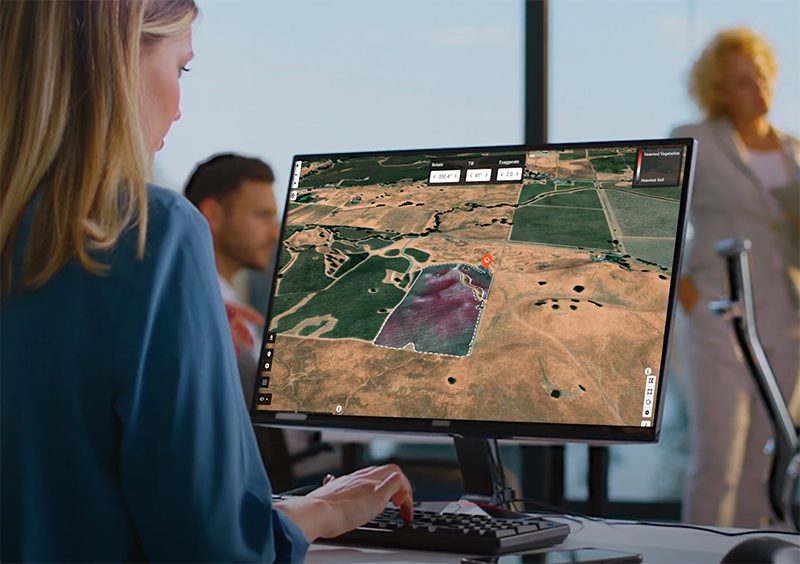
It is dawn over an almond orchard in California's Central Valley, and a small fixed-wing plane is already in the air. It carries no passengers. It carries sensors - cameras tuned to wavelengths the human eye cannot see - and it is taking a picture of every tree, one leaf at a time. Back at a desk in Oakland, that picture becomes a map of where the water is going, which roots are stressed, and which corner of the orchard is about to cost its owner real money. The plane belongs to Ceres AI. So does the map.
01 Who they are now
Ceres AI sells what farms have always wanted and could never quite have: a confident, plant-level answer to the simplest question in agriculture. Is this thing okay. The company, based in Oakland with operations spanning four continents and roughly forty crops, marries custom-built spectral sensors flown low and slow over fields with machine-learning models trained on years of ground truth. The output is decision support, not pretty pictures - although the pictures are, admittedly, very pretty.
In 2024 the company quietly retired the name "Ceres Imaging" and re-emerged as Ceres AI. The shift is not cosmetic. The lens used to be the point. Now the model is.
The difference between Ceres AI and other technologies is the help I get from their expert team.- Jake Samuel, Partner, Samuel Farms
02 The problem they saw
Agriculture is the world's largest consumer of fresh water and one of its largest emitters of greenhouse gases. It is also, somewhat incredibly, one of the least instrumented industries on the planet. Most farms still discover stress the way they always have - by walking the rows, talking to a foreman, or watching yields slip in October when there is nothing left to do but write it down.
Ceres AI was founded in 2014, in the middle of a California drought so brutal that growers were ripping up almond trees for firewood. Satellites were too coarse. Drones were too short-legged. Ground sensors were too sparse. There was a gap in the middle of the sky, and a gap in the middle of the business case, and the team decided to fly into both.
Drought is the dramatic version of the problem. The chronic version - misallocated nitrogen, leaky drip lines, undiagnosed disease - is far more expensive and far less photogenic.
03 The founders' bet
Ashwin Madgavkar, the founder, assembled a team that on paper made no sense: Stanford PhDs in physics, agronomists who could read a tissue sample like a tarot card, and engineers who could solder a sensor to a Cessna without anyone losing a fingertip. The bet was simple. Flying a custom rig on a manned plane at a few hundred feet would beat both satellites and drones on the only metric that matters to a working farm: cost per useful insight.
That bet has aged well. In late 2022 the company brought in Ramsey Masri as CEO. Masri's resume includes the kind of executive-track tour that Series B boards love, but the relevant line is buried lower: twenty years growing grapes commercially. The company has, at multiple points, been run by someone who has actually argued with a banker about irrigation.
These flights can cover way more ground - and it's cheaper to implement.- Patrick Pinkard, Assistant Manager, Terranova Ranch
04 The product, briefly
Ceres AI ships four product lines that all run off the same imagery pipeline, which is the elegant part. Farm Solutions serves the grower directly: water stress maps, plant-level diagnostics, variable-rate prescriptions, a calendar of "go look at this row tomorrow" alerts. Sustainability Solutions packages the same data as scorecards for agribusinesses that have made commitments to investors or regulators they would now like to actually keep. Risk Solutions hands the imagery to crop insurers and reinsurers, who use it for hazard damage assessment and underwriting. Portfolio Insights does the same trick for ag lenders and asset managers, who would prefer to know which of the farms in their portfolio is quietly running out of water before the loan officer finds out from a lawyer.
05 A short company history
From a drought-era idea to a multi-continent data platform - and the rebrand that admitted what the company had quietly become.
06 The proof
The case for Ceres AI is, in the end, the case for measurement. Below is a rough sketch of the company's footprint, drawn from public disclosures and the kind of round numbers that founders quote at conferences.
Eleven billion is the kind of number that loses meaning by the second comma. Translation: if every American counted to that number once a second, they'd be done in about 35 years.
Customers do most of the talking. Samuel Farms uses the imagery to plan crews and irrigation around the bottlenecks the satellite never sees. Fiscalini Cheese Company, the multi-generational dairy in Modesto, runs its forage program against Ceres flyovers. Terranova Ranch in Helm, California, treats the data as an extra agronomist on staff. None of these are unicorn case studies. They are working farms that took a meeting and stayed.
The Ceres AI Quick Card
- Headquarters409 13th Street, Oakland, California
- Founded2014, mid-drought, Bay Area
- CEORamsey Masri (CEO since 2022)
- FounderAshwin Madgavkar
- Capital raised~$100M across Series A through 2025 venture round
- CustomersGrowers, agribusinesses, lenders, insurers, sustainability programs
- GeographyUSA, Australia, South America, expanding
- Why it mattersThe connective tissue between farms, water and capital
07 The mission
Ceres AI's public mission is the kind of sentence you can fit on a slide: protect yields and natural resources. The interesting version is harder to fit. Agriculture is being asked, in the same decade, to feed more people, use less water, emit less carbon, survive worsening weather, and stay solvent. These goals do not pull in the same direction, and nobody in the supply chain has the data to triangulate them.
Ceres AI's quiet ambition is to be the layer of measurement that lets a farmer, a banker, an insurer and a sustainability officer all argue from the same picture. That is less glamorous than autonomous tractors, but it is closer to the actual shape of the problem.
The lens used to be the point. Now the model is.- The rebrand, summarized
08 Why it matters tomorrow
Climate change is, among many other things, an information problem. Heat waves, atmospheric rivers, novel pests and shifting growing zones will keep arriving faster than tradition can absorb them. The farms that survive will be the ones that can see further than the row in front of them - that can underwrite their own water budget, defend their own yield curve, and prove their own sustainability claims to whoever is signing the check.
Ceres AI is, at its heart, a piece of infrastructure for that future. It is not the most photogenic agtech story - no humanoid robot, no glowing greenhouse - but it is one of the more durable ones, because the data flywheel only spins faster as the climate gets weirder. Every flight makes the next prediction better. Every bad season makes the case for measurement louder.
Back to the orchard at dawn. The plane has finished its pass. The grower's phone buzzes with a map he did not have yesterday. He drives to the corner the map flagged, walks twenty feet down the row, and finds a kinked drip line nobody had reported. He fixes it before lunch. The trees, who do not know what Ceres AI is, will live through the summer anyway. That is the whole point.