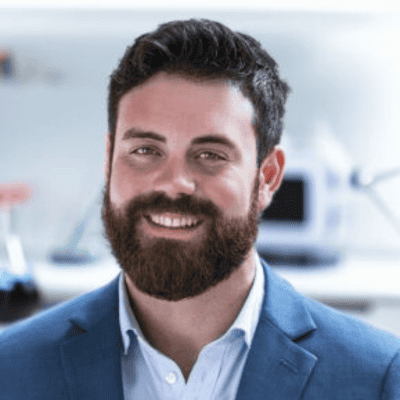
Most medicines are dumb on purpose. You take a pill, it goes everywhere, and you hope it does more good than harm. Jacob Becraft finds this offensive. His company, Strand Therapeutics, is built on a stranger idea: that a drug should carry instructions - genetic circuits that let it sense its surroundings, switch on only inside a tumor, and quiet down everywhere else. He calls it a programming language for mRNA. Regulators call it a first-in-human trial.
Becraft is the co-founder and CEO of Strand, a Boston company he started in 2017 with fellow MIT synthetic biologist Tasuku Kitada. The pitch is deceptively simple and enormous at the same time: programming biology will be as transformative for medicine as software was for technology. The rest of his career is the slow, expensive work of proving that sentence true.
The proof is starting to show up. In 2025, Strand reported the first human data for its lead candidate, STX-001 - a self-replicating mRNA that instructs a tumor to manufacture its own IL-12, effectively conscripting the cancer into its own destruction. Across 22 patients in the United States and Australia, the trial logged a confirmed complete response and multiple partial responses, and the drug was tolerated up to 300 micrograms. In a field where most cancer bets quietly fail, a complete response is the kind of signal that makes investors lean in.
How a programmable mRNA thinks
Programming biology will be as transformative for medicine as software was for technology.
The insulin wound
Becraft did not arrive at cancer by accident. He grew up watching family members struggle to get the care they needed, and the thing that stuck with him was the ordinariness of it. He has talked about being frustrated that "simple things like insulin, which has been around for a hundred years, were not accessible." The Human Genome Project had just been completed. The future was supposedly here. And basic medicine still wasn't reaching people who needed it. That gap between what science could do and what patients actually got became the engine underneath everything.
He went to the University of Illinois at Urbana-Champaign for chemical and biomolecular engineering, graduating magna cum laude, collecting a Barry Goldwater Scholarship along the way. Then to MIT's Synthetic Biology Center for a PhD - and here's the tell about how he thinks. He aimed his doctorate not at making a specific therapy, but at building the tools to make many of them. He wanted, in his words, to "see our technologies being used to bring mRNA therapeutics to as many patients as possible." A platform, not a product. A language, not a sentence.
In low odds games, if you don't go 100 percent all in, the odds will be zero.
One paper became one company
In 2018, Becraft and colleagues published "Small-molecule-based regulation of RNA-delivered circuits in mammalian cells" in Nature Chemical Biology. In plain terms: they showed you could put an on/off switch inside RNA circuits running in mammalian cells and control them with a small molecule. It reads like a lab curiosity. It was actually a foundation. That paper is the bedrock the entire company stands on - the moment the programming metaphor stopped being a metaphor.
The leap from bench to business is where a lot of brilliant scientists stall. Becraft reframed his own job instead. He stopped thinking of himself as a scientist and started describing his role as "a liaison between capital market and capital expenditure" - the translator standing between the people with money and the machines and minds that turn money into medicine. He hired deliberately for what he lacked, recruiting immuno-oncology and manufacturing experts he openly called "better and smarter" than himself.
If some bullshit hype filters into this, it's worth it to take the correct swings at the truly big ideas, because one out of 10 transformations is better than seven out of 10 logical steps forward.
Selling the future before it exists
Raising money for something this early is a confidence trick in the honest sense - you sell conviction before you have proof. Becraft's playbook is blunt about it. Get investors to think "big if true," he says, and then spend the following weeks letting them decide whether they believe it's true, and whether you're the right person to make it true. It worked. Strand pulled together roughly $409 million in total funding, including a $153 million Series B in 2025 - a number made more striking by the fact that the broader biotech market was contracting at the time.
For all the swing-for-the-fences talk, the moments Becraft treasures are small. Not a fundraise, not a headline. He points to "the day I walked into our lab and saw our first hire taking a meeting" - the ordinary sight of a company becoming real without him in the frame. It's a founder who measures himself by whether the thing can run without him, which is exactly the trait you'd want in someone trying to build medical infrastructure meant to outlast any one drug.
Science, capital, and the Capitol
Becraft doesn't stay in the lab. He operates at the seam of science, business, and policy - he has served on MassBio's board, advised the accelerator Nucleate, sat on venture advisory boards, and even advised the Massachusetts State Legislature on science and technology. His view of why that matters is characteristically plain: "No one will learn until they care." If you want programmable medicine to reach people, someone has to do the unglamorous work of explaining it to the people who write the rules and the checks.
What he's actually chasing is longer than any funding round. His near-term goal is mastering tissue-specific mRNA expression - getting a medicine to turn on in one kind of tissue and stay silent in the rest. Further out, he wants to solve immunogenicity and stretch how long mRNA can safely keep expressing, so that a single dose could deliver a precise, long-acting, potentially curative treatment. The destination is programmable mRNA as foundational medical infrastructure - drugs that behave like software, updatable and precise, for problems well beyond cancer.
Our goal at Strand is to cure human beings of human-being diseases, and do so in a safe, effective, scalable way.
It's a big claim from a young company with early data. Becraft would be the first to tell you the odds are long. He'd also tell you that in a long-odds game, hedging guarantees you lose. So he's all in - on the notion that the cell is a computer, the mRNA is the code, and the programmer finally knows the language.