Lunch has a front end and a back end. At the front: someone choosing a sandwich, a cashier taking payment, a screen offering an extra. At the back: a small procession of messages that must reach the right place in the right order. The sandwich gets the applause. The procession gets noticed when something goes wrong.
Israel L'Heureux has worked on both kinds of traffic. Before becoming founder and CEO of Touchpoint Restaurant Solutions, he co-founded Redline Networks, which built technology to improve the delivery of web applications. His career puts data centers and restaurant counters on the same itinerary. The surroundings change considerably. The need to get a request through a system survives the journey.
That connection is an editorial reading of his work, rather than a claim about a private moment of inspiration. There is a particularly useful date behind it. In May 2012, L'Heureux and co-inventor Mark D. Alleman filed a patent application describing the processing of restaurant orders. Two years before his recorded start at Touchpoint, he was already working through the machinery of getting an order from a customer to a kitchen and a delivery agent.
The paperwork offers an unusually concrete way into a founder's story. It begins with the transaction itself, instead of a speech about changing an industry. Someone asks for food. Several people and devices have to agree on what happens next. A lunch order can be wonderfully simple to make and surprisingly complicated to keep.
An education in things that have to work
L'Heureux attended Stanford University from 1989 to 1993, studying Product Design Engineering. His early career included project management at BMW, followed by consulting for the Home Shopping Network and Internet Shopping Network, online strategy at Daimler, and an online management role at Dell. That is a varied apprenticeship in products, commerce and the systems supporting them.
The sequence matters more than a collection of famous employers. A designed object has to make sense to the person using it. An online storefront has to connect that person's intention with an operation behind the screen. Network infrastructure must make the connection dependable. These are useful ways to read the work, without pretending that a job title reveals everything about its holder.
By the time Redline appeared, L'Heureux's work had crossed the boundary between building a product and moving a transaction. A buyer sees the page. An engineer sees the requests, responses and resources needed to deliver it. A business sees the cost of supporting the exchange. The three views can describe the same event while producing three very different meetings.
- 2000Redline founded
- 2005Juniper acquires Redline
- 2012Restaurant-ordering application filed
- 2014Touchpoint role begins
The company inside the connection
Redline Networks was founded in early 2000. Its application front ends operated within corporate data centers, improving the performance and flexibility of web-based environments. L'Heureux served as a founder, founding CEO and chief technology officer. At the time of the acquisition announcement in April 2005, Redline had more than 350 enterprise customers.
Juniper Networks announced an agreement to acquire Redline for approximately $132 million in cash and assumed stock options. The deal closed on May 2, 2005. The number belongs to a company transaction, with a specific financial structure. The achievement for this story is the path from a young networking business to technology that a larger networking company wanted to bring into its own portfolio.
Redline's position was easy to overlook from outside a data center. Its products did their work between a request and a response. Infrastructure has this peculiar social arrangement: the better it behaves, the less attention it receives. A website visitor rarely pauses to congratulate an appliance. There is usually something else to click.
The product continued under a new name. Redline 4.2 became DXOS 5.0 in October 2005, and later DXOS releases appeared in 2006 and 2007. That modest detail gives the acquisition a second ending. Beyond the announcement and its price, there was software to maintain, release and support. A transaction changed the ownership; the engineering calendar kept running.
Enterprise customers at Redline when Juniper announced its acquisition in April 2005.
A web page with less baggage
One of L'Heureux's inventions with Christopher Peiffer makes the work tangible. Their web-resource acceleration patent, granted in December 2004 and assigned to Redline, described removing non-renderable material from a requested resource before sending it to the client. Comments, whitespace and other material that did not contribute to the browser's presentation could be filtered out.
Imagine a parcel whose useful contents stay intact while unnecessary packing comes away. The analogy is imperfect, but it captures the distinction: the reader wants the page; the network must carry the material used to produce it. The invention addressed the material in transit. Its subject was a small technical choice with a practical consequence for the entire exchange.
Another application, published in 2003, concerned a multiplexor and demultiplexor for secure HTTP transactions. It named the same two inventors. Here, the problem involved handling secure requests through a networking device. Taken together, the filings show a working interest in the organization of communication, well before restaurant ordering became part of L'Heureux's public career.
There is no need to turn those documents into personality tests. They tell us what he worked on with other people. That is already revealing enough. A founder can be described through the problems he has helped specify, especially when the specifications are more precise than the usual entrepreneurial adjectives.
Permission before distribution
The next stop concerned digital assets. A patent granted in August 2011 named L'Heureux and Christopher J. Peiffer as inventors of a digital asset distribution system. It described hosting assets with associated permissions, checking whether a requesting user had access, and offering a substitute when authorization was absent. The substitute could include a route to obtaining permission.
The subject shifted from how efficiently something travelled to the conditions under which it could travel. A file can be technically easy to send while still requiring rules about access. The design gave those rules a place in the system itself. Distribution was treated as a managed relationship between publishers, assets and users.
Read alongside the earlier networking work, the filing adds another dimension to the career. Delivery, access and ownership are separate questions. Software has to answer each one somewhere. The distinction becomes especially interesting when L'Heureux's work later reaches businesses whose transactions happen across several customer channels. A successful transfer tells only part of the story.
A founder can be described through the problems he has helped specify.
From this feature
The order leaves the screen
The restaurant-ordering application filed in 2012 made the handoff explicit. A customer could choose a restaurant and menu items on a device. The system would route the food order to restaurant workstations and direct a delivery task to a separate device used by a delivery agent. Kitchen preparation and delivery were coordinated parts of one transaction.
L'Heureux and Alleman's application was published in July 2014; the record lists it as abandoned. It is evidence of a proposed design, rather than a granted restaurant patent or proof that every described feature became a product. The chronology nevertheless establishes restaurant systems as an identifiable subject of his work before the Touchpoint role recorded from June 2014.
The useful change in scenery is the presence of people doing physical work. A web request can be answered by a server. A food order also needs preparation, collection and movement through the world. The system has to communicate with people whose next action is not another line of software. Somewhere, someone must pick up a bag.
That gives the abstract diagram a rather good test. Can each participant tell what to do? The customer, the kitchen and the delivery agent need different information about the same order. A design that respects those differences has a chance of making a complicated sequence feel ordinary. Ordinary is a respectable ambition when lunch is involved.
A counter, several channels, one operator
At Touchpoint, L'Heureux leads a business offering restaurant ordering, operations and customer-data software. Its current OmniFusion platform brings together point of sale, kiosks, online ordering, mobile apps and delivery integrations. It also allows restaurants to retain other providers through APIs. The choice of a complete suite or a connected combination is part of the company's stated proposition.
The company advertises five layers of redundancy and 99.95% uptime. Those are Touchpoint's claims, rather than an independent performance measurement. Its emphasis on reliability provides a clear link with the category of work L'Heureux did at Redline. At a counter, availability is experienced as the ability to take the next order.
Touchpoint also promotes restaurant ownership of transaction and customer data, organized in a private warehouse. Its language makes a useful distinction between processing a purchase and retaining a usable record of the relationship. The order may arrive through an app or at a register; the operator still needs to understand the business those exchanges create.
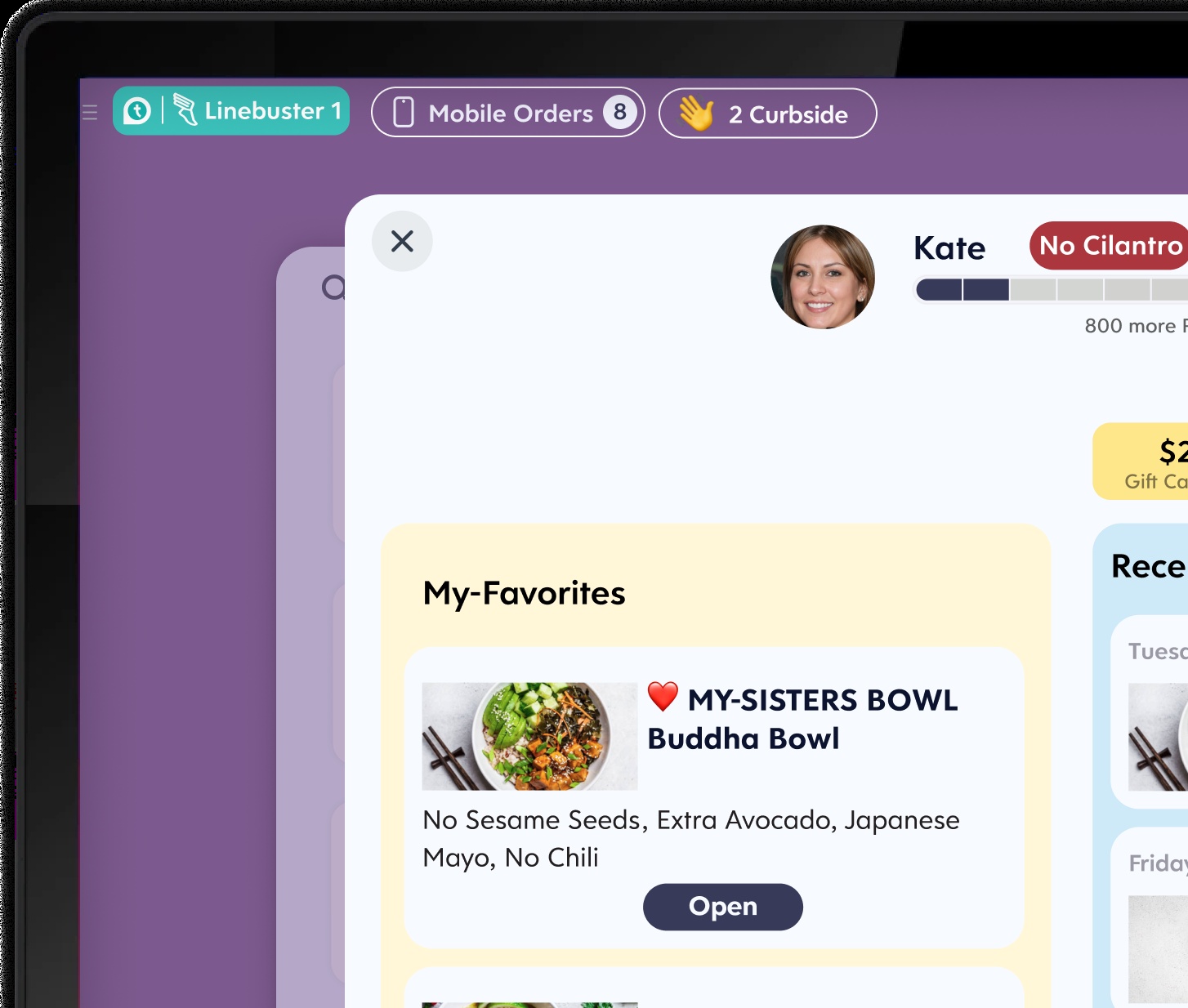
A counter is an unusually candid place to test technology. The customer is present. The worker is present. The next customer is often present too, offering an unsolicited opinion through the act of waiting. An elegant management screen has to earn its elegance in that company.
Across L'Heureux's career, the documented subjects have changed: product design, online commerce, web acceleration, digital distribution and restaurant orders. The continuity is a way of looking at the space between an intention and its fulfillment. That is an interpretation of the record, and the record gives it substance. His inventions keep returning to the handoff.
Touchpoint puts that handoff in view of people who have little reason to care about its architecture. They care whether the order arrives correctly and whether the next visit feels familiar. For a founder whose earlier work lived inside the data center, the restaurant counter is a public examination room. The examiner would like a sandwich.
Follow the connections
Explore the companies and inventions along the way.