Innovation DuPage puts a conspicuous number on its website: 0%. That is the equity stake it takes in the businesses it supports. For an entrepreneur who needs help with pricing, hiring or finding customers, the proposition is refreshingly legible. Get assistance without handing over a slice of the company. The harder question is what makes that bargain possible.
The answer begins with a community college, a suburban civic center and a broad definition of entrepreneurship. Innovation DuPage, usually shortened to ID, is a nonprofit incubator and accelerator serving early companies and established small businesses. Its members include people making games, selling coffee, building software and working in clean energy. A business need not resemble a venture capitalist’s favorite pitch to belong.
As of September 2026, ID’s website reports more than 200 current members, over 400 companies served, more than 200 student interns engaged and over $900,000 in scholarships awarded. Those are measures of activity and access. The ownership figure tells readers something about the organization’s incentives: it can support a useful local business without needing that business to produce an investment exit.
Equity taken by Innovation DuPage
A stated policy. Membership and program costs are separate.A startup address inside the civic center
The institutional roots matter. College of DuPage created ID in 2018; its headquarters opened in May 2019. That distinction explains why both years appear in public accounts. Choose DuPage, Rev3 and the Village of Glen Ellyn helped develop the venture, with academic and business partners joining the effort. This was an organized expansion of regional business support, rather than a lone founder’s garage experiment.
The opening-day account describes 8,200 square feet of renovated civic-center space, plus 1,200 square feet shared with other users, under a 10-year licensing agreement. The college also relocated its Business Development Center there. Entrepreneurs could reach the building from the Metra station and walk to downtown restaurants. A convenient commute is an unglamorous feature. It is also one people actually use.
The businesses gave the place its personality. Gray Matters Games, founded by Joe and Lauren Barron, was among the companies moving in. Before the headquarters opened, the company had already secured a deal placing a word game in 700 Target stores. That chronology is useful: ID was welcoming a business with traction, rather than creating its retail success from scratch.
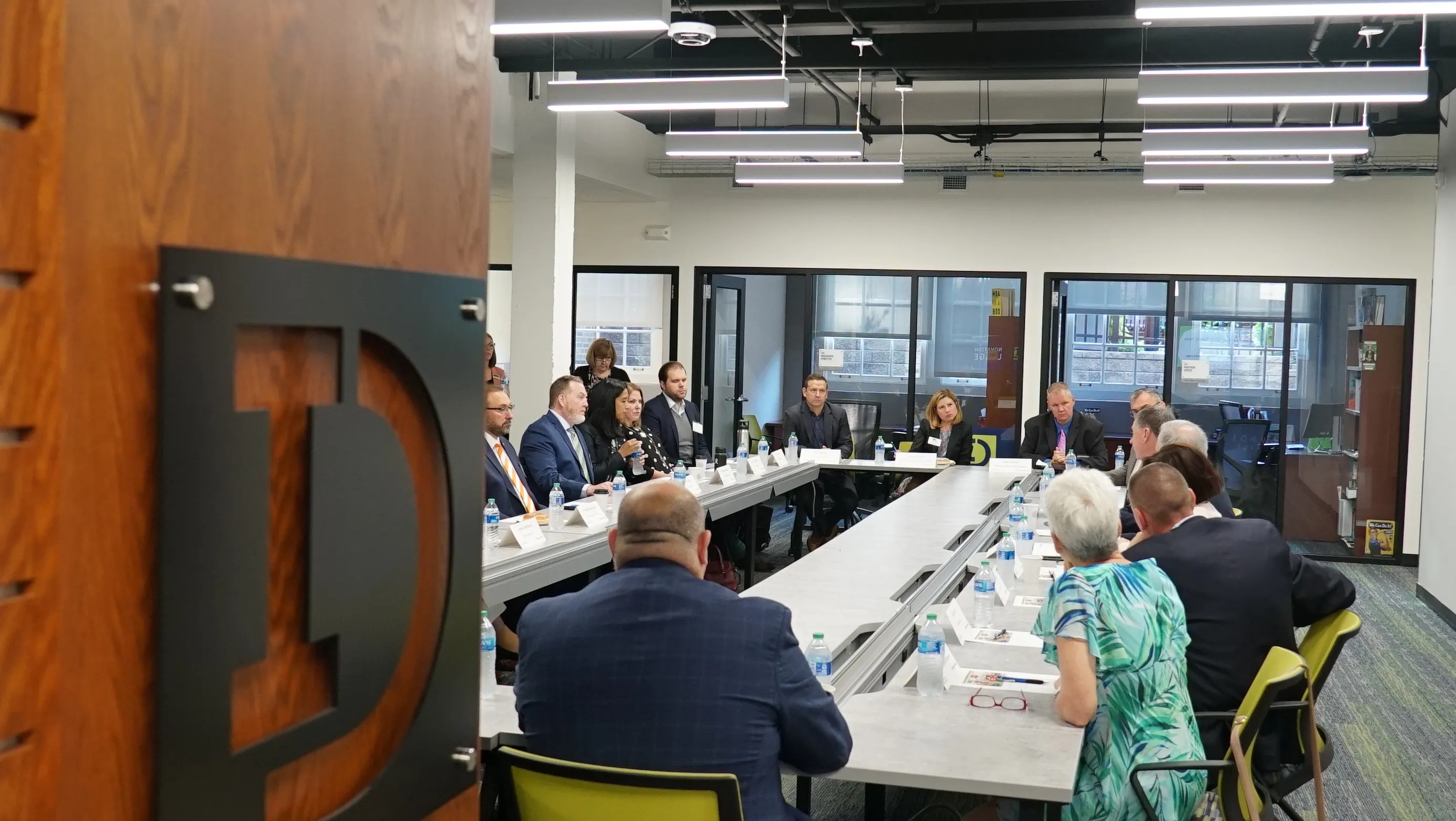
What happens after you walk in
The membership process starts with a conversation. A founder completes a contact form, meets an ID team member and selects a membership level. The three published tiers separate different needs: IDeate includes an initial assessment, business consulting, market-research databases and mentoring; Collaborate adds coworking, technology resources, cohort programs and access to subsidized interns; Scale adds services such as design and video support, reservable rooms and university-linked business analysis.
That menu addresses a familiar small-business problem: the owner is simultaneously the sales department, recruiter and person fixing the website. ID assembles people and tools that would otherwise require separate searches. The useful question for a prospective member is specific: which unfinished job could this membership help complete? A desk has limited value if the actual blockage is an unreliable sales process.
The expertise is distributed across practitioners and institutions. Its partner network includes College of DuPage, Northern Illinois University, local chambers, research institutions and business-service firms. Dan Facchini leads the organization as managing director. The appeal is the ability to find relevant help across several disciplines, without expecting one mentor to be an expert in everything.

“As the first member company of Innovation DuPage, we’ve grown up together.”Joe Barron · Gray Matters Games
The owner has homework
The name Owner 2 CEO identifies the bottleneck plainly: being indispensable to every task can prevent a company from growing. ID’s 10-week accelerator covers delegation, strategy, sales, financial management and other operating decisions. Participants complete assessments, outside assignments and a strategic action plan. The published schedule calls for Tuesday and Thursday evening Zoom sessions.
This particular program is aimed at operating businesses. Its stated eligibility includes at least two years in business, $200,000 in revenue in the most recent fiscal year and two employees, with owners allowed in that count. A person still sketching an idea should look at incubation or introductory programming first. The distinction saves everyone a frustrating mismatch.
The construction version makes the curriculum more concrete, sometimes literally. Developed with the Hispanic American Construction Industry Association, Construction Owner 2 CEO adds bidding, project management, construction finance, legal issues, insurance and bonding. An owner can be good at delivering work and still need help preparing a bid that protects a margin. Specialized instruction connects the general management lesson to the paperwork on the desk.
Zero equity still has a bill
ID’s offer depends on money coming from somewhere other than an eventual sale of its members. Memberships, institutional support, grants and sponsorships sustain the nonprofit model. College of DuPage’s FY2026 funding recommendation sought a $550,000 annual contribution covering space, utilities and operational support, the same level budgeted for FY2025. That is a recurring support figure, not the original cost of opening the building.
Tax-filing data compiled by Cause IQ records $835,893 in organizational revenue and $760,067 in expenses for 2025. These belong to the nonprofit itself. A separate June 2025 college update reported that its 165-plus member companies represented more than $46 million in annual revenue and over 850 full- and part-time jobs. The member totals describe the businesses served; they should not be mistaken for income earned by ID or jobs proven to have been created by it.
For a founder, cost also means time. Twice-weekly classes, assignments and changes to operating habits compete with paying customers. A subsidized program works best when the owner can make room to apply what it teaches. Attending sessions without changing a pricing decision, delegation habit or sales routine leaves much of the value on the table.
A grant is cash. A membership is something else.
ID’s Neurodiverse Entrepreneur Program puts its inclusion ambitions into a tangible package. In its August 11, 2026 announcement, the organization reported more than 650 applications from across the United States and 10 countries. Two companies were selected for the fourth cohort: Fueled By AF, founded by Angelica Ford, and Stimeez, founded by Anthony Elder.
Fueled By AF produces vegan protein bites and nut butters in an adaptive manufacturing facility. The announcement says 90% of its team identifies as having a disability. Stimeez develops sensory-informed character toys intended to help children explore emotions through tactile play. These are product businesses with different customers, united here by an effort to support neurodivergent leadership.
The package includes a $4,000 microgrant from Autism Angels Group, a support model valued at $5,000, Scale membership valued at $2,700 and an opportunity to take Owner 2 CEO, valued in that announcement at $10,000. The distinction matters: only $4,000 is cash. Training and membership have value through use, and the advertised package is not a check for the total.
The broader design lesson is practical. Pair money with support that addresses the recipient’s actual working conditions. The program illustrates that approach; its competitive selection also means it cannot be treated as an automatic funding source for every eligible founder.
When the room stopped being the answer
An incubator built around proximity had an obvious vulnerability when the pandemic disrupted gathering in person. A December 2020 profile of Jim Bell, then responsible for operations and partner engagement, describes ID moving programs onto online platforms. The assumption under strain was that useful participation required everybody to be in the same room.
Bell saw greater accessibility in the change. Online delivery suggested a way to serve companies farther away, including owners who might only visit the center occasionally. It was a shift in how the organization understood its reach. The current accelerator’s Zoom schedule shows that physical membership and remote instruction can coexist.
Other local organizations can copy the sequence: assemble existing expertise, offer a defined program, then test which activities require a building and which travel well online. That approach depends on partners doing real work, reliable coordination and founders willing to participate. A list of impressive institutional logos cannot perform those jobs by itself.
Clean energy, paid interns and the next useful introduction
Clean energy is now a distinct part of ID’s offer. Its Clean Energy Contractor Incubator, supported through Illinois’ Climate and Equitable Jobs Act and the Department of Commerce and Economic Opportunity, advertises no-cost training and individual business support. Benefits include premium membership, mentoring, licensing and certification assistance, and connections to low-cost capital.
The emphasis is on helping small and emerging businesses operate in the clean-energy economy. That can mean understanding business requirements as much as refining a technology. For an eligible contractor, removing the fee and organizing support around the industry’s needs gives the program a different purpose from renting a desk in a general coworking office.
InternPlus tackles another constraint: work that needs doing before a small company can support a larger staff. College students take paid roles in areas such as marketing, design, web development and sales. ID and the member company split the internship cost, while students also attend career-readiness workshops. The arrangement gives entrepreneurs help and students experience inside businesses where their contributions are visible.
That places ID among regional business-support organizations, alongside alternatives such as small-business advising, SCORE mentoring, university incubators and coworking providers. These can overlap with its network rather than compete cleanly against it. ID’s particular combination is an ongoing community, structured acceleration, practical workspace and access to college resources, with no equity stake taken.
The sensible first move for an interested entrepreneur is to bring one concrete problem to the intake conversation: a stalled sales pipeline, a first hire, an unfamiliar bid or a product that needs customer testing. Then ask which program, person and next action fit. Innovation DuPage’s proposition becomes most convincing at that scale - one business, one obstacle and someone useful on the other side of the table.
Make the next introduction
Explore membership and program fit, browse ID’s news and member stories, or listen to DuPage Business Beat with Dan Facchini and Datatelligent founder Larry Blackburn.