The least glamorous object in an aircraft factory may be its most valuable: the record of exactly what happened. Which revision did the technician see? Was the torque wrench calibrated? Who signed the inspection? Which supplier lot went into serial number 417? If a part fails years later, somebody has to reconstruct the answer without relying on a retired engineer's memory or a three-ring binder from 2009.
That is the territory iBASEt has claimed. The Lake Forest, California company makes Solumina, a manufacturing operations platform for complex products that are assembled in low volumes, changed often, regulated heavily and maintained for decades. Its customers include names more commonly seen on aircraft, engines and government contracts: Lockheed Martin, Northrop Grumman, Pratt & Whitney, Rolls-Royce, Airbus Defense & Space, Textron Systems, Saab, Leonardo DRS and NASA.
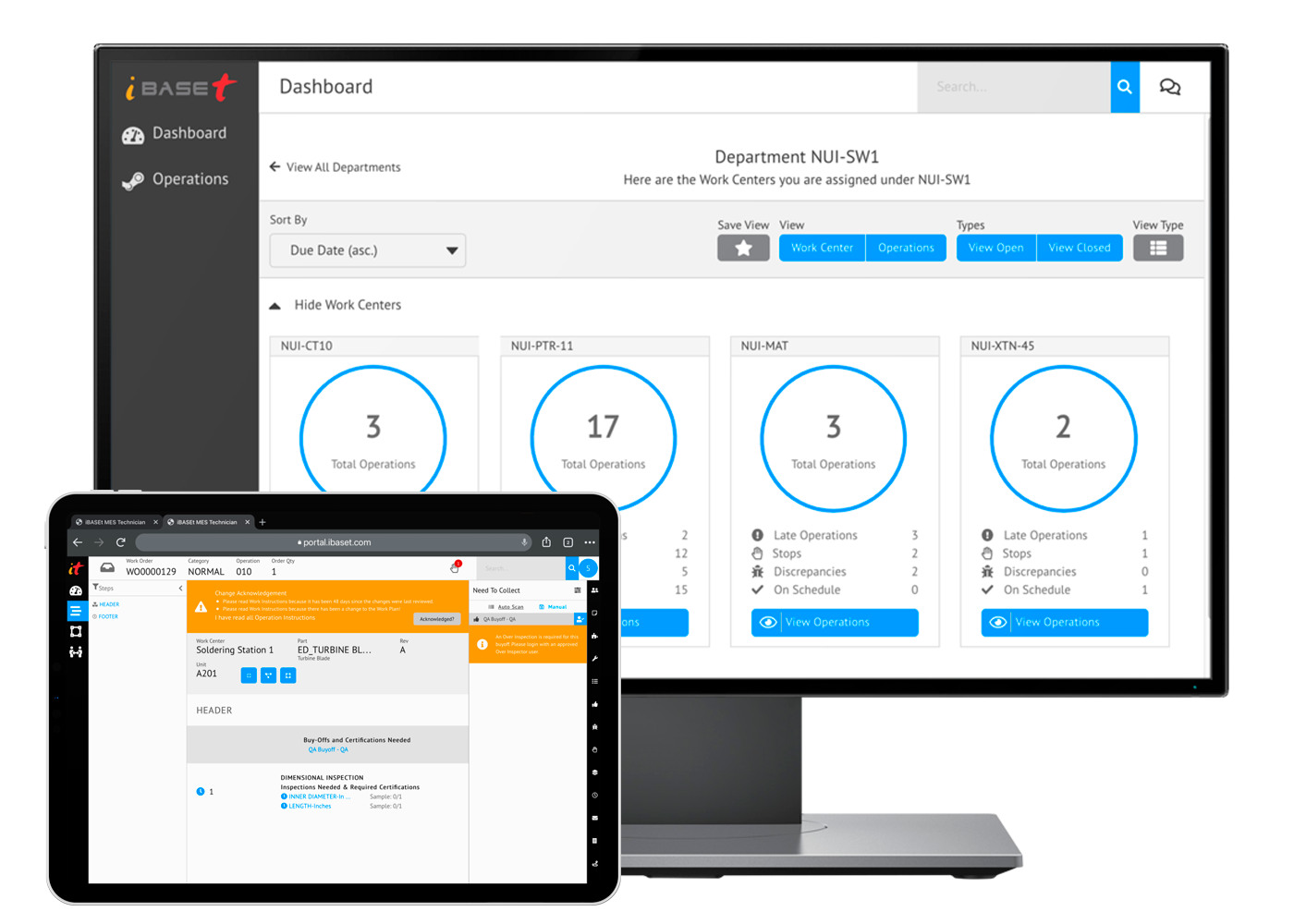
The pitch is less "smart factory" than controlled execution. ERP software plans orders and money. Product lifecycle management software owns the design. Solumina occupies the untidy middle, converting engineering intent into work a person can perform, enforcing the required quality steps, and returning an as-built record. It also follows the asset into maintenance, repair and overhaul. The company calls this continuity a digital thread. In practical terms, it means fewer scavenger hunts.
Paper failed first
Amrik Singh Poonian founded the business in Southern California in 1986, originally as a consultancy called Telecom Solutions Inc. The early enemy was not another software vendor. It was paper, followed by email, spreadsheets and disconnected applications. Those tools work until a product carries thousands of parts, multiple configurations, frequent engineering changes and a supply chain that does not share one clock.
When the system breaks, it rarely announces itself with a theatrical crash. A planner prints an obsolete instruction. An inspector cannot see that the same defect appeared at another site. A supplier correction sits in an inbox. A mechanic discovers that the configuration in front of her differs from the manual. People compensate with meetings and tribal knowledge. Production continues, but every handoff creates interpretation, delay and risk.
“Quality is key. Solumina lets us tightly control the process, validate everything, configure systems properly, and sign off quickly.”Leon Rowson / Airbus Defense and Space
Solumina replaces that patchwork with digital work instructions, data collection, skills checks, electronic approvals, discrepancy handling and product genealogy. Its supplier-quality module brings outside vendors into inspection and corrective-action workflows. Embedded enterprise quality management can stop work when a discrepancy appears. The MRO module manages teardown, inspection, repair and reassembly while retaining the asset's configuration history.
The product is sold as software plus the work required to make it belong in an existing factory. iBASEt offers integration, configuration, training, upgrades, support and operational consulting. That service layer matters because no two aerospace plants arrive with the same stack or maturity. One may be replacing binders; another may already have modern PLM and ERP systems but still reconcile changes by hand. Solumina is designed to enter without becoming the owner of every upstream system. Its job is to preserve the handoff, execute the approved plan and send trustworthy results back.
definition
plan
execution
record
feedback
A narrow market can be a wide moat
The MES market is crowded with industrial incumbents and software specialists: Siemens Opcenter, Dassault Systemes DELMIA Apriso, Rockwell Plex and FactoryTalk, SAP Digital Manufacturing, GE Vernova Proficy, AVEVA, Critical Manufacturing and Tulip. Some arrive from factory controls, some from ERP, some from broad multi-industry platforms. iBASEt's difference is concentration. Aerospace and defense is not a vertical tab on the website; it is the center of the product.
That focus shows up in unromantic vocabulary: effectivities, serialized units, certifications, nonconformances, holds, source inspections and model-based work instructions. Solumina can run in the cloud, on premises, in hybrid setups and in restricted environments. It integrates with the PLM and ERP estates customers already own instead of insisting that one vendor replace everything.
These are company-reported customer-award figures, not a controlled study, but they reveal the scale of the assignment. MES adoption is not a clever app dropped into one work cell. It can involve thousands of workers, validation rules, interfaces, training programs and local process arguments. The software is only half the sale. The other half is getting a factory to agree on how work should happen.
The AI bet begins with the record
In January 2026, iBASEt made four Solumina AI modules generally available. ScanAI converts paper instructions and records into structured inputs. Digital SME answers contextual questions and guides users through the software. Intelligence lets managers query operational performance. PulseAI assembles dashboards around production, workforce readiness, skills and certifications.
The interesting choice is architectural, not conversational. iBASEt says the AI can run with an embedded language model in a customer-controlled cloud or on-premises environment, including restricted and air-gapped settings. Responses are grounded in Solumina's governed manufacturing record. In aerospace, an answer that sounds plausible is a liability. It must be attached to the correct configuration, permissions and evidence.
That makes the previous 40 years look less like legacy and more like preparation. AI needs context. A domain-specific execution system already knows the work order, operation, discrepancy, certification and effectivity. The model does not have to invent a factory from a generic document pile. It can operate inside a system that has been collecting the boring facts all along.
What it costs - and what actually costs more
iBASEt does not publish list prices. Solumina is quote-based enterprise software, so the real bill depends on modules, users, deployment model, integrations, data migration, validation, training and support. Buyers should treat license cost as one row in a larger spreadsheet. The expensive parts are often process redesign, connecting old systems, cleaning master data and winning adoption across plants with their own habits.
The company itself now acknowledges that implementation cannot end at go-live. In August 2026 it formed a Value Realization Organization led by Chelsea Morgan. Client Value Partners are meant to connect the ROI promised during a sale to measured results after deployment. Lean Operations Consultants work on the shop floor to remove waste and translate improvements into standard work. It is a revealing change: the vendor is putting structure around the point where enterprise projects commonly disappoint.
The playbook worth stealing
First, choose a niche where failure is expensive and expertise compounds. iBASEt did not attempt to become generic factory software. It learned the grammar of aerospace work until that grammar became product functionality. A founder can copy the method without copying the market: find the workflows that outsiders dismiss as edge cases, then make those cases native.
Second, digitize the decision trail, not merely the document. A PDF on a tablet is paper with better lighting. The useful system knows whether the instruction applies to this serial number, whether the operator is qualified, whether the tool is calibrated and what should happen when a measurement falls outside tolerance.
Third, stage the rollout. iBASEt's cloud guidance explicitly suggests beginning with a line, department or plant, then expanding after the approach proves itself. Pick a measurable constraint: defect escapes, discrepancy cycle time, rework, training speed or schedule adherence. Establish the baseline before the demo. Keep customization on a short leash. Turn the first win into a reusable template.
Finally, add AI only after the operational record deserves to be trusted. Solumina AI is not compelling because it can produce text. It is compelling if a technician receives a fast answer that respects the exact product configuration and leaves evidence behind. That condition is demanding, which is precisely why a 1986 software company has a credible seat at the 2026 AI table.
The lesson is deliciously unfashionable: before the factory gets an AI brain, it needs a decent memory.
TA Associates placed an undisclosed strategic growth investment in iBASEt in March 2026, backing further product development, AI capability and international expansion. The company followed with Solumina i130, which moved process planning into the web interface and tied more shop-floor actions to 3D models. In August it added former Belcan CEO Lance Kwasniewski to the board. The sequence suggests a company trying to turn deep product fit into a larger global footprint.
Whether it succeeds will depend less on the novelty of its AI and more on the discipline of its deployments. Regulated factories do not need another confident assistant. They need fewer ambiguous handoffs, faster correction loops and a record that survives the people and systems that created it. iBASEt has spent decades assembling that record. Now comes the harder test: making it useful without making it less trustworthy.