The expensive thing in a machine shop is rarely the paper. It is the machine waiting behind the paper. A traveler goes missing. A revised drawing never reaches the operator. A gauge is somewhere in the building, but nobody knows where. The spindle sits still while payroll keeps moving. In the late 1990s, the founders of Pro CNC in Bellingham, Washington, were learning this lesson one interruption at a time.
Kelsey Heikoop, Paul Van Metre and Matthew Carrico had opened the precision shop in 1997. As it grew into aerospace work, the software stack became a drag: a conventional ERP in one place, quality records in another, paper moving between people and hard-won setup knowledge living in somebody's head. The first failure was not one dramatic crash. It was the seams. Every handoff created another chance for the real shop and its official record to disagree.
So they wrote the system they wanted to use. ProShop was web-based and paperless before those qualities became safe brochure language. It connected quotes, work orders, schedules, tooling, inspections, training and maintenance around the unit that actually mattered - the job moving through the building. The company says the internal software helped Pro CNC triple revenue without adding headcount. By 2014, other shops wanted it. The founders sold the machine shop and kept the software.
One shop, one nervous system
Today ProShop sells a subscription platform to small and midsize precision manufacturers, particularly shops serving aerospace, defense, medical, space and energy customers. Calling it an ERP is accurate in the same way that calling a Swiss Army knife a knife is accurate. The suite includes estimating and quoting, purchasing, inventory, work orders, finite-capacity scheduling, time tracking and live job costing. It also includes manufacturing execution, digital work instructions, inspection plans, nonconformance records, calibration, preventive maintenance and employee training.
That combination is the competitive argument. General-purpose systems can be configured for manufacturing. Standalone QMS and MES products can be connected to an ERP. A determined owner can run a surprising business on Excel, QuickBooks, shared drives and a whiteboard. ProShop's wager is that a precision shop pays for those boundaries every day. A quality requirement belongs beside the work order. A setup photograph belongs where the next operator will see it. Labor, material and machine costs should update while the job is alive, not during an archaeological dig after shipment.
This is why ProShop does not let customers cherry-pick the core modules. It prices by the number and type of users - shop, office and executive or administrator - and expects nearly every employee to have a login. Standard and Government versions are custom-quoted. There is no public sticker price. The model asks for a bigger behavioral commitment than a departmental tool because clean handoffs require broad adoption.
It also clarifies where the product fits. ProShop is narrower than NetSuite, Microsoft Dynamics or SAP, but deeper in the peculiar grammar of a high-mix machine shop. Its most direct alternatives include JobBOSS², E2, MIE Trak Pro, Epicor and other manufacturing ERPs. Its less obvious competitor is inertia: the old system plus the spreadsheet that fixes it, plus the paper packet everybody trusts more than the screen.
The bill is private. The waste is visible.
What does it cost? ProShop will only say that pricing is customized. A customer story offers a better way to think about the purchase. Beacon Industries, a 60-person aerospace shop in Dallas, estimated it had been spending $20,000 to $25,000 a year on paper, toner and printing. After a five-month implementation, it reported that those savings alone exceeded the annual ProShop subscription.
Beacon's estimated low-end annual savings on paper and printing. The old ritual was physical: print the traveler, walk it to quality, wait for signoffs, move it to the foreman, then carry it to material handling.
The larger savings came from elapsed time. Beacon said a complex shipping document package that once took four to eight hours could be assembled in about 10 minutes, a reported 96 percent reduction. A customer review that once occupied three days later took one hour. Those figures come from a vendor case study, so they are evidence of what can happen, not a universal forecast. Still, they expose the economic mechanism: less searching, less re-keying and less serial approval.
East Branch Engineering presents the other side of the switch. It had used JobBOSS and then E2. As the business became more demanding, employees spent hours managing certificates outside the ERP; paper travelers went stale; and inspection work fell back to spreadsheets. The owner reviewed dozens of systems. What changed his mind was a detailed ProShop demonstration that mapped to the shop's real problems. He signed within four days.
East Branch installed computer kiosks at work centers, migrated data and trained remotely. Four weeks after signing, it was running work orders in ProShop. Within a year, the company reported an 18 percent revenue increase, setup times cut by more than half, $20,000 less in expediting fees and $12,000 less in shipping costs. On-time delivery for its largest customer moved from 70 to 100 percent.
“We used to be only 70% on-time for our largest customer. Now, we're 100% on time and we're spending less time and money to do it.”Chris Guidotti, East Branch Engineering
Implementation is part of the product
ERP projects usually fail in organizationally boring ways. ProShop names three: the software does not fit the real workflow, the team is not ready to work differently on day one, or the people who matter are absent from the rollout. Its implementation service is designed around those failure points, with configuration, migration, role-based training, practice, a soft launch and post-launch support. Public customer examples range from roughly four weeks for a 16-person shop to five months for a 60-person operation.
The whole-shop loop
What can another operator copy? Start with the handoffs that stop production, not a catalog of desired features. Give the people beside the machine access to the same live record as estimating and quality. Photograph the setup. Put revision control on instructions. Record actual labor and machine time. Then use the last job's facts to quote the next one. The pattern is less “buy an ERP” than “turn recurring improvisation into a shared operating routine.”
The conditions matter. A tiny shop that wants only inventory software, a company that insists on buying modules à la carte, or a team unwilling to replace paper habits may not capture the benefit. Nor is precision machining a synonym for all manufacturing. ProShop's domain depth is the point, but it also sets the boundary. Buyers need to verify integrations, workflow fit, security responsibility and total implementation effort against their own operation.
From recording work to guiding it
After seven years financed by its founders, ProShop took a $32 million growth-equity investment from Mainsail Partners in July 2023. Paul Van Metre later explained the tension plainly: growth was catching up with cash flow. The company wanted capital and operating experience to invest in product, service and hiring while remaining focused on the market it knew.
Leadership changed in 2025. Alison Hawkins, previously chief operating officer and chief financial officer, became CEO. Heikoop moved to chairman, while Van Metre remained chief evangelist and Carrico chief architect. The published culture - “Win Together,” “Lead with Care,” “Embrace the Pace,” and “Say It, Do It” - reads like a scaling company trying to keep the directness of a shop floor while adding professional management.
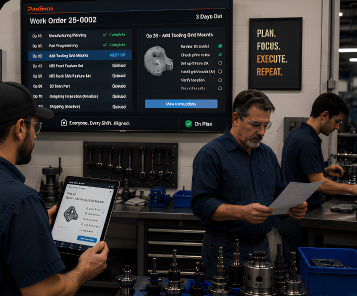
In June 2026, ProShop introduced Chip, an AI layer that marks its most ambitious change in position. The company now calls the product a “system of execution.” A conventional system of record can tell a manager what happened; Chip is supposed to capture what experienced workers know, guide the next operator, surface profitable historical evidence to an estimator and warn about trouble before a job hits the floor. A ProShop-sponsored survey of 144 precision manufacturers found that 52 percent said institutional knowledge begins degrading within a week of a key person's departure. That is the hole Chip is meant to fill.
The defense market adds a second frontier. In July 2026, ProShop announced that its FedCloud environment on AWS GovCloud had been independently assessed by a recognized third-party organization against the FedRAMP Moderate baseline. That matters for shops handling Controlled Unclassified Information. It is equally important to say what it is not: ProShop is not FedRAMP Authorized, and the assessment does not remove a manufacturer's own compliance duties. The company provides a responsibility matrix to show which controls it handles, shares or leaves with the customer.
ProShop's integrations reveal a practical view of the market. Paperless Parts connects quoting; Datanomix supplies machine data; Mastercam handles CAM tooling; HIGH QA, Net-Inspect and GroundControl extend inspection and first-article workflows; QuickBooks and Sage 50 handle accounting. The suite wants to be the operational backbone, not the only software in the building.
The funny thing about ProShop is that its modern pitch - connected data, institutional memory, AI guidance - still rests on a blunt lesson from 1997. Software earns its place in a factory when the spindle waits less. Everything else is a dashboard.