At Valent BioSciences’ Osage plant, the quality-control staff had a peculiar daily occupation: printing. Leucine’s account of the deployment says they spent two hours a day producing records. Here was a manufacturing operation built around careful measurements and fermentation, with skilled people feeding a printer. The machines made the product. The paper made the wait.
- Leucine connects manufacturing records, quality workflows and cleaning validation.
- Its customers include Cipla, Piramal Pharma and Valent BioSciences.
- The useful lesson: fix one painful workflow, standardise the evidence, then expand.
The same study reports batch review and reconciliation falling from 20 days to one after digitisation. It is a vendor-published result, rather than a universal forecast. Still, it poses an excellent question. What if a factory’s next capacity improvement begins with the record of the work, rather than the machinery doing it?
Batch review and reconciliation. Company-published customer result; other deployments will vary.
First, rescue the record
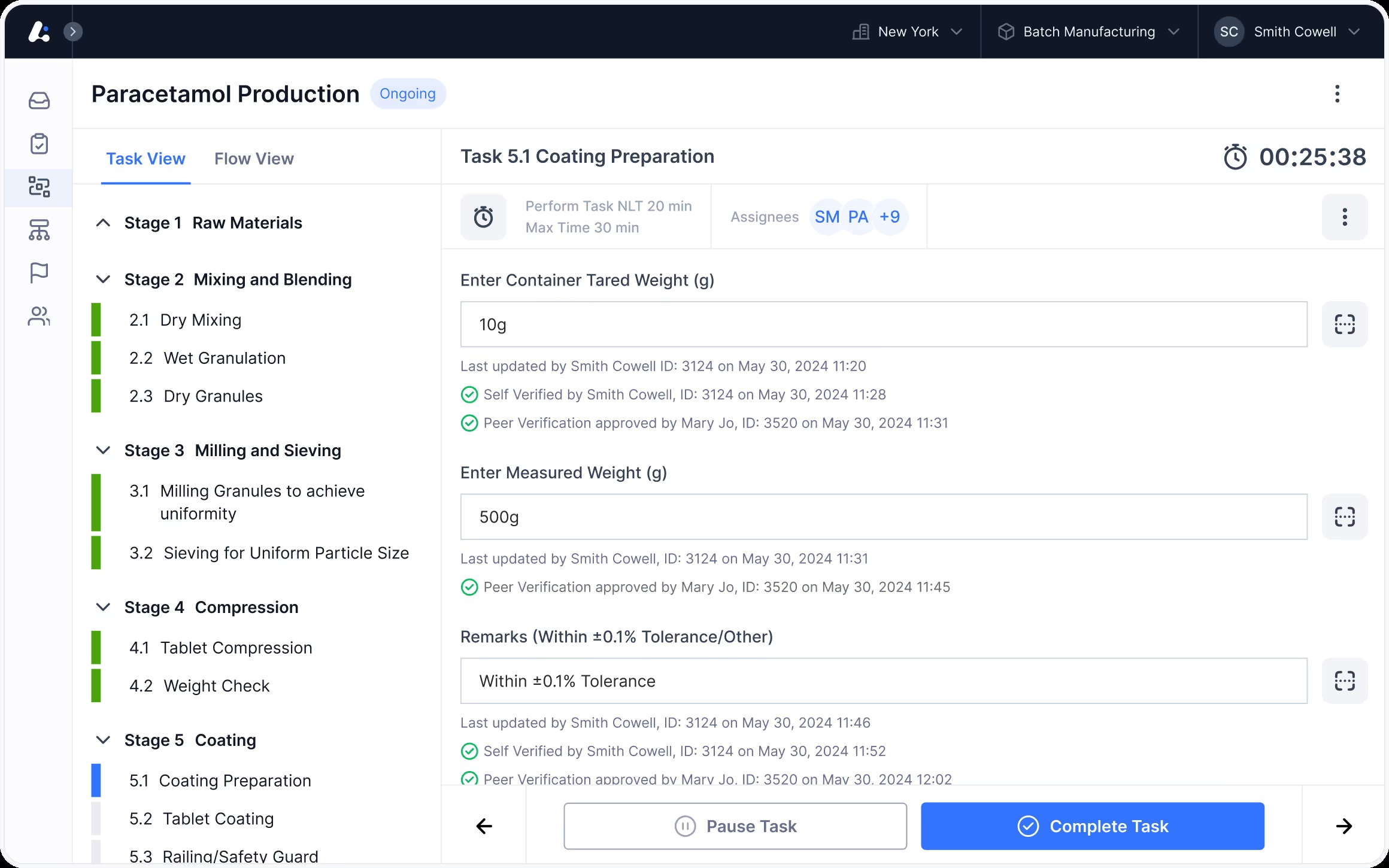
Leucine’s rollout at Valent began in the QC lab, then expanded into electronic batch records. The study describes 52 configured production processes, with 30 initially moved to paperless operation. This is the detail worth copying: start where people already feel the inconvenience. A promise about artificial intelligence can be abstract. A form that no longer needs printing is wonderfully specific.
Leucine was founded in 2019 by Vivek Gera and Mustaq Singh Bijral. It sells software to the teams responsible for making medicines and documenting that work. Its territory includes manufacturing execution, quality assurance, quality control and laboratory operations. The buyer has a practical problem: production must move, and the evidence must move with it.
At its October 2023 funding announcement, Leucine reported deployment across more than 300 facilities at 30 companies in ten countries. Its current website puts the footprint at more than 400 GMP facilities. Those are company-reported figures, measured at different moments. They describe a business already dealing with real factories, rather than merely presenting a model of one.
Thirty sites, one definition of complete
Cipla supplies another kind of evidence. Leucine’s study reports 30 sites, more than three million process records and 84 million data entries. Scale makes the question of consistency unavoidable. If one plant records equipment status differently from another, collecting both records in the same database does not necessarily make them comparable.
The study says 98.4% of data-capture fields across nearly 5,000 published templates are mandatory. Corrections are attributed and logged. The attraction is a change in the character of the form: it can require an answer, preserve its history and make a missing entry visible. Paper has many virtues. Insisting that you fill it in is rarely one of them.
“Manual entry is stopped, there is no data integrity issue, and this has made us more compliant.”Sanjay Mishra, VP Operations, Cipla, in Leucine’s customer study
There is a revealing time detail, too. Configuration began in late 2022; major production sites went live in early 2024. A large deployment has a preparation story. That matters when reading any software promise about a rapid launch: a useful first workflow and a finished manufacturing network are different milestones.
The spreadsheet has neighbours
The products address adjacent pieces of the same problem. MES handles execution on the shop floor. LeucineOS brings together quality applications for documents, training, deviations, corrective actions and other work. CLEEN deals with cleaning validation: exposure limits, residue calculations, protocols and the trail connecting them.
Consider equipment shared between products. The next manufacturing run depends on the cleaning state left by the last. LeucineOS describes connections in which an expired cleaning status blocks a batch start, while a revised procedure triggers training. The point is to make relationships operational. A perfectly filed cleaning record is less useful if the production workflow never checks it.
In his February 2026 customer letter, product chief Mustaq Singh argues that disconnected applications leave AI working on fragments. Leucine’s answer is a shared data architecture linking batches, equipment, cleaning and quality events. This is its stated competitive thesis. It is persuasive as a design principle; buying decisions still need evidence from the buyer’s own workflows.
The person still signs
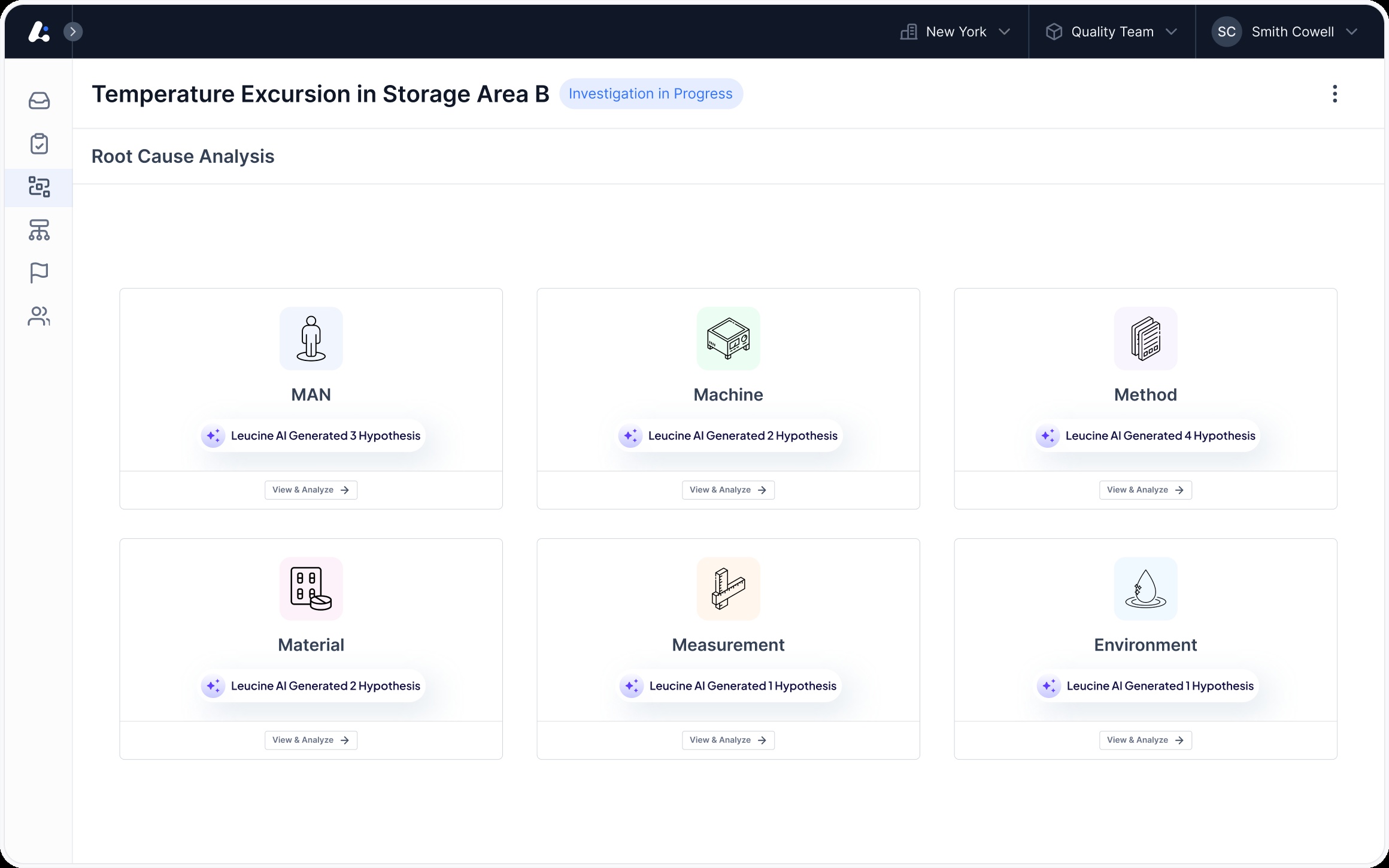
AI assistance enters through tasks such as investigation drafting and exception review. Leucine’s MES page says its Cortex recommendations pass through human approval workflows before being committed. That boundary matters. A suggestion about a manufacturing process needs an accountable decision and a recoverable record of how the decision was reached.
Piramal’s experience supplies the organisational counterpart. Its published study describes harmonising logbook formats before digitising them, then training operators, running paper and digital systems in parallel and cutting over after site validation. What failed first was the usefulness of fragmented evidence. The lesson is almost annoyingly ordinary: agree on the process before asking software to enforce it.
Count the products, read the contract
Leucine is enterprise SaaS. Its current MES subscription is priced by actively manufactured products, with unlimited users and batch executions. Quotes depend on the footprint. Buyers should scope integrations, equipment and rollout work alongside the licence; a subscription unit alone cannot describe the whole project.
The company announced a $7 million Series A led by Ecolab in October 2023. In November 2025, Rx-360 added complimentary FDA Tracker Premium access for consortium members, extending Leucine’s regulatory intelligence reach. Manufacturing software also has established alternatives, including Körber PAS-X and MasterControl. AI and digital records are features competitors discuss too.
The conditions for success are visible in the customer accounts: agreed templates, operator participation, accessible data and quality teams willing to validate a change. Without those, a connected platform inherits disconnected habits. Leucine’s most transferable idea is modest enough to be useful: find the point where evidence stops helping the work, repair it, and let the next improvement earn its place.