The Google Glass prototype was supposed to go back to its owner. Ian Shakil was having difficulty with that part. At a social gathering in 2012, a Google employee had passed around the device, giving him a brief look at a possible business. Shakil had recently finished business school. Within weeks, he and Pelu Tran were starting Augmedix.
It is an appealing opening: an object changes hands, a career changes direction. Yet the object explains only a portion of what followed. Tran was already someone Shakil knew he could work with. His engineering education and time inside an established company had given him experience to draw on. The encounter supplied a trigger for preparations that were already under way.
Today Shakil is chief strategy officer at Commure, which acquired Augmedix in October 2024. Between the prototype and that job lies a less tidy education in customers, colleagues, authority and the difficulty of persuading other people that your idea deserves their Tuesday afternoon.
The customer has several opinions
Shakil’s early working life included a Florida video store and a Whole Foods checkout. At 15, the video-store job required a lottery-ball costume. Later, in Coral Springs, groceries brought him into regular contact with the public. A customer service role, he came to believe, was useful preparation for business because it made you interact with people.
“You’re forced to be extroverted,” he said. There are cheaper ways to study communication than an MBA, although few come with such persistent demands for a price check. His account gives those early jobs a practical place in his education: they required him to deal with people whose priorities were entirely their own.
His family supplied another view of enterprise. His mother ran an interior design business; his father operated a steel mill in Bangladesh. Childhood visits between Florida and Bangladesh meant that the geography of business was personal long before it became part of a company’s operating plan.
A degree, then an apprenticeship
At Duke University, Shakil studied biomedical engineering, graduating in 2006. An internship at PixelOptics in 2005 had already exposed him to electronic eyewear. The later Glass encounter therefore arrived with a useful footnote: he had seen people working on the category before Google put its version in front of him.
After Duke came Edwards Lifesciences. His responsibilities crossed engineering, operations and marketing. That sequence matters because a founder eventually has to make those functions talk to one another. A working product, a dependable operation and an intelligible commercial proposition each impose their own demands. Experience in one does not automatically settle the others.
Shakil has recalled a particular management lesson from this period. Given responsibility for 70 people, many older than himself, he initially underestimated the need to win their support. His manager, Dominique Chapman, gave him feedback. The young engineer’s confidence had encountered an organization full of people with experience, judgment and views of their own.
“I am a technophile and a techno-optimist.”
Ian Shakil
That self-description helps explain his appetite for new devices. His account of learning to manage adds a useful complication. Being excited by a possibility does not relieve anyone of the work of explaining it. A colleague cannot be persuaded by the mere intensity of your enthusiasm.
The collaborator before the company
Shakil entered Stanford’s MBA program in 2010 and graduated in 2012. He also spent a summer at Intuitive Surgical and briefly worked at MC10 after graduation. His route into entrepreneurship included established businesses as well as the university’s opportunities to meet people from different disciplines.
One of those people was Tran. They met through Stanford coursework and discovered they worked well together before settling on the company they would build. It is a small reversal of the usual pitch-deck chronology. The relationship had time to develop before the opportunity demanded a decision.
A cofounder is someone who will be present when the original explanation stops being sufficient. The ability to disagree, divide work and return to the same problem matters. In Shakil and Tran’s case, their shared experience gave the decision to start Augmedix a foundation beyond their interest in the device.
Joins Edwards
Cofounds Augmedix
Joins Commure
When the object leaves the center
Glass offered a distinctive starting point. Google’s own history of the project describes an evolution from consumer exploration toward enterprise uses. Early ambitions for an everyday wearable gave way to more specific workplace applications. The device’s public story and the businesses built around it could take different paths.
Augmedix also evolved. By late 2022, Shakil was explaining that most of its users were using phones rather than Glass. That is a consequential detail in a company so closely associated with a recognizable piece of hardware. The original interface had become one option within a larger service.
For a founder, such a shift tests the attachment to an origin story. The object that makes a company memorable may lose its central position as the business develops. A photograph of a new gadget can explain an opening chapter beautifully. It has limited capacity to explain everything that happens a decade later.
In a 2023 interview, Shakil emphasized transparency, structured data and implementation. The vocabulary had become more concerned with the work surrounding a product. Those are less glamorous words than smart glasses, but they describe the questions that emerge when customers expect software to fit into organizations that already exist.
The founder changes seats
Augmedix’s corporate biographies record another evolution. Shakil served as CEO through October 2018 and became chief strategy officer that month. He was also board chairman from August 2018 to September 2020. Emmanuel Krakaris took the chief executive role in October 2018.
These dates put some necessary texture into the word founder. It describes a relationship to the beginning of a company, while the actual job can change. Shakil remained involved through strategy and board service. Leadership had become a division of responsibilities rather than a single title carrying the entire account.
The eventual Commure transaction developed through a series of conversations. The merger record describes a July 2023 meeting about potential commercial arrangements. Further discussions followed in 2024, including a conversation with Commure CEO Tanay Tandon in April. The first written acquisition proposal came in May.
That chronology gives the acquisition an ordinary business rhythm: meetings, reports to the board, proposals and review. A completed deal compresses all of that into an announcement. The underlying process involves people gradually establishing what they might do together and then putting terms around the possibility.
The acquisition closed on October 2, 2024, following shareholder approval on September 27. Augmedix became a wholly owned subsidiary of Commure. Shareholders were entitled to $2.35 in cash per share, and the company’s stock ceased trading. For Shakil, the next role was chief strategy officer at the acquiring company.
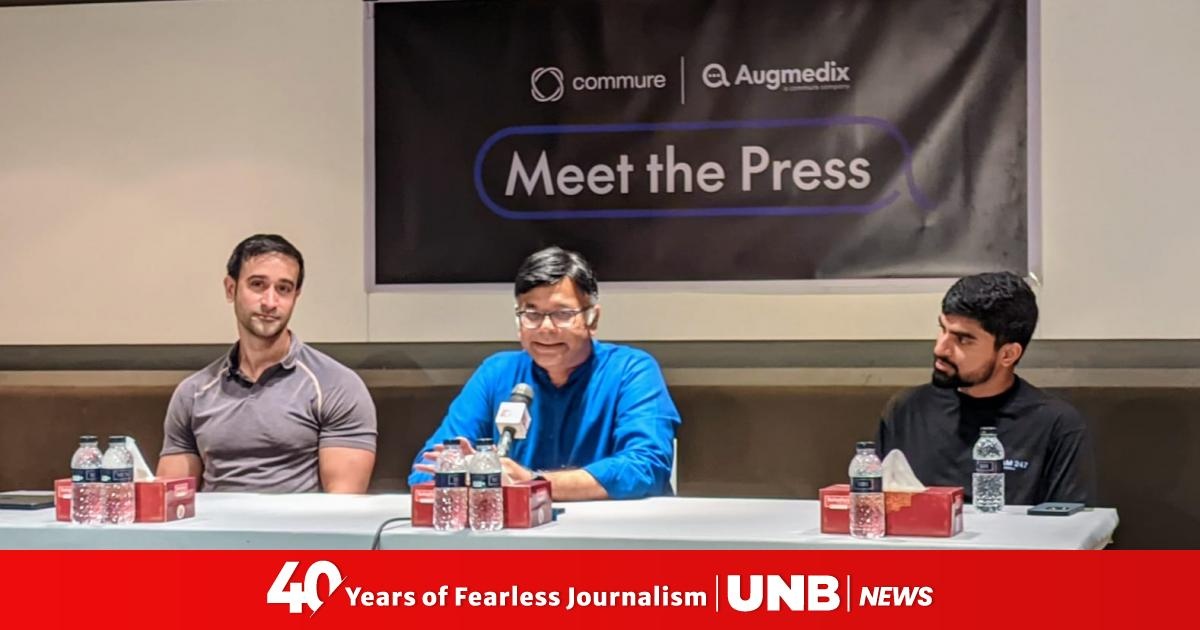
Bangladesh remained in the picture. At a November press event in Dhaka, Shakil appeared alongside Commure’s Hersh Solanki and Augmedix country director Rashed Noman. The setting connected the transaction with an existing part of the company’s operations, and with a country that had been part of his life since childhood.
The photograph from Dhaka is an appropriate interruption to the familiar image of a solitary founder. Three executives share a table; two company names share the backdrop. It records a public explanation of what a transaction means for an organization that stretches across borders. The founder is present, alongside people responsible for other parts of the business.
There is no need to turn every change of role into a revelation. The dates themselves show sustained involvement across different responsibilities. They also make space for the colleagues whose names tend to disappear when a company’s history gets reduced to its founding moment.
After the acquisition, another argument
At Commure’s May 2025 Nexus event, Shakil argued for consolidating fragmented software into platforms. The company published his remarks that July. His concern was the accumulation of separate tools and the friction involved in making them work together. His proposed direction was a broader platform relationship.
There is an interesting change of scale here. The young entrepreneur had acted on a specific device and a specific opportunity. The strategy executive was now discussing how a collection of products should fit together. Starting something and integrating things require different conversations, even when the same person takes part in both.
In March 2026, he appeared in a video interview with Matthew Holt discussing Commure and the division of work among enterprise technology suppliers. The SXSW London 2026 program also listed him for a June session titled “Dhaka to Deep Tech.” Both appearances place his current work in the wider conversation about organizations, technology and where innovation happens.
There is a quieter clue to his interests in an earlier Duke speaker biography: Shakil described himself as an improv nerd, a foodie and a regular Burning Man attendee. Improvisation suits a career that has repeatedly required a response to other people. An idea can begin in your head. Building a company gives everyone else speaking parts.