At four in the morning, Paulo Rosado decided that the future he had been preparing for was somebody else’s. He was at a university workstation, finishing a project alongside four other students. An academic career had seemed the plan. In that late hour, he recalled, the prospect lost its appeal. Stanford had brought him to California; Silicon Valley was offering him a different education.
There is a pleasing inconvenience in beginning the story here. Rosado would spend much of his working life trying to make change less expensive. His own career began with a revision. The Portuguese computer-engineering graduate became a software professional, an entrepreneur and, eventually, the founding chief executive of OutSystems. The subject changed; the habit of questioning the arrangement survived.
Four in the morning
Rosado studied computer engineering at Universidade Nova de Lisboa and earned a master’s in computer science at Stanford. He went on to work at Oracle in Silicon Valley, in research and development and product management. The combination matters: engineering concerns how something works; product management requires asking whether anyone needs it to work that way.
In 1997, he co-founded Intervento, a software business that combined with Altitude Software two years later. He took an executive role in global marketing and strategy. Before OutSystems, then, he had already encountered several versions of the software industry: a large American vendor, a smaller business delivering projects, and a company selling internationally.
These were useful places to acquire an irritation. Software was supposed to make other people’s work more efficient. Producing it could be a spectacularly inefficient occupation. A team could possess the necessary intelligence, the right intentions and a respectable plan, yet still finish late. The customer would have another request. The plan would acquire another appendix. The calendar would quietly surrender.
The invoice for a new idea
When Rosado later described the origins of OutSystems, he returned to the overruns at his earlier business. His team was capable, but projects missed both schedules and budgets. “We’re smart. How is this possible?” was how he remembered their bewilderment. Initially, they blamed the requirements. Then they reconsidered the diagnosis.
Customers were changing their minds because their circumstances were changing. The expense of revising the software was the more persistent problem. A specification could look reasonable when agreed and become inadequate before delivery. Treating every adjustment as a failure of planning made ordinary business change seem like misconduct.
OutSystems, founded in Portugal in 2001, grew from that frustration. Its low-code approach uses visual development and automation to help teams build applications. The proposition put the process of making software under examination. If organizations needed to keep adapting their systems, development tools ought to make that work less punishing.
The distinction has a human consequence. A new request carries a different atmosphere when everyone expects an argument about the budget. Make revision easier and the conversation has room for curiosity. The promise still has to survive real customers and working systems. But it begins with a recognizable wish: let a useful idea arrive without requiring an apology.
“We’re smart. How is this possible?”Paulo Rosado, recalling the project overruns before OutSystems
Seventeen years is a long overnight
The company’s calendar resists the usual startup compression. Founded in 2001, OutSystems reached its unicorn funding milestone in 2018. Seventeen years separate the two events. An origin story can cross that distance in a paragraph. A founder has to live through the intervening Mondays.
One consequential decision came in 2007. Rosado described moving from selling software upfront to providing it as a service, with cloud availability. He identified the immediate fall in revenue as a risk of the transition. The company asking customers to embrace more adaptable technology had to change its own commercial machinery.
Then came the more easily photographed milestones. In June 2018, KKR and Goldman Sachs invested $360 million at a valuation above $1 billion. Their announcement named customers including Toyota, Logitech and Schneider Electric. A development idea that began in Portugal was being sold into the working lives of international businesses.
In February 2021, OutSystems announced another $150 million investment, co-led by Abdiel Capital and Tiger Global, at a $9.5 billion valuation. The company reported customers in 87 countries and more than 1,300 employees. The figures belong to that announcement and that moment. They describe the scale of the business Rosado was leading, rather than a personal fortune.
Rosado has offered a less polished measure of the journey. Accepting Portugal’s innovation personality award in 2024, he described a business that could have died at least four times and had reinvented itself ten. Those were his retrospective counts, rather than an audited taxonomy of close calls. They give the account some welcome rough edges.
A company can keep its name while changing a great deal underneath it. Products, pricing and routes to customers all require decisions. Reinvention sounds agreeable at an awards ceremony. Inside a business, it means asking people to abandon some arrangements that previously made sense. The founder’s job includes explaining why yesterday’s good decision has an expiry date.
The rule of why
Rosado’s account of leadership has an unusually practical starting point: people should understand why they are doing something. He described an OutSystems rule requiring that understanding. Managers had to explain reasons; employees needed enough context to act with greater independence. An instruction could no longer arrive with its job title serving as the entire explanation.
He also named the leaders he admired. Costco co-founder James Sinegal appealed to him for staying close to operational reality. Larry Page represented the ability to organize innovation at scale. Alexandre Soares dos Santos stood for attention to people and integrity. The examples place everyday management beside technological invention.
The rule asks something of both sides. A manager must articulate the purpose. A colleague gains the responsibility of understanding it. That exchange is more demanding than attaching the word autonomy to a presentation. It requires conversations in which a reasonable question can interrupt a convenient answer.
There is an echo here of the early software frustration. In both cases, an arrangement becomes costly when the people inside it cannot respond intelligently to new information. The connection is an interpretation of his public ideas, but a useful one: a company that sells adaptability also needs some capacity to practise it.
A small country, a large map
Portugal supplies more than scenery to Rosado’s story. His education and career took him abroad, while his entrepreneurial work helped build an international software company from a Portuguese beginning. The route involves a recurring decision for founders in smaller markets: where to establish the organization, and where to find enough customers for it.
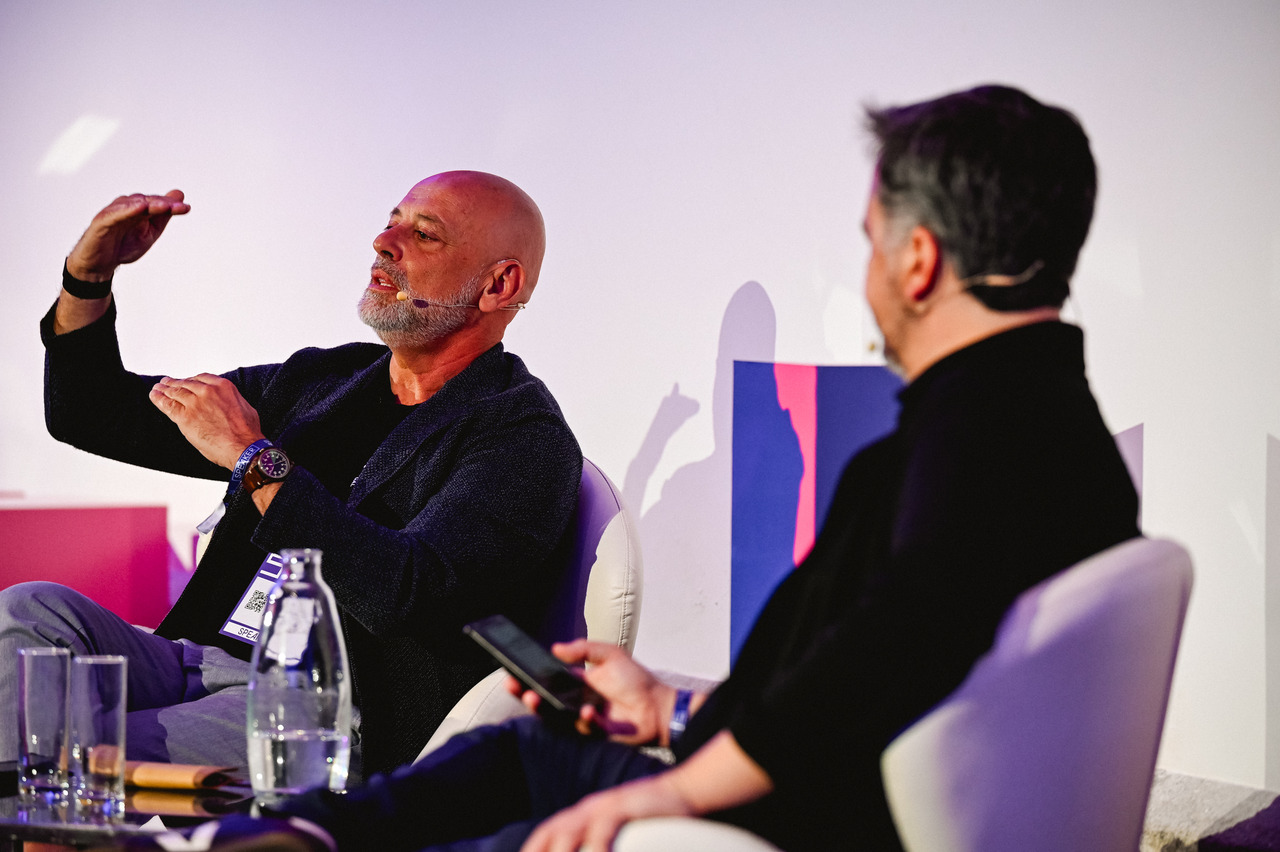
At SIM Conference in Porto in May 2026, Rosado argued that European structures, including constraints around financing and regulation, made company growth harder. He paired the criticism with an advantage he saw in Portugal’s limited domestic market: an ambitious founder has to think globally from the start. A small customer pool makes the geography difficult to ignore.
His point has a certain unsentimental appeal. A business can love its home without expecting the home market to be sufficient. International ambition then becomes a working requirement. It influences which customers to pursue, how teams communicate and what a product must accommodate. The map enters the organization before it decorates the office wall.
Twenty-four years, then a handover
On May 20, 2025, OutSystems announced Woodson Martin as its new CEO. Rosado remained chairman of the board and strategic advisor. The announcement also reported that company revenue had passed €500 million, with more than 2,000 global customers and over 500 partners. After 24 years, the founder’s relationship with the business acquired a different job description.
His message to the developer community opened simply: “Change has always been part of our story.” He thanked the people who had built on the platform and welcomed Martin, a former Salesforce executive. He discussed a move toward AI-driven agents alongside applications. The language of the industry was changing again; the community still had things to build.
Earlier that year, in conversation with Tanuja Randery on the AWS Executive Insights podcast, Rosado had returned to reducing the cost of software changes. The discussion covered AI’s effect on development timelines and maintaining a startup mindset while growing globally. New tools were entering an argument he had been making for years.
The handover gives the story a useful pause rather than a tidy ending. Rosado’s public role now involves board leadership and strategic advice. The software business keeps presenting fresh versions of its old difficulty: circumstances move faster than the systems designed to contain them.
At Stanford, he changed his plan. At Intervento, he questioned the explanation for missed deadlines. At OutSystems, he spent more than two decades building around the consequences. A career can look remarkably consistent when viewed through the right question. For Rosado, that question remains disarmingly ordinary: what happens when somebody needs to change their mind?
Keep the conversation going
Interviews, writing and places to follow.
- OutSystems - company website · Company profile
- Paulo Rosado on LinkedIn · X · Personal site / writing
- Watch: Drag & Drop, episode 100 with Paulo Rosado
- Listen: Decreasing the Cost of Change
- Read: Tackling Technical Debt: Founding OutSystems
- Read: Rosado’s message to the developer community
- Read: His 2026 SIM Conference comments (Portuguese)