Samar Birwadker had the sort of problem that a résumé cannot explain. He had worked at an organization he considered good, yet the experience did not suit him. “It was a great organization, but it wasn’t for me,” he told Fast Company in 2013. The distinction became the premise of Good&Co: perhaps choosing a workplace required knowing more than its reputation.
- Free personality quizzes helped individuals explore strengths and workplace compatibility.
- Employer tools turned those insights into candidate comparisons and team analysis.
- StepStone bought Good&Co in January 2016.
- A documented signup redesign shows why enterprise products must earn trust before asking for commitment.
A good job in the wrong place
Think of a job interview as a carefully arranged introduction. The employer presents a polished account of itself. The applicant supplies a polished account of experience. Both parties can emerge impressed without learning much about the working relationship they are about to enter. Who gets to decide? How much ambiguity is tolerable? Does disagreement count as initiative or insubordination?
These are questions about daily life. A famous company can contain a team whose habits make you miserable. A less fashionable employer might give you precisely the structure you need. Good&Co’s proposition was that personality and environment belonged in the same conversation as qualifications. Its ambition was to make that conversation easier to begin, and less dependent on the interviewer’s hunch.
Founded in 2012, the company paired Birwadker’s consumer instincts with founding CTO Subbu Balakrishnan and psychometrician Kerry Schofield. It joined Techstars Cloud in January 2013 and launched that April. In an early interview with YPulse, it described an initial audience of recent graduates pursuing design, marketing, advertising, and technology careers. These were people choosing both an occupation and a setting in which to attempt it.

A quiz with a business behind it
The consumer product made the subject approachable. Instead of leaving users alone with technical trait names, it presented illustrated professional archetypes. The early interface offered figures such as the Dreamer, the Maverick, and the Rock. A personality report had acquired the social manners of a shareable quiz. There was pleasure in the label, and a practical question underneath: what kind of work brings out your strengths?
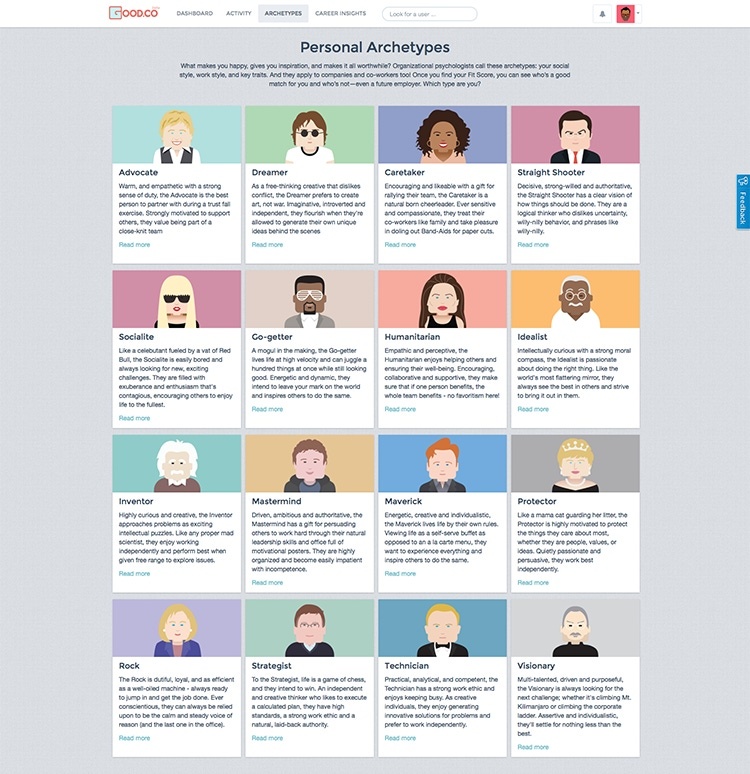
Users could explore their own tendencies and compare compatibility with colleagues or companies. Employers faced a related problem from the other direction: how might a candidate work within a particular group? Good&Co occupied the space between career discovery and employment assessment, combining consumer participation with tools for people who hired and managed teams.
Its commercial logic followed that division. The consumer app was free. Employer software supplied the business side, including paid features. Good&Co’s model depended on making self-discovery attractive to individuals while making the resulting insights useful to managers. A curious consumer and a recruiter with a vacancy might use the same underlying assessment, but they needed different experiences.
StepStone’s acquisition made that proposition interesting at job-board scale. Catapult Advisors, Good&Co’s transaction adviser, dates the all-cash deal to January 22, 2016. It describes a competitive process involving both potential buyers and venture investors, and says the public announcement waited several months while Good&Co worked on its next mobile version. The adviser’s interpretation was explicit: StepStone was moving toward personality-based job matching.
There was also a distribution opportunity. A recruiting business already had relationships with employers and applicants. In May 2018, StepStone introduced Good&Co in the UK. Its COO described interest among hospitality businesses reached through Caterer.com. Interest is a modest claim; it still shows why compatibility appealed in a sector where people spend much of the working day dealing with other people.
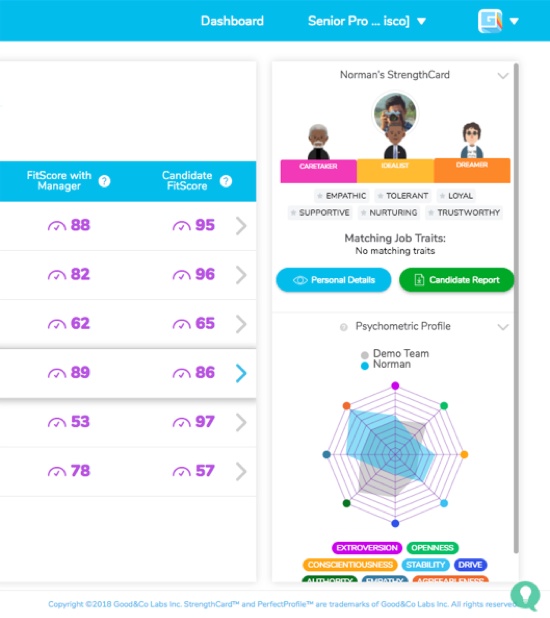
Teamwork Pro launched in August 2018. Good&Co said it had drawn on data from more than 2.5 million consumer users. Its assessment used the Big Five personality traits alongside authority, drive, and empathy. The employer product offered team analysis and weekly engagement surveys. Those were the company’s stated capabilities; improved retention or hiring performance would require separate evidence.
The expensive request at the front door
The software’s own introduction to customers provides a particularly useful piece of the story. In a public case study, product designer Jemma Pearce described a Teamwork Pro trial flow that asked for payment before users saw the product. She reported 97.2% drop-off at the first step. Inviting colleagues also demanded trust the product had yet to earn.
First-step drop-off in a flow asking for payment upfront.
Her team reduced five signup screens to one and tested two alternatives. The preferred version required less data entry and brought people into the product sooner. Read this as a lesson about sequence: a request that might be reasonable after a demonstration can feel unreasonable before one. The redesign is documented; a later conversion rate is not.
A separate job-opening project found another pile-up of requests. Creating an opening involved 15 clicks through modal windows. The original brief was to add a feature. Pearce argued for simplifying the whole journey instead. The resulting single-page layout reduced it to 10 clicks, marked optional steps, and renamed “Ideal Profile” as “Ready-Made Profile” to distinguish it from the paid custom “PerfectProfile.”
That is a practical change of mind worth copying. When a feature request arrives, look at the task it joins. The user experiences the accumulated burden, not the elegance of the newest addition. Even a label can impose work: two names that sound nearly identical force a buyer to investigate a distinction the interface should have made obvious.
A hiring tool needs a reason to return
The team also encountered a quieter commercial difficulty. Managers tended to use Teamwork Pro when hiring, according to Pearce’s engagement case study. Hiring can be sporadic. The product therefore needed a reason for managers to return between vacancies. Working with sales and customer support, the team developed weekly, six-question engagement surveys focused on individual teams.
Research with four managers prioritized an overall score, changes from the baseline, weaker areas, and recommendations. That is an instructive order. A manager first wants to know whether there is a problem, then whether it is getting worse, then what to do. A dashboard can contain plenty of information and still fail to answer those questions in a useful sequence.
The first version arrived under a tight parent-company deadline. Later refinements addressed a word-heavy setup screen and uncertainty about when results would appear. Prototype testing with five people prompted clearer grouping and plainer language. Scheduling controls remained constrained by engineering capacity. Good&Co’s experience shows how easily a promising recurring feature can create a new explanation problem.
A customer’s first experience is part of the product’s argument.
The lesson from the documented redesigns
Fit should open a conversation
For a job seeker, the useful idea was to articulate preferences before accepting an offer. For a manager, it was to consider how people worked together rather than relying entirely on a persuasive interview. The approach becomes less useful when a compatibility score closes discussion. A team can need someone who challenges its habits, and similarity alone is a thin definition of contribution.
There are straightforward ways to borrow the thinking. Ask candidates about the environments in which they do their best work. Describe the actual team’s decision-making habits. Give buyers a useful glimpse before requesting payment or access to colleagues. If your product serves an occasional task, investigate a recurring need through customer conversations before adding another dashboard.
This is a historical company profile. Public directories now list Good&Co as closed, and its former good.co domain serves a logistics business as of October 2026. The enduring interest lies in the attempt: a company set out to explain the relationships inside a workplace, then discovered how much depended on the relationship at its own front door.
Follow the historical company profiles on LinkedIn, Twitter/X, and Facebook. The former website domain now serves a different business.
Read the trial redesign, job-opening redesign, and engagement design case study; explore the Teamwork Pro launch, acquisition account, early founder interview, and UK launch coverage.
Watch Good&Co’s development partnership interview or visit its historical YouTube channel.