Company HR Tech · AI Screening
The Company That Reads the Internet So HR Doesn't Have To
Fama built AI that scans 10,000-plus public sources to catch the red flags a resume hides - then convinced the background-check giants to run on its engine.
In 2015, a manager named Ben Mones made a hire that went badly. The details were the ordinary kind of bad - a person whose conduct at work turned out to be a problem - but the part that stuck with him was different. When he went looking afterward, the warning signs were sitting in plain sight, on public profiles anyone could have read before the offer letter went out. Nobody had looked, because looking well is slow, inconsistent, and legally fraught. Fama Technologies is the company he built so that looking would stop being any of those things.
He is not shy about the incident's role in the origin story, and it gives the company an unusually specific mission: help organizations protect their workplace culture and prevent harassment by surfacing behavior that a resume and an interview will never reveal. The premise is that the most consequential thing about a hire is sometimes the thing they broadcast publicly and no one bothered to read.
A decade later, the Los Angeles firm is not a household name, and that is partly the point. Fama sells online screening - software that reads the public internet about a job candidate or a current employee and flags workplace-relevant behavior like harassment, threats, and hate speech. Most people who have been screened by Fama will never know the company exists, because it often runs as the engine inside the background-check brands they do recognize. It has delivered more than 45 million reports, and in 2023 it bought the oldest competitor in its category to become the largest online screening provider on the market.
What it actually doesReading the internet, on purpose and on the record
The core product, Fama 360, does something conceptually simple and operationally hard. Given a candidate's identity, it searches more than 10,000 public online sources - social platforms, forums, news, video - and uses natural-language processing and image recognition to surface content that maps to workplace risk. The output is not a personality read or a credit-style score. It is a sorted list of specific behaviors: references to violence, harassment, intolerance, illegal activity, and a handful of other categories, each tied back to the post it came from.
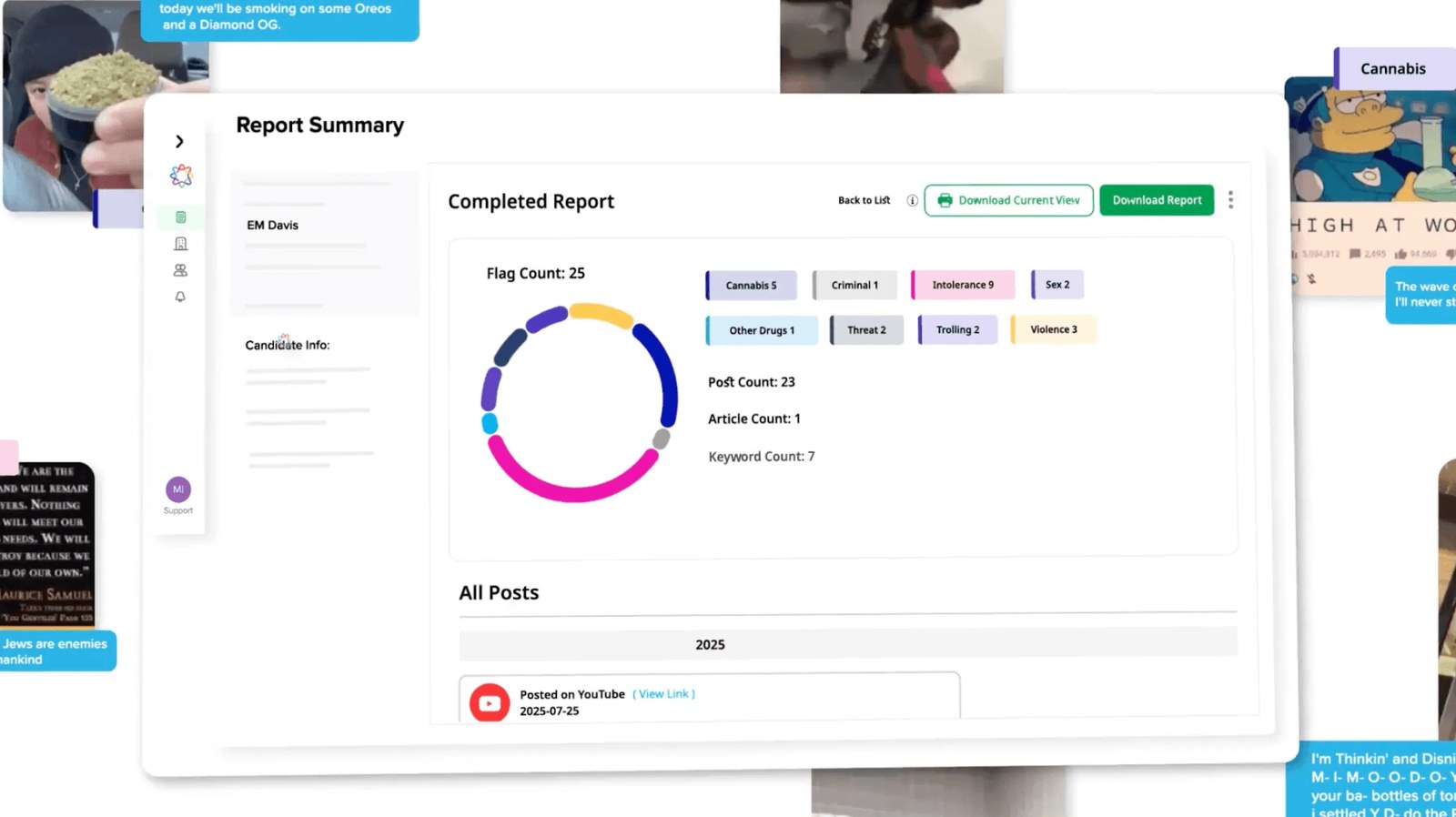
The finished report reads less like a dossier and more like a dashboard. A donut chart tallies the flag count and breaks it into labeled slices - Cannabis, Criminal, Intolerance, Sex, Threat, Trolling, Violence - and every flag links to the underlying post so a human reviewer can judge tone and context. That last step matters more than the AI. Fama keeps analysts in the loop to confirm or override machine flags, because sarcasm, quotation, and reclaimed language are exactly where automated moderation tends to fail.
The redaction trick
Screening someone's social media is legally dangerous for one obvious reason: the internet reveals things employers are not allowed to consider. Race, religion, disability, pregnancy, age - all of it can surface in a public feed, and once a hiring manager has seen it, the company is exposed. Mones has been blunt about the trap. "If you're a hiring manager and you see that a person is pregnant or disabled when you're running that check, you've seen something you're not supposed to see," he has said.
Fama's answer is to redact protected-class information before a human ever sees the results, and to run every candidate through the same standardized search so the process is consistent rather than ad hoc. Combined with FCRA limits - compliant checks look only at the past seven years - the redaction step is the entire compliance argument. It is also the reason the company describes itself in terms of "behavior-first AI": the model is built to classify what someone did, not to infer who they are.
Search
Scan 10,000+ public sources across text, image, and video in 30+ languages.
Redact
Strip protected-class signals - race, religion, disability, pregnancy - from results.
Classify
AI sorts remaining content into workplace-risk categories with a flag count.
Review
Human analysts confirm tone and context, overriding false positives before delivery.
Scale you don't see
The reach is bigger than the customer count suggests, because a large share of Fama's volume flows through channel partners. The company's screening runs inside major background-check providers - Sterling, HireRight, First Advantage - and connects into 80-plus HR and applicant-tracking systems like Workday, ADP, Greenhouse, and iCIMS. When a Fortune 500 employer orders a background check, there is a good chance Fama is quietly doing the online portion without its name on the invoice.
The customer list skews toward organizations with a lot to lose from a public misstep - enterprises, staffing firms, and brands where a single employee's conduct can become a reputational event. The Miami Dolphins have used Fama, a reminder that the buyers here are as often protecting a name as filling a role. That framing shapes the pitch: Fama does not sell hiring speed, it sells the avoided lawsuit and the harasser who never made the roster. It is a stickier budget line than efficiency, and a harder one to cut.
Where the flags land
Illustrative category mix from a single Fama screening report - the shape of a real result.
The company also publishes what it sees in aggregate, and the trend line points up. In 2025 Fama reported that about 6.45% of screenings - roughly 1 in 15 - contained at least one misconduct signal, a 34% jump year over year. Whether that says more about candidates or about the internet is an open question, but for an employer weighing risk, the direction is the headline.
Money and marketA quietly consolidated category
Fama raised its first seed capital at the end of 2015 and filed the patent that would become the backbone of its defensibility. A Series A followed, and in February 2022 the company closed a $10 million Series B led by Silverton Partners, with Bullpen Capital, Crosscut, Navigate VC, and Gaingels joining. The business model spreads risk across two revenue streams: direct enterprise subscriptions and per-report volume, plus the white-label channel that puts Fama inside the background-check incumbents.
The defining strategic move came in April 2023, when Fama acquired Social Intelligence - the Santa Barbara firm that, back in 2011, had worked with the Federal Trade Commission to establish the compliance framework that made social media screening legal in the first place. The deal expanded Fama's partner network by more than 75% and let it claim the top position in a category it had spent years defining. Buying the pioneer is a tidy way to end an argument about who leads a market.
Who else is in the room
Fama's most direct challenger is Ferretly, which pitches transparent per-report pricing and fast turnaround against Fama's enterprise, sales-led model. Broader background-check players - Certn, Checkr, GoodHire, and First Advantage - overlap at the edges, though several of them are also customers or partners rather than pure rivals. Fama's foundational patent, whose 22 claims the USPTO allowed, is meant to keep that competitive set from copying the core method outright.
The category's real friction is not a competitor; it is the discomfort of the product itself. Harvard Business School wrote a case study on Fama in 2023, and the tension it teaches is telling: social media screening is a genuinely hard pitch to venture capitalists, because public opinion on it is mixed and the ethical stakes are high. Fama's counter is procedural - standardized searches, redaction, human review - rather than rhetorical.

From posts to video, and beyond
The newest frontier is video. In 2025 Fama shipped "TikTok as a Source," extending screening to public TikTok text, captions, and audio - a recognition that the risky content of the moment is as likely to be spoken into a phone as typed into a status box. It is a logical next step for a company whose whole thesis is that behavior lives wherever people post, and that an employer's blind spots move as fast as the platforms do.
For an HR leader, the practical value is narrow and specific. Fama does not promise to predict performance or read character. It promises to catch the small number of cases where a candidate's public conduct is a genuine liability - the harasser, the person threatening violence, the pattern that turns into a lawsuit or a headline - and to do it the same way every time, with the legally radioactive details stripped out. For a category that started with one bad hire, that is a durable place to stand.