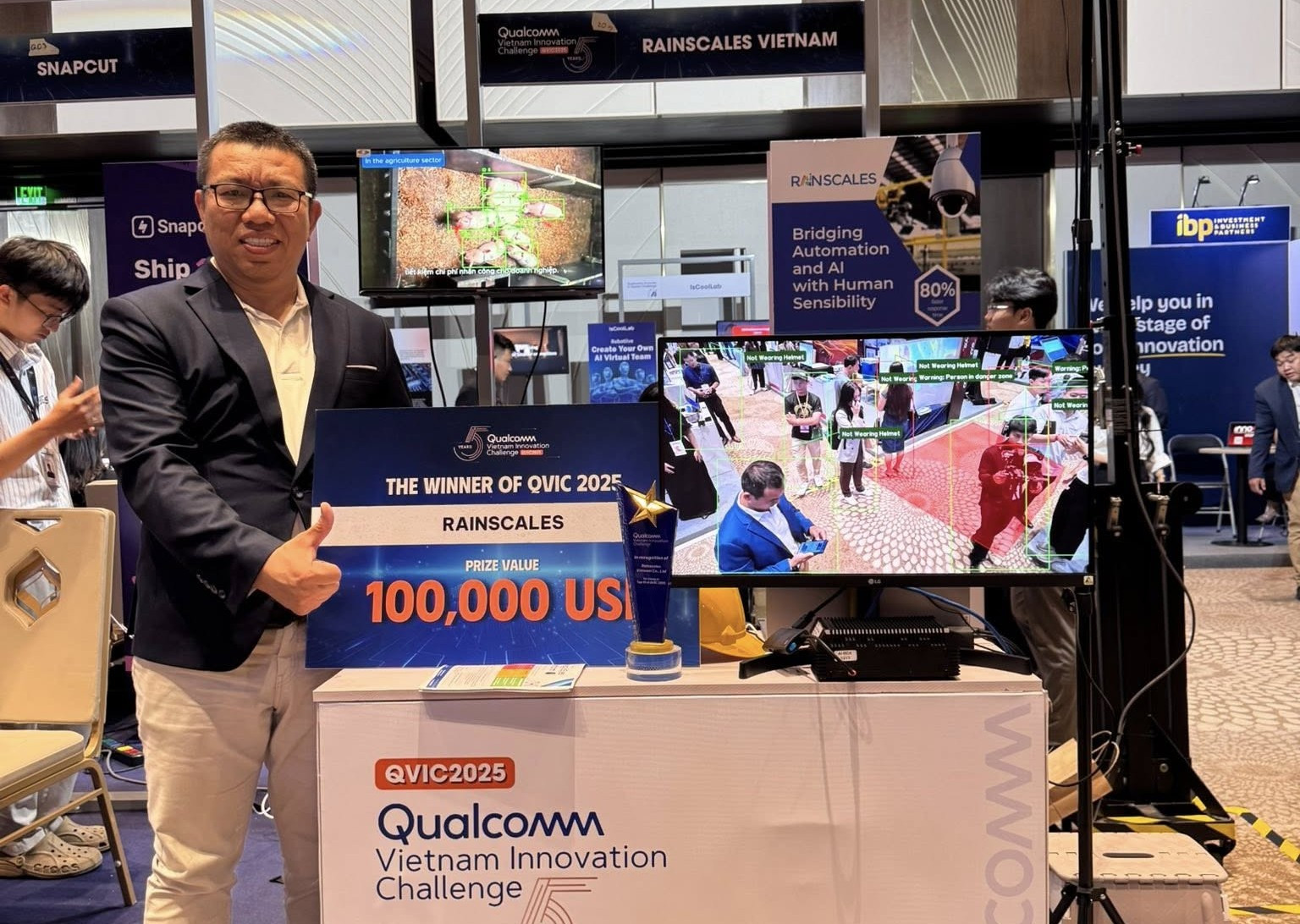
At the Rainscales booth at InnoEx 2025, Huy Tran posed with a prize board large enough to require its own travel arrangements. It announced a $100,000 win. Beside him, a monitor showed visitors outlined by computer vision, with labels identifying missing helmets and a marked danger zone. The money was easy to photograph. The more interesting object was the screen: an ordinary view of people moving around, now carrying instructions about what deserved attention.
Rainscales had taken first place in the Qualcomm Vietnam Innovation Challenge. During the 2025 competition, Huy was identified as its CEO and co-founder. Known in Vietnamese as Trần Mạnh Huy, he had reached this exhibition stand by a route that included university teaching, software management and business process outsourcing. Long before the cameras, there had been data to enter and customers to satisfy. The trophy arrived well into the story.
The business-card years
Huy’s working life began in the classroom. From September 1997 to May 1998, he taught at the University of Natural Sciences in Ho Chi Minh City. He then joined Paragon Solutions, where he worked as an employee and manager until 2006. Several company leadership positions followed. By July 2008, he was directing business process outsourcing operations at FPT Information System in Da Nang.
In September 2010, he became general director and a board member of V.B.P.O. Business process outsourcing is a rather formal name for work that often rewards patience more than spectacle: entering information, processing images, digitizing documents and supporting accounting tasks. A company gives an outside team a process to handle. That team must understand the assignment, organize the work and produce something dependable.
One early contract involved entering business-card information for Japanese businesses. The fees were low. Huy continued looking for orders. Later, the business developed digital products including invoice management and accounting tools. These are less glamorous objects than an exhibition trophy, but an invoice has a useful habit: it forces a technology business to explain precisely what it does.
His earlier venture also attracted attention beyond its customer base. In January 2021, Startup Grind Hanoi featured him in its Founder Storytelling programme. The event looked back at V.B.P.O’s growth and its work in international markets, including Japan. Years before the QVIC photograph, there was already a founder story worth gathering people to hear.
Huy supplied a less formal description of himself in 2021: “nhiều chuyện,” an expression that can suggest a busybody or someone always getting involved. The activities behind the joke included starting ventures and finding work for people. At V.B.P.O, recruits could experience the company’s operations and decide which work they could do, followed by training. The arrangement gave the employee a part in choosing the task. It also made learning part of the business process, rather than something that had to be completed before anyone arrived.
- 1997University teaching in Ho Chi Minh City
- 2010Leadership at V.B.P.O in Da Nang
- 2025Rainscales wins QVIC
- 2026A seat in the National Assembly
A camera with another assignment
The question that led to eMagicEyes emerged from a warehouse incident in 2022. Huy and his collaborators considered whether cameras could provide an immediate warning, giving workers a chance to respond. A recording can explain an event afterwards. Their proposed system would have to recognize something useful while the event was still unfolding.
The choice to work with existing cameras was central. A warehouse or factory might already have CCTV and telecommunications infrastructure. Rainscales’ approach added analysis to that equipment. The customer would be buying a new capability for an installed system, with the practical constraints that come with a real workplace. The wall did not need another camera merely to make the sales presentation look busy.
For the winning project, eMagicEyes used Qualcomm’s QCS8550 edge AI platform. The models would operate on site, supporting monitoring, incident response and compliance. For Huy’s team, the task connected computer vision with the operating habits of a facility. A detected event had to become something a person could act upon.
Conceptual workflow, not a performance measurement.
That last step matters to the way Rainscales describes itself today. Its published approach keeps human judgment in decisions, fits systems to a customer’s workflow and begins by understanding a process. Read beside Huy’s outsourcing background, the emphasis has a familiar shape. Collecting information is one task. Making it useful inside somebody else’s working day requires another set of decisions.
The company’s current deployment outline makes those decisions explicit. A pilot begins with agreed success measures, connects to a selection of the customer’s cameras or systems, and validates results before expansion. Its published process names precision, recall and operator time saved among the measures. Those are useful questions to bring back to an exhibition demonstration: which events did the system identify correctly, what did it miss, and how much work did it actually change?
The award, and the less photogenic appointment
The QVIC result came in August 2025 at InnoEx in Ho Chi Minh City. Rainscales finished ahead of Viet Dynamic and Enfarm Agritech. First place brought $100,000; the three winners shared $225,000 in prizes. The programme also provided technical support, coaching, intellectual property training and mentorship, with opportunities to connect to Qualcomm’s wider network.
There is an understandable temptation to let an award stand for an entire company. Huy’s 2025 calendar offers a more textured picture. Four months earlier, on April 18, Rainscales Vietnam had signed a training contract and cooperation memorandum with BSI Vietnam. The subject was ISO/IEC 42001 and the management of artificial intelligence.
The agreement concerned training a team to implement an AI management system, alongside cooperation and shared practical experience. It was a commitment to organizational work around the product. A training agreement should be understood on those terms; it does not itself establish certification. That distinction is part of taking the undertaking seriously.
At the signing, Huy connected the initiative to confidence among partners. Customers considering AI have questions about how a supplier operates as well as what its demonstration can show. The exhibition monitor and the training room therefore belong in the same business story. One displays a capability. The other addresses the arrangements needed to manage it.
$100,000 first prize
The teacher kept his timetable
Education continued alongside Huy’s company roles. From November 2019 to September 2025, he headed the information technology faculty at Danang University of Architecture. He subsequently remained a lecturer. That makes teaching a substantial part of his working life, stretching from his first university appointment to the period in which Rainscales was developing and presenting eMagicEyes.
On June 21, 2025, he joined Rainscales Vietnam colleagues at Can Tho University’s College of Information and Communication Technology. They met the college’s principal, Nguyễn Hữu Hòa, and other representatives to sign a cooperation memorandum. The stated plans covered research, training, recruitment, internships, company visits and professional events.
These are concrete points at which a university and a business can meet. Students need opportunities to encounter the conditions under which their skills will be used. Employers need people who can do the work. The agreement proposed ways to connect those needs, including experience inside a company and collaboration on the development of technical skills.
It is a revealing companion to the competition result. In the same summer, Huy’s company was presenting a product to judges and making arrangements for students to encounter professional practice. Both activities required a connection beyond the team itself: somebody else had to understand, evaluate or learn to use the work.
A different kind of public brief
By 2026, Huy’s responsibilities had expanded into elected office. He became a deputy in Vietnam’s 16th National Assembly, representing Da Nang, and joined its science, technology and environment committee. He also chaired HTV Blockchain Solutions. The entrepreneur whose public appearances had included a startup interview and product demonstrations now had a legislative role.
His election action programme tied science to practical use, education to employment and economic activity to social responsibility. It called for digital skills, foreign languages and practical capabilities for young people, along with retraining for workers as technology changes. These were stated priorities, with the work of turning them into policy still ahead.
“Education must be connected to employment.”
Huy Tran · translated from his 2026 action programme
In August 2026, he was still doing something recognizable from the classroom. At an AI training session in Thang Truong, he introduced basic concepts and helped participants practise with tools on smartphones and personal computers. The session also covered information security and data protection. A new institutional role had left room for a very direct form of instruction: helping someone use the device in front of them.
In August 2026, he was identified as a senior advisor to Rainscales Vietnam, following his role as CEO during the 2025 competition. On October 12, he attended a Da Nang voter meeting ahead of the National Assembly’s second session, appearing among the city’s deputies as a lecturer, business chairman and committee member.
The career now spans several rooms: the lecture hall, the company office, the exhibition booth and the public meeting. Looking across them, the recurring subject is practical use. There is information to process, a camera to interpret, a student to prepare, a tool to explain. The prize board captures one satisfying afternoon. The screen beside it asks the longer-running question: once you have seen something, what can you help somebody do?