The blog was thriving, at least in the particular way a dashboard likes to define life. It belonged to a company Higher Logic had acquired, and it had roughly three times as many subscribers as Higher Logic’s own. There was traffic. There were keywords. There was the pleasing hum of a content machine doing what content machines do. Hunter Montgomery, then Higher Logic’s chief marketing officer, looked beneath the hum and found an awkward silence: useful leads were not arriving.
The audience, he concluded, was not really their audience. The blog could be popular and still fail the business. “I like activity but not activity for the sake of activity,” he later recalled. It is the kind of sentence that makes a crowded marketing calendar feel suddenly self-conscious.
That episode is a neat pocket version of Montgomery’s career. He is not hostile to activity, technology, content or creative ambition. He has spent more than 25 years making those things work. He simply wants them to answer a second question after they have answered the first. Fine, people noticed. Then what?
A history major discovers the pleasure of a clean line
Montgomery studied history at Colgate University and later earned an MBA in information technology from the University of Texas at Austin’s McCombs School of Business. The combination feels apt. History asks what happened and why. Information systems ask whether the answer can survive contact with a database.
His early career included general-management work at Nantucket Nectars, followed by database and corporate marketing roles. By the 2000s he was leading global marketing at Cybertrust, then moved into security solutions and global marketing platforms at Verizon Business. Vocus followed, where he became vice president of marketing and worked across planning, budgeting, analytics, data governance, campaigns and the often diplomatic labor of aligning sales with marketing.
In 2013, Higher Logic appointed him CMO. During his nearly six years there, he was part of the management team as annual revenue grew from under $10 million to more than $60 million. The company expanded from its roots in online communities for associations toward corporate communities and marketing automation. Montgomery’s work sat in the middle of that change: product, audience, acquisition and engagement all needed a common language.
I like math, which sounds kind of crazy. I’m not a quant guy, I’m not a math major, a history major in undergrad.Hunter Montgomery, 2019
What he liked was not arithmetic for its own sake. It was the ability to walk into a conversation with a chief executive, finance leader or sales team and draw a line from marketing work to bookings and revenue. Sometimes the line was direct. Sometimes it was dotted. His account of it allowed for both, which is rarer than any attribution vendor would care to admit.
Measurement gave marketing a way to earn credibility without pretending to own every good thing that happened near a campaign. It also exposed lovely-looking nonsense. A blog can have a large audience and the wrong audience. A full calendar can conceal a missing purpose. An impressive tool can automate a flawed idea with tremendous efficiency.
The customer keeps the better ledger
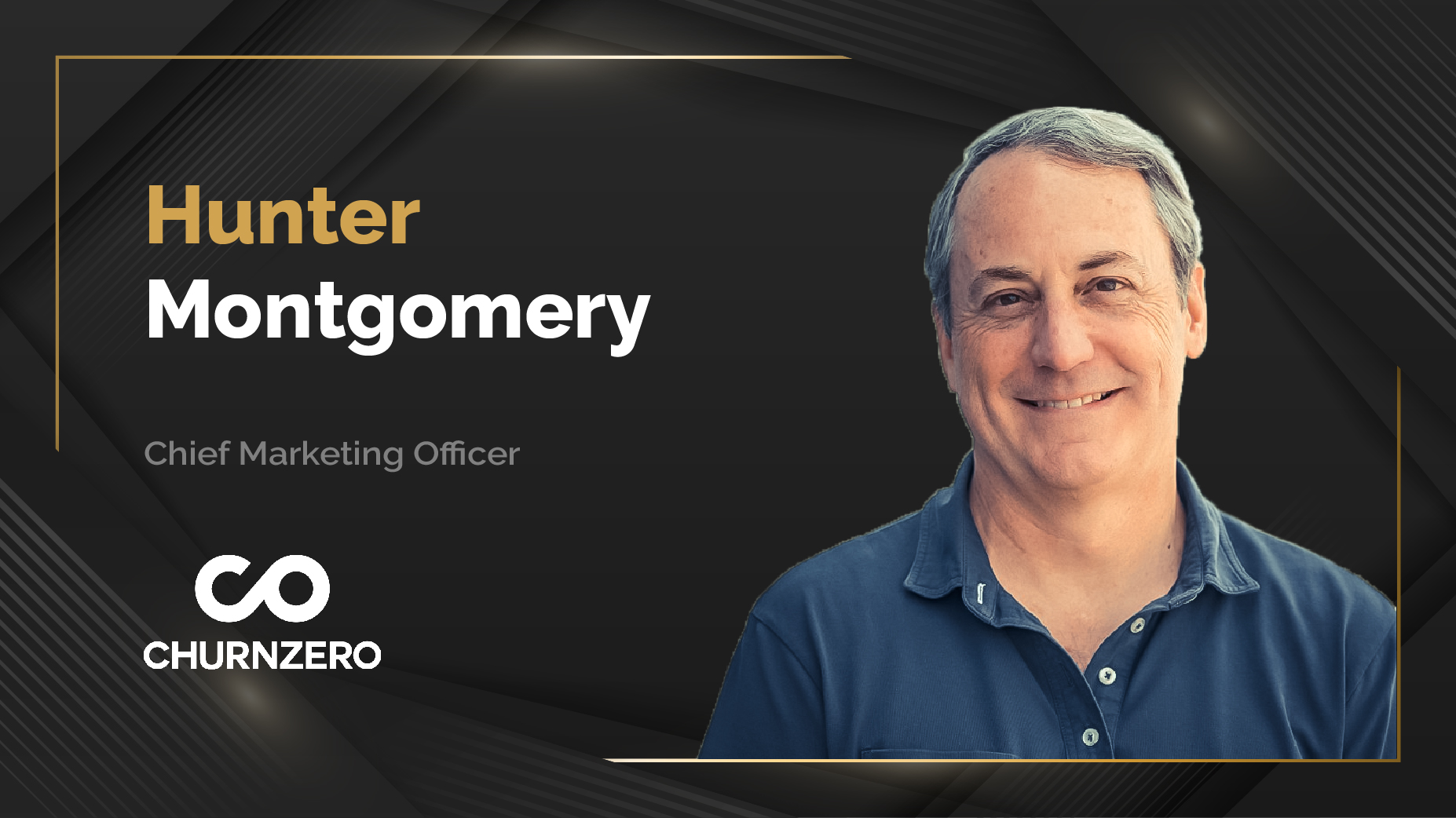
Montgomery joined ChurnZero as chief marketing officer in August 2019. The move placed him at a company built around a business problem he had already been circling: in subscription software, the sale is not the final verdict. It is the beginning of a recurring vote.
Customers renew, expand, advocate or leave. Their product usage, support conversations, survey responses and patterns of engagement contain a more candid account of value than the buyer persona drafted before anyone signed a contract. Montgomery’s argument is that marketing should be reading that account.
He calls customer success marketing’s best-kept secret. The secret is practical, not mystical. Marketing teams spend a great deal of time trying to imagine life from a customer’s point of view. Montgomery respects the impulse and distrusts the imagination. “Empathy is essential to marketing,” he has said. “But it needs to be informed, not imagined.”
The remedy is wonderfully inconvenient. Talk to customers. Look at what they use. Ask support teams what creates friction. Notice the features that successful accounts adopt and the ones struggling accounts ignore. Listen for the words customers choose, because a campaign written in the company’s dialect will always sound faintly foreign.
This makes customer success data useful well beyond a health score. It can identify a relevant webinar audience, sharpen a customer profile, surface a case-study candidate or reveal an expansion opportunity. It can also puncture a marketing assumption before the assumption acquires a budget and a launch date.
Empathy is essential to marketing. But it needs to be informed, not imagined.Hunter Montgomery, 2022
Retention is the back half of the bow tie, and the bill comes due there
The subscription model rearranged the economics of software. Acquisition still matters, but a company with a leaky customer base cannot outrun the hole forever. Retention allows revenue to compound. Expansion requires an account that stayed. Advocates matter because buyers increasingly consult peers, reviews and communities before accepting the polished version offered by a vendor.
For Montgomery, this moves customer success from the soft edge of the organization toward its financial center. He has argued that the function has evolved from an association with satisfaction and engagement into direct ownership of renewals and revenue. In that world, the post-sale experience is not a courtesy. It is where the promise in the pitch meets the arithmetic in the forecast.
His 2024 conversation on the Revenue Engine podcast pushed the idea into customer marketing. Use deep customer data to find relevant opportunities. Personalize campaigns around behavior. Align marketing and customer success. Add educational content that improves adoption. Then keep integrating the results, because a campaign is a hypothesis wearing nicer clothes.
Early operating experience at Nantucket Nectars, before his long run in technology marketing.
Leadership work across Cybertrust, Verizon Business and Vocus.
CMO during a period in which annual revenue grew from under $10 million to more than $60 million.
Leading positioning, demand, brand, communications, events and partnerships around customer growth.
No magic bullets, even from a software executive
There is a comic honesty in hearing a software CMO warn people against buying software too quickly. Montgomery has watched marketing stacks fill with point solutions, redundancies and neglected tools. His diagnosis is that teams often buy technology before naming the process or strategy that is broken.
“Technology won’t fix that,” he said. His advice was to consolidate, remove what is unused and ignore the sunk-cost instinct that keeps an unhelpful product on life support. This is not an argument against software. It is an argument for giving software a job.
The same impatience appears in his view of campaign work. Marketing-qualified leads should not dictate every decision, but performance cannot be politely ignored. Teams that lose sight of the result begin choosing projects because they are interesting, filling calendars because calendars dislike whitespace and defending processes that have outlived their purpose.
His preferred rhythm is quicker and less ceremonial: put work into the world, learn, iterate and move toward the result. In August 2026, when he publicly announced two new strategic hires for ChurnZero’s marketing team, he asked for people with initiative, people able to see a gap, build the plan and run with it. The standard was ownership without pageantry.
The useful discipline of asking what changed
Montgomery’s career has crossed several versions of B2B technology: security software, public-relations software, online communities, marketing automation and customer-success platforms. The tools shifted. The buyer gained more control. The subscription model moved attention beyond the contract. AI made it possible to sift far more customer information. Through each change, his most durable idea stayed pleasantly low-tech.
Diagnose before buying. Listen before personalizing. Connect activity to an outcome. Show the line when it is solid and admit when it is dotted. Make the message concise enough for an executive changing contexts all day, but informed enough to respect the customer living with the product.
A crowded field rewards motion because motion is easy to photograph. There are launches, webinars, posts, leads and dashboards, each waving cheerfully for attention. Value is quieter. It appears in a customer who adopts, renews, expands or recommends. Montgomery’s work keeps returning to that quieter evidence.
The old blog story is funny because nearly everyone recognizes the temptation. Three times the subscribers! What executive could resist the exclamation point? Montgomery resisted long enough to inspect the audience. The traffic was real. The lesson was better.