Long before Hui Tian became a chief executive, he spent a great deal of time thinking about interference. His Stanford dissertation, dated August 2000, had a title with little interest in charming a dinner party: Noise Analysis in CMOS Image Sensors. It concerned the small electrical fluctuations that can spoil a picture. A camera may point faithfully at the world while its own circuitry adds something the world never supplied.
That is a useful place to begin with Tian. Today he is Axbio's co-founder, chairman and CEO. His work has carried him through camera chips, quantum-dot sensors and the construction of a company spanning the United States and China. The objects have changed. The recurring problem has a familiar shape: how do you get a complicated system to deliver information you can trust?
The picture before the company
Tian's education joined applied physics at Tsinghua University with electrical engineering and applied physics at Stanford. Those subjects meet in a sensor. Physics describes what happens when the world encounters a material. Engineering decides whether the encounter can become a useful measurement, repeated reliably enough to put inside a product.
His dissertation examined a particularly awkward feature of image sensors: their electrical conditions change during operation. A convenient mathematical assumption can therefore become an inconvenient description of the actual circuit. The work developed ways to analyze noise under those changing conditions. In ordinary language, the instrument needed an honest account of its own behavior before it could offer an honest account of anything else.
The distinction matters because a photograph conceals its manufacture. We see a face, a mountain or a badly parked car. Behind the image sit decisions about transistors, charge and timing. Tian's early research occupied that hidden territory. Its audience was small; the kind of device under discussion would eventually become thoroughly ordinary.
In 2001, he and colleagues including Xinqiao Liu, SukHwan Lim, Stuart Kleinfelder and Abbas El Gamal investigated active pixel sensors made with standard 0.18-micrometer CMOS technology. Earlier predictions had raised doubts about acceptable imaging performance at smaller process dimensions. The team built test structures to examine what the devices actually did. The experiment gave a physical question a physical answer: fabricate the pixels, measure them, inspect the compromises.
Another paper, written with El Gamal, addressed flicker noise in switched transistor circuits. These are modest-sounding subjects with demanding consequences. An error in a model does not become less troublesome because the model fits elegantly on a page. In this early work, Tian was already dealing with the distance between an attractive explanation and a working device.
- 2000Stanford doctorate in applied physics
- 2007Begins vice presidency at InVisage
- 2016Becomes Axbio's founding CEO
- 2026Signs Axbio's May announcement as chairman
When a pixel becomes a management problem
The next part of his career moved through the organizations that turn technical work into products. He held a principal sensor scientist position at IC Media, became a director at Pixim, and served as a vice president at InVisage. Aptina followed, then Genia and the sequencing operation at Roche. Each move widened the range of people and decisions surrounding the circuitry.
At InVisage, the material itself was part of the experiment. Its QuantumFilm technology used quantum dots in image sensing. The company would later be acquired by Apple; Pixim was acquired by Sony. Those corporate destinations belong to the companies' histories. Tian's own thread runs through the work of making sensors and leading the groups responsible for them.
There is a temptation to read such a résumé as a collection of famous names. The more interesting detail is the variety of work beneath them. A sensor scientist can spend a day pursuing one stubborn device characteristic. A director must decide how that pursuit fits a product. A vice president has to connect engineering choices with schedules, colleagues and customers. The technical question survives, surrounded by more questions.
Axbio makes that accumulation visible. Tian's job now includes strategy, global operations, financial management and research and development. A design decision sits alongside a staffing decision; both compete for the same finite time. The organization has to keep moving while its specialists attend to details that cannot safely be hurried past.
A partner who sees another part of the problem
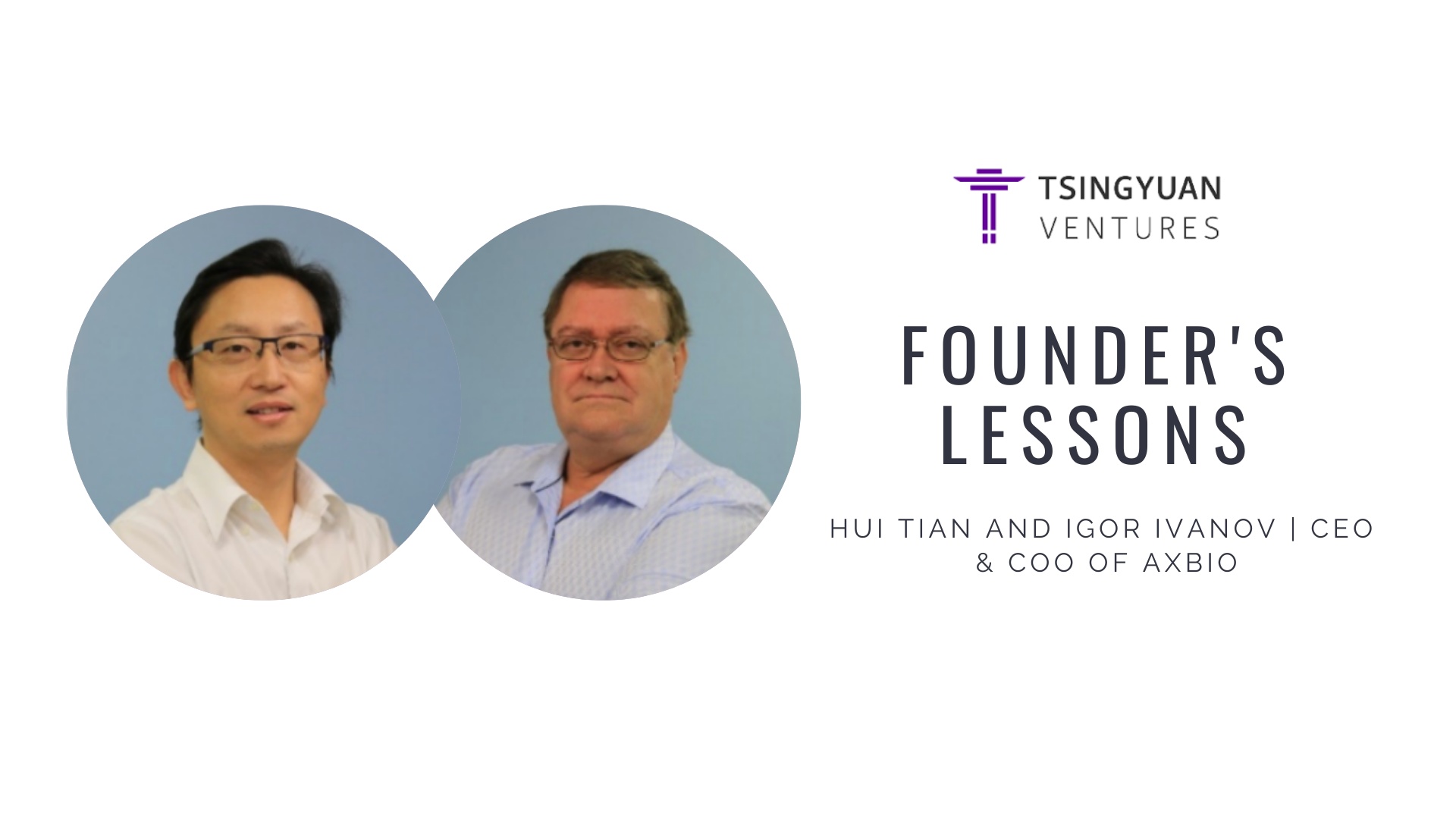
At InVisage, Tian also met Igor Ivanov, his future Axbio co-founder. Their backgrounds complemented one another: Tian brought physics and circuit experience; Ivanov brought chemistry and materials expertise. The partnership carried an advantage that no organizational chart can manufacture on demand. They had already worked together.
Tian has described a habit of considering Ivanov's perspective, with the courtesy returned. For a company working across specialties, that is a practical arrangement. A circuit designer and a materials scientist can look at the same disappointing result and notice different causes. Their usefulness to each other depends on being able to keep both explanations in the room long enough to investigate.
He calls himself a people-person. His hiring preference is for colleagues who start solving problems without waiting to be instructed, and who can cooperate while doing it. His phrase for Axbio is brief: We're a consensus-driven company.
Agreement takes work when participants have different technical vocabularies. So does ensuring that agreement leads to a decision.
The attractive version of a technical startup is a room full of clever people. The working version needs those people to understand the implications of one another's work. A change that improves one component can complicate another. Tian's account of partnership suggests a useful response: spend enough time inside the other person's reasoning to see what your own answer might cost.
“We're a consensus-driven company.”
Hui Tian, 2020
The chip has to leave the drawing
Axbio was founded in 2016. Three years later, its collaboration with TowerJazz provided a concrete view of the engineering behind the company. The partners announced a microfluidics Bio-CMOS device using a 65-nanometer RFCMOS platform, developed at a 300-millimeter manufacturing facility in Uozu, Japan. Silicon Valley ideas had acquired a manufacturing address.
Those numbers describe different things. The 65-nanometer figure identifies the semiconductor process platform. The 300-millimeter figure describes wafer diameter. Neither is a measure of a finished instrument's performance. Together, however, they locate the work in the world of semiconductor production, where a design must fit a process that can actually make it.
Microfluidics adds another kind of engineering: controlling liquids at small scales. Putting it alongside circuitry requires the two parts to work together physically. The announcement described a partnership built over several years. Even the calendar offers a corrective to the idea of invention as a single inspired afternoon. Manufacturing relationships have their own long, unphotogenic middle.
Conceptual map of the disciplines in Tian's career, rather than a product specification.
For Tian, this is familiar ground enlarged. His early papers asked whether assumptions survived contact with a fabricated device. A company has to ask a broader version of that question. Can the design survive fabrication, assembly and repeated use? Can colleagues with different responsibilities recognize the same problem? Can an improvement be carried through the entire system?
The larger circuit
By 2025, Tian was presenting Axbio's work publicly in Santa Clara. A conference appearance puts a particular demand on a technical founder: explain enough of the machinery to make the choices intelligible, while giving listeners a reason to care about the finished thing. The audience cannot be expected to have spent years inside the design.
In May 2026, his name appeared as chairman on Axbio's Hong Kong exchange announcement. The accompanying application documents remained drafts, subject to change. The distinction between an application and a completed listing matters. What they show clearly is the scale of the job he had taken on: a founder responsible for a business as well as its technical direction.
His later description of leadership emphasizes execution, accountability and shared purpose. Those words can become wallpaper in a corporate presentation. Placed beside a career in sensors and manufacturing, they acquire more specific demands. Someone must own the measurement. Someone must explain a delay. Someone must make sure the decision reaches the people who will build the next version.
Outside work, Tian has named hiking, travel, strategy games and video games among his interests. A strategy game is unusually polite about showing where the rules end. A company supplies fresh uncertainties while the players are already taking their turns. That makes a considerate partner and a self-directed colleague useful companions.
The continuity in Tian's career is easiest to see at this smaller scale. A pixel produces a signal. A colleague contributes an explanation. A manufacturing partner supplies a constraint. Each has to be understood in relation to the rest. The change of scale is considerable. A circuit can be redrawn on a screen; a team needs a conversation, a decision and a way to carry it out. The founder who once studied interference inside a camera circuit now spends his working life helping a much larger system make sense together.