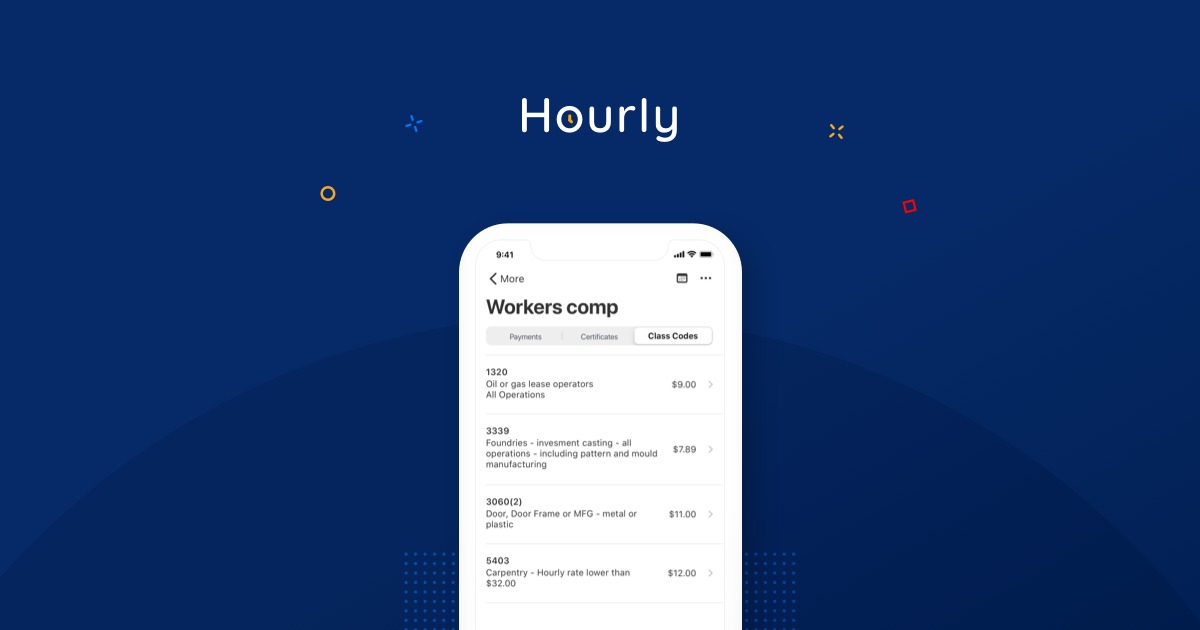
A small contractor finishes payroll on Friday afternoon using his phone.
He doesn't wait for a spreadsheet. He doesn't call an accountant. He runs the numbers for eight workers who clocked in from three different job sites that week, and within minutes the system has already calculated how much his workers' compensation insurance will cost for those specific hours, those specific wages, that specific week. No estimate. No guessing. No year-end audit bill he didn't budget for.
That is the daily reality Hourly built for 500+ small businesses across construction, transportation, manufacturing, and the trades. Not a novel concept on paper. Apparently, a hard one to execute in practice - which is why nobody got there before them.
Workers' comp was running on vibes and annual guesses.
Here's how workers' compensation insurance worked for most small businesses before Hourly: at the start of the year, an insurer estimated what your payroll would be. You paid premiums based on that estimate. At year-end, an auditor showed up, reviewed your actual payroll records, and handed you a bill for the difference - or a refund, if you were lucky. Most weren't lucky.
For a business with 10-50 hourly workers whose hours fluctuate week to week, that system is basically a guarantee of financial surprises. You're either overpaying all year, or you're facing an audit bill at the worst possible moment.
"We were overpaying for workers' comp and didn't know it until after the year-end audit."- Hourly customer, publicly quoted on hourly.io
Tom Sagi, Hourly's CEO, didn't read this problem in a market research report. He lived it managing his family's real estate development and construction company. The year-end audit wasn't an abstraction for him - it was a recurring headache that seemed like it should have a technological solution, and didn't.
Three people who decided the problem was worth seven years of their lives.
Managed his family's real estate and construction company. No formal tech background. Started Hourly because he experienced the workers' comp payroll mess firsthand. Ranked among Comparably's top 10 best CEOs in 2022.
20 years of technology experience. Serves on multiple boards. Brought the technical architecture to Hourly's mobile-first platform and the system integrations that make real-time workers' comp calculations work.
Former SVP at GlobalFoundries. Tech entrepreneur, investor, and senior executive with board experience across multiple startups. Brought strategic and institutional credibility to an early-stage team.
The founding trio covered the bases: one who understood the customer's pain from the inside, one who could build the product, and one who had navigated large organizations and investor expectations. It's not an unusual team structure - but it worked. They founded in 2018, raised a $7.15M seed round in 2019, and spent three years building before the Series A.
Three tools. One app. Zero year-end audit surprises.
Hourly's product is not complicated to explain - which is part of why it works. Three core functions, wired together in a mobile-first platform built for people who are running job sites, not sitting behind desks:
Real-time collection of hours, task data, and worker location. The data feeds directly into payroll and insurance calculations - no manual re-entry.
Streamlined payroll built for hourly and mobile workers. Employers verify, approve, and execute - the platform handles the math and the compliance.
Premiums calculated against actual wages paid each payroll cycle. No estimates. No audits. No surprises. The number adjusts every single pay run.
Employee onboarding, workforce management, and compliance tools built alongside the payroll and insurance stack, not bolted on later.
"Hourly.io banks $27M for its new approach to providing workers' comp and payroll for hourly wage workers."- TechCrunch, June 2022
The integration is the product. Any of these three things exist separately in the market. Time tracking apps are everywhere. Payroll services are a crowded field. Workers' comp is a regulated industry with well-established carriers. What Hourly built is the connection between them - a single data layer where the hours a worker logs feed directly into that week's insurance premium without anyone having to touch a spreadsheet.
Six years from family frustration to $168M acquisition.
A 4.8/5 rating and a Nationwide partnership are hard to fake.
Hourly's strongest validation came not from press coverage but from two sources: customer reviews and institutional partners willing to stake their own credibility on the platform.
The 4.8/5 rating across major review platforms represents real small-business owners - not enterprise procurement teams with vendor evaluation checklists, but contractors and operators who chose to write public reviews. That's a different kind of signal.
The Nationwide partnership in 2023 is more formal and arguably more telling. Being named a Managing General Underwriter by a major national insurer means Hourly isn't just a software company that integrates with insurance - it's operating as part of the insurance distribution chain, with regulatory standing and underwriting authority. For a 130-person startup, that's an unusual position to hold.
Annual revenue at time of acquisition: approximately $17.8M. That's a roughly 9x revenue multiple on the acquisition price - not unusual for a high-growth SaaS/insurtech combination, but a real number that reflects genuine commercial traction.
Competing against everyone, differentiated by the combination.
Who else is in the room?
Boring paperwork was costing real businesses real money.
Hourly's mission is essentially administrative: make payroll and workers' compensation work accurately and automatically for small businesses that run on hourly labor. There's no moonshot language in that sentence. That's intentional.
What makes the mission matter isn't its ambition - it's its specificity. The businesses Hourly serves are in construction, maintenance, manufacturing, landscaping, transportation, food service, energy. These are not tech companies. Many of their owners are not financially sophisticated in the institutional sense. A $6,500 annual savings from not overpaying workers' comp premiums is meaningful money to a 15-person roofing company. A year-end audit bill they didn't expect can affect cash flow in a real way.
"Tom Sagi started Hourly after managing his family's real estate and construction business and experiencing firsthand the frustration of complex workers' comp and payroll processes."- Forbes
The culture appears to reflect this mission-ground connection. Winning Comparably's happiest employees recognition from a pool of 70,000 companies isn't a branding exercise - it suggests a workplace that's actually functional, which is more than most startups can say in year four.
- Nationwide partnership as Managing General Underwriter (2023) - institutional validation for a startup
- Comparably "happiest employees" out of 70,000 companies surveyed (2022)
- CEO Tom Sagi ranked top 10 on Comparably's Best CEOs list (2022)
- 4.8/5 rating across major customer review platforms
- $168M acquisition by WeSure Insurance (July 2025)
- Covered by TechCrunch, Forbes, Business Insider, Fast Company, USA Today
Back to that contractor finishing payroll on Friday afternoon.
The thing is, that scene exists because Hourly built a bridge between three systems that had always been separate: the record of hours worked, the calculation of wages owed, and the premium charged for insuring those workers. Connecting them in real time required dealing with insurance regulatory complexity, building mobile UX that worked for people managing physical labor, and convincing insurers to underwrite policies through the platform. That's why it took from 2018 to 2023 to fully execute.
WeSure's $168M acquisition in 2025 is not just a financial event - it's a thesis confirmation. A well-capitalized Israeli insurtech saw what Hourly had built and decided the right move was to own it, not compete with it. Hourly shareholders retained approximately 49% of WeSure US, which suggests the founders and early investors believed in what comes next as much as what got them there.
The $17.8M in annual revenue on 500+ customers leaves room for multiples of growth. The real story is what happens when WeSure's capital and insurance infrastructure meets Hourly's platform - and whether the pay-as-you-go workers' comp model scales from hundreds of businesses to thousands.
"A new approach to providing workers' comp and payroll for hourly wage workers."- TechCrunch headline, June 2022
For the contractor wrapping up payroll on his phone: the system works. The premium is right. There's no audit coming. That's the whole product. Simple to describe, apparently hard to build, and clearly worth building.