The list had 140,000 records. It looked, at least by the ordinary arithmetic of marketing, like something worth having. Then HMA looked inside. The company’s published audit identified more than 6,600 reputation-related threats and over 5,300 conversion threats. Some addresses belonged to categories that could damage delivery. Others were unlikely to produce much of anything. A large audience had become a rather more complicated proposition.
That example, released by HMA in September 2025, makes a useful introduction to a hospitality marketing company whose work begins before the attractive email appears. Its audit delivers a suppression file and a plan for fixing the underlying collection problems. The question is wonderfully unglamorous: who, exactly, are we about to write to?
The guest is there. The record needs work.
Hotels are particularly interesting places to ask that question. HMA describes databases containing duplicate profiles, placeholder addresses from online travel agencies, incomplete details and guest histories scattered across systems. A reservation can be perfectly useful for allocating a room while leaving the marketing team with a poor account of the person who occupied it.
The consequences stretch beyond an undelivered message. If two records belong to one person, a frequent visitor may appear less frequent. If stays at different hotels remain separate, a group may miss a customer’s wider relationship with its properties. These are the practical problems HMA’s Intelligencia platform is designed to address.
Its sequence is straightforward: bring hotel and marketing data together, clean and reconcile the records, then use the resulting profiles to select audiences and communicate. A customer data platform does the assembling; CRM and campaign tools help the hotel act on what it learns. HMA puts those functions together with continuing marketing support.
- 01CollectBring guest and booking histories together.
- 02ReconcileClean records and connect repeat identities.
- 03ActTarget an offer, recover a booking, prepare a welcome.
Forty years, and a tiny degree symbol
Rick and Michelle Heuer founded HMA in 1984. Its own history describes an enduring interest in data, marketing and technology. The company now brings together analysts, strategists, designers, developers and engineers. That mixture helps explain why its offer crosses the usual boundary between buying a software tool and hiring an agency.
In its rebrand explanation, first published in October 2023, HMA describes a progression from data management to hospitality intelligence. The little degree symbol in its identity represents a full-circle view, from collecting information to converting it into business. It is a substantial assignment for a very small piece of punctuation.
The documented change is in the company’s capabilities and presentation: guest analysis now sits alongside automated communications, recovery tools and recognition at arrival. Intelligencia’s September 2024 version 3.0 announcement added updated dashboards and AI-assisted content development within the email builder, plus an enhancement to Valet’s data integration. The new writing assistance sits inside a much older business concerned with understanding guests.
A dashboard with colleagues attached
HMA’s intended customers include independent upscale hotels, resorts and management companies operating multiple properties. The appeal for a lean hotel team is practical. Someone must decide which guests receive an offer, produce it, send it and interpret the outcome. HMA supplies campaign help as part of its positioning, including dedicated account management for hotel groups.
Creative services cover the visible work: email design, marketing collateral and campaign assets. Guest History Analysis supports decisions about audiences and stay patterns. The combination lets an operator buy assistance with both the data and the work that follows. It also makes service scope an important part of the purchasing decision: a portal alone does not tell you who will build next month’s campaign.
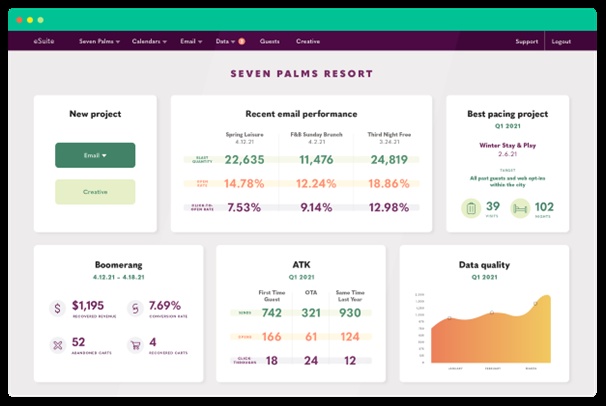
HMA is operating in a market with substantial overlap. Revinate also markets a hospitality customer data platform with profile unification and identity resolution. Cleaning guest information is therefore a capability buyers should compare, rather than assume belongs exclusively to HMA. HMA’s particular proposition combines that work with ongoing, hands-on marketing execution. The useful comparison is the complete working arrangement.
The reservation that almost happened
Boomerang addresses a smaller moment in the guest journey. Someone starts a reservation and leaves before finishing. HMA’s recovery tool connects to the booking engine and triggers a three-touch email sequence. Its product page advertises a price below $350 per month for most properties. That is pricing for the recovery offering, not a quotation for the entire Intelligencia suite.
For most properties, according to HMA’s product page.
HMA reports a 5,702% return on investment for an unnamed California coastal property using booking recovery. Treat that as a company-reported case result. For a buyer, the worthwhile exercise is to establish how recovered bookings are attributed, which costs enter the calculation and what happens after cancellations. A striking percentage is the beginning of that conversation.
The mechanics suggest the limits, too. Recovery needs an identifiable abandoned reservation and a working connection to the booking engine. It cannot produce the same opportunity when those ingredients are absent. Hotels considering it can begin with a concrete task: measure their own recoverable booking activity and evaluate completed stays against the cost of the service.
Recognize the person before they reach the desk
Valet, introduced in 2023, carries guest information into hotel operations. Properties define VIP tiers using criteria such as revenue or visit frequency. The system surfaces cross-property history, sends daily arrival alerts and lets staff track amenities. A guest need not enroll in a points program to become recognizable through their behavior.
This is a different kind of personalization from inserting a first name into an email. A team can prepare for someone’s arrival and coordinate what they will receive. The value still depends on people: an alert needs someone to read it, and an amenity needs someone to deliver it. Software can make the handoff explicit. The welcome remains a hotel’s responsibility.
DataView takes the analysis beyond a single property. It supports guest-history reporting, audience exports and destination analysis, and HMA says it can be purchased independently of its CRM offering. In a published testimonial, Yosemite Mariposa County Tourism Bureau chief Jonathan Farrington describes using HMA’s analysis to understand seasonal visitors. He credits confidence in privacy and confidentiality with helping secure participation from destination partners.
That observation explains a condition easy to miss in a product demonstration. A shared view of visitors requires organizations willing to contribute their information. The Australian Black Sheep Tourism partnership, published on HMA’s blog in 2023, offers another example of its technology reaching customers through a local partner’s relationships and expertise.
Start with the names you already have
The most transferable lesson here is a sequence of work. Check whether the guest records represent reachable people. Resolve fragmented histories. Choose a specific action those histories can support. Assign someone to execute it. Then judge the resulting bookings or service delivery. Each step gives the next one a better chance.
“An Email Marketing Database Threat Analysis is the oil change of lifecycle marketing”
Bryn Tyler · HMA Vice President of Operations · 2025
For a hotel, that may mean a smaller mailing audience, a reminder to someone who nearly booked, or a front desk colleague who knows a returning guest is due today. HMA’s products connect these modest acts. A hotel already spends considerable effort welcoming strangers. Remembering the people who have stayed before deserves some of that attention.
Explore HMA’s working parts
Company website · Intelligencia · Boomerang · Valet · DataView · HMA blog
LinkedIn · X · Instagram · Facebook · HMA on YouTube