In January 2019, Heather McGee was part of a student team working on an unglamorous problem: how to tell whether money intended to do good was actually doing it. Their proposed web application, Unetrics IM+M, would help impact funders and organizations measure, manage, and report social and environmental results in real time. It was a modestly technical answer to an enormously slippery question. Good intentions are easy to announce. They are rather less accommodating when asked to produce a spreadsheet.
The question has followed McGee into the executive suite. Today she is chief executive officer and chief compliance officer of Intentional Asset Management, a New York investment advisory and asset management firm. She also leads its affiliated investment institute. Her working world includes consulting clients, corporate strategy, daily operations, research, and a fellowship program. That assortment gives her a vantage point across the places where an investment idea can become practical, stall, or require another attempt.
Her career offers a useful way into impact investing because it includes the mechanics as well as the ambition. Political organizing, fund operations, philanthropy, graduate research, and business development all appear along the way. So do setbacks. McGee has spoken publicly about restructuring and preserving a product by spinning it off. The thread running through these episodes is the difficulty of turning a desired outcome into an organization capable of delivering it.
A campaign with a different kind of donor
McGee grew up along Utah's Wasatch Mountains and now lives in New York. Her early professional work was in politics: the state political party, the legislature, campaign management, and fundraising for candidates at local, state, and federal levels. Her University of Utah degree was in political science, with a minor in campaign management. Before investment capital became her subject, she was already working with the institutions and fundraising that help an idea gather support.
There is a recognizable connection between those fields, although the rules and responsibilities differ. Both require people to commit resources to something that has yet to happen. Both involve constituencies whose priorities may differ. McGee's older professional biography describes her interest in responsible capital markets through the language of a grassroots campaign. It is an apt piece of vocabulary for a career that began with actual campaigns and later moved into finance.
After moving to New York, she worked at Ramius Alternative Solutions, then at the Pershing Square Foundation. Her roles put investment operations and philanthropic work on the same résumé. The foundation's portfolio included grants and program-related investments; McGee supported its grantees and investment recipients. Those are different ways of putting resources behind an objective. Encountering both helps explain why the means of financing, as well as the goal, recur throughout her subsequent work.
The problem she took to graduate school
At New York University's Wagner school, McGee studied social impact, innovation, and investment, completing her Master of Public Administration in 2019. Her graduate work examined how investors measure and manage the impact of portfolio companies across asset classes. The wording matters. Measuring describes the attempt to observe an outcome. Managing adds the possibility of doing something with what has been learned.
Unetrics brought that concern into a proposed product. McGee joined Daniel Vitaletti and Helen Sacco in NYU's January 2019 Startup Sprint cohort. Their application was designed for impact funders and organizations. The accompanying capstone work described a tool that would simplify the choice of metrics, streamline data collection, automate analysis and projections, and provide performance information in real time. The team was tackling the administrative friction between making a commitment and understanding its consequences.
It is a revealing early project. A cause can attract an investor; collecting usable information from the organizations involved is another undertaking entirely. McGee's student work went straight to that second undertaking. Its ambition was practical enough to involve software, recurring data, and reporting. A fine mission statement can survive indefinitely on a website. A reporting system eventually needs someone to fill in the fields.
- 01Collect data
- 02Select metrics
- 03Analyze performance
- 04Report results
The proposed application linked data collection with impact reporting. A design concept from 2019, rather than a claim about current product availability.
When the product needs a new home
Before joining 17 Asset Management, McGee supported business development for the Good Capital Project, a two-year SOCAP initiative intended to help investors incorporate impact into their portfolios. In September 2019, she joined 17 AM. Her responsibilities as chief operating officer included implementing strategy, running daily operations, and maintaining relationships with investors, partners, clients, and the team. Her current biography dates her promotion to CEO to 2024.
That progression might look smooth when reduced to titles. Her account of business life is less polished. In a March 2025 conversation with Mark Spencer Cook on Bold Encounters, McGee discussed product loss, staffing cuts, new markets, and changes to how the business operated. The interview's subjects included revenue, expenses, restructuring, virtual operations, and Caribbean expansion. There is no ceremonial ribbon in a decision about cash flow.
One of her observations was unusually concrete: “In order to preserve the product, we spun the product off.” Preserving work by changing where it belongs is a different measure of progress from keeping every initiative inside the same organization. Her other concise reflection, “An ending is just a new beginning,” sounds more grounded alongside that operational choice. Here, a new beginning could require a new structure.
“In order to preserve the product, we spun the product off.”
Heather McGee · Bold Encounters, March 2025
The present firm has its own sequence of formation and launch. Intentional Funds was established by 17 AM in 2022; Intentional Asset Management formally launched as a dedicated wealth and asset management business in 2025. McGee's current titles combine leadership with compliance, and she holds a Series 65 qualification. Strategy and the obligations attached to investment advice sit within the same job description.
A map that extends beyond the beach
The Caribbean gives this work a specific geography. IAM manages CaribGROW, a private equity vehicle designed for growth-stage businesses across the region's food systems. Its proposed instruments include common equity, preferred equity, and financing linked to revenue. Agriculture and fisheries sit within a wider investment picture that also includes processing, logistics, distribution, and the infrastructure those businesses need.
The institute's Caribbean work began in 2020 and argues that many regional businesses fall between the financing categories available to them. They may be too large for microfinance while remaining too small or dispersed for conventional institutional private equity. Outside ownership can also raise questions for family businesses. Preparing a company for investment therefore involves valuation and diligence alongside the less numerical work of building understanding and trust.
CaribGROW emerged from a Caribbean food systems initiative supported by the United Nations Food and Agriculture Organization. The institute describes a regional assessment spanning eleven markets, a catalogue of more than 130 investment opportunities, and training for more than 700 officials, financial institutions, and value-chain participants. Those figures describe the collaborative groundwork. They are not McGee's personal investment record, and they do not indicate that each opportunity has received funding.
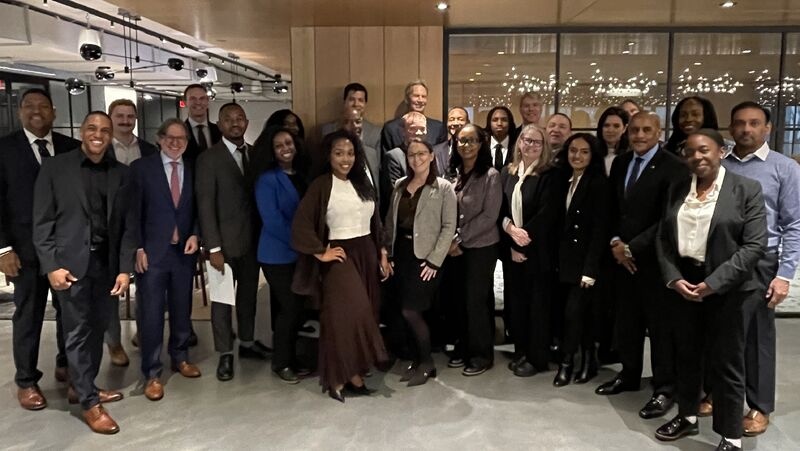
In February 2026, McGee shared her enjoyment of that New York gathering and invited people to subsequent events in Washington and Barbados. The meeting brought together investors, development institutions, regional leaders, and other participants around the question of mobilizing Caribbean capital. John Morris, IAM's executive chairman and 17 AM's founder, presented the $100 million CaribGROW offering. That figure describes the vehicle being marketed, rather than a completed fundraise.
Teaching the work, then returning to it
Alongside her commercial responsibilities, McGee is executive director of the 17 Intentional Investment Institute and oversees its global fellowship. The five-month program combines research, financial modeling, impact measurement, and systems thinking with live projects. Its published network comprises more than 300 fellows and alumni across more than 35 countries. Students, early-career professionals, and people changing careers are among its intended participants.
There is continuity with her own graduate experience: learning through a problem that demands an actual deliverable. Fellowship work includes regional research, diligence, and investment preparation. The program is part-time, with remote participation and opportunities in New York. Its reach gives McGee's remit a geographic breadth that her home city alone cannot convey. It also places the development of future practitioners beside the daily business of serving current clients.
Her institutional connections extend into PeaceTech. Working with strategic adviser Judith Francois Langevin, McGee forged a partnership with the University for Peace's New York initiative. The program connects research, investment structuring, and support for technology ventures aimed at peace and governance. In a different setting, she joined the November 2024 ETP Forum panel on the future of indexing, alongside participants from Syntax Data, LSEG, and MerQube.
These settings range from a student software proposal to a public-markets panel and regional private investment. Together they show where McGee's work has taken her. The interesting detail is how often the task returns to the arrangements behind an ambition: who gathers the information, what sort of financing fits, how a company prepares, and who keeps the organization running. Her career has repeatedly put her close to those arrangements. The spreadsheet, after all, still needs an owner.