The most expensive photograph on a construction project may be the one nobody can find. It is somewhere in an inspector’s camera roll, next to a lunch photo and three nearly identical shots of wet concrete. The timestamp is vague. The location lives in somebody’s memory. Six months later, a contractor asks to be paid, an owner questions whether the work met specification, and a project team begins an archaeological dig through folders, notebooks and inboxes.
HeadLight, a Seattle software company born from University of Washington transportation research, built its business around ending that dig. Its Fieldbook product lets inspectors capture photographs, video, quantities, notes and forms in the field, attaches useful context, and moves the record into reports, approvals, search and analytics. The company calls itself the digital backbone of modern infrastructure delivery. A less polished description is more revealing: it gives roads, bridges, tunnels and water projects a memory that survives staff turnover and contractual disagreement.
The first thing that broke was the inspector’s evening
HeadLight did not begin with an AI pitch. The company began in 2005 as Pavia Systems, the first startup spun out of UW’s civil and environmental engineering department. George White, Si Katara and professors Joe Mahoney and Steve Muench commercialized web-based training and design tools for the paving industry. It was a sensible origin: learn the technical language, earn credibility and serve a market ignored by general software.
But training was not the sharpest pain. Road inspectors were still documenting work with pencils, paper and standalone cameras, then returning to the office to reconstruct a daily report. HeadLight, launched as Pavia’s mobile inspection product around 2014, attacked that second shift. A 2015 pilot reported savings of one hour and 45 minutes per inspector per day. That result clarified the opportunity. The product was no longer about putting industry knowledge on a screen; it was about capturing reality before context evaporated.
“I can’t buy time but I can buy HeadLight.”Senior inspector at a state transportation department, quoted by HeadLight
What the product actually does
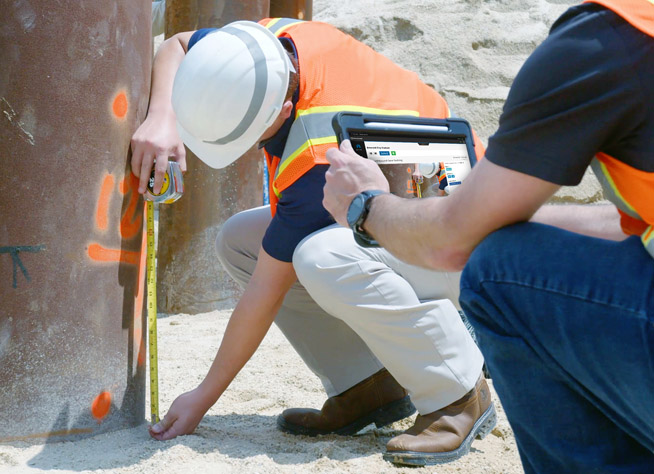
Fieldbook connects an iPad app used at the jobsite with a web workspace used by project engineers, managers and reviewers. An inspector records an observation once. The system can associate photos and notes with location, time, contract activity or material, then use that same information to assemble daily work reports and move them through submission, comment, approval or rejection. Office users search the record while the field keeps working.
Around that core, HeadLight sells configured modules for construction oversight, materials sampling and laboratory testing, digital forms, contract administration, bridge and asset inspection, reporting and data integrations. Bridge teams can combine field observations with drone imagery, tag defects, record condition ratings and compare imagery across time. Materials teams can follow a sample from plan to collection to lab result. An open API and integrations such as Louisiana DOTD’s connection to AASHTOWare SiteManager aim to prevent the old disease - typing the same fact into two systems.
The record gains value downstream
The distinction from a generic construction platform is depth, not magic. Procore, Autodesk Construction Cloud, HCSS, e-Builder, Kahua, Aurigo, AASHTOWare and a determined collection of spreadsheets can all cover pieces of the job. HeadLight’s bet is that public infrastructure inspection has enough specialized vocabulary, mandated output and institutional friction to reward a purpose-built system. Its website says 350 distinct document formats have been configured. That number is less glamorous than an AI demo and more likely to explain why a transportation agency stays.
The customer is a chain, not a persona
HeadLight sells to public owners, transportation departments, engineering firms and contractors, but the buying committee is only half the story. Field inspectors must accept the capture experience. Project engineers must trust the reports. Executives need visibility. Records managers need retrieval. IT and security teams need controlled access and integration. A tool that delights the dashboard buyer while irritating the person standing in rain beside fresh asphalt will produce a beautifully visualized data desert.
Named customers and project partners include Louisiana DOTD, Utah DOT, Minnesota DOT, Contra Costa Transportation Authority, Jacobs, Hill International, HNTB, Sound Transit and GFT, formerly TranSystems. HeadLight says its technology has supported more than $20 billion of infrastructure across more than 25 states. On one Sound Transit expansion, Hill International logged more than 60,000 observations. On a Chicago bridge job, TranSystems reported finishing six months early, under budget and without claims. Those outcomes belong to entire delivery teams; software is an instrument, not the orchestra.
Signals from the field
Independent transportation research supplies the more useful nuance. In an Oregon DOT pilot, 74 percent of participants found team information-sharing easier, all believed the quantity of collected data improved, and 63 percent said quality improved. Yet end-of-day entry averaged 27 minutes with HeadLight versus 29 minutes in the traditional process because an integration was not active. That near-tie is the warning label: a mobile interface alone does not remove work if the surrounding system still demands duplication.
What it costs - and what customers are really buying
HeadLight uses enterprise pricing tailored to team size, project scope and features. The company offers a free trial for its Beam Capture tool, but the full platform is sold by quote. This is not app-store software because the invoice covers more than seats. Configuration, integrations, deployment, iPad inspection units, training and support are part of making the workflow operational. In government and major infrastructure, the cost comparison is not “software versus paper.” It is software and change management versus administrative time, missing records, delayed decisions and claims exposure.
The company has financed that approach with roughly $32.5 million across publicly reported rounds, including a $25.6 million Series B led by Viking Global Investors in June 2020. That capital arrived when Pavia Systems adopted the name of its flagship product and set out to scale photo-based inspection. HeadLight’s supplied company data estimates 54 employees and $15 million in annual revenue; because it is private, the revenue figure should be treated as an estimate rather than a filing-grade fact.

HeadLight describes its culture as collaborative, flexible and supportive, with approachable leadership and a blunt “no-jerks” policy. Its operating principles emphasize customer focus, trust, action, growth mindset and ownership. That may sound like standard careers-page material until you match it to the product. Enterprise field software lives or dies in deployment. The people configuring forms and training hesitant users are not a service layer pasted onto the product; they are part of the product’s reliability.
The AI is useful when it stays in its lane
HeadLight’s bridge product uses machine learning to process large image sets and identify features such as cracks or spalling, guiding inspectors toward areas of concern. The word “guiding” matters. Its terms describe HeadLight as a project-management and inspection tool, not a source of engineering, legal or regulatory advice. For critical infrastructure, automated detection should narrow attention, standardize review and reveal changes across time - not turn a probabilistic suggestion into an unattended safety decision.
The deeper AI advantage may be less photogenic. Structured, consistently labeled field observations are the raw material any useful model needs. A company that captures the moment of work, maintains provenance and knows the agency’s forms owns a cleaner path to analysis than one trying to reconstruct meaning from a folder called “Final Photos 2.” HeadLight’s phrase “AI-ready data” is credible only to the extent that its customers maintain the capture discipline.
The steal-this playbook
Build the memory before the dashboard
- Start where the data is created, not where executives eventually review it.
- Attach context automatically while the event is fresh.
- Reuse one observation across reports, approvals, payments and search.
- Match the customer’s mandated output instead of demanding a clean-slate process.
- Treat training, integration and support as core product surfaces.
Where the model works - and where it does not
HeadLight is strongest on long-lived, regulated, multi-party projects where visual proof matters and the cost of ambiguity compounds: highways, bridges, transit, stormwater, utilities and disaster recovery. The more inspectors, contract items, required forms and years involved, the more valuable a consistent record becomes. A searchable history also helps when experienced staff retire or when a project moves from construction into maintenance.
Good conditions
- Regulated, evidence-heavy infrastructure work
- Many field and office stakeholders
- Repeatable forms and approval workflows
- Real claims or compliance exposure
- Leadership funds training and integration
Bad conditions
- Small, simple, short-duration projects
- Teams unwilling to change field habits
- No owner for data standards
- Weak device or connectivity planning
- Duplicate entry remains after rollout
It is a weaker fit when documentation is light, the team is tiny, and a shared folder genuinely works. It can also disappoint when buyers underfund onboarding, preserve conflicting legacy processes, or mistake more data for better decisions. HeadLight’s own release notes show the prosaic work of maintaining an operational tool: faster uploads, storage management, form filtering, bug fixes and ending support for old iOS versions. Field software must be boringly dependable before it can be strategically interesting.
The latest stage is larger. In 2026, HeadLight announced work with STV and Turner Construction on the Port Authority of New York and New Jersey’s Midtown Bus Terminal replacement program, a complicated build that must keep a major commuter gateway operating. It is exactly the sort of environment that tests the thesis: enormous stakeholder count, years of work and expensive consequences when the record fractures.
The lesson from HeadLight is not that every paper form deserves a startup. It is that some forms are the visible edge of an unusually costly information problem. Follow the observation from creation to dispute. Count every re-entry, missing attachment and after-hours reconstruction. Then build the shortest trustworthy path between the person who saw the work and the person who must decide what it means. Infrastructure already lasts for decades. Its memory should, too.