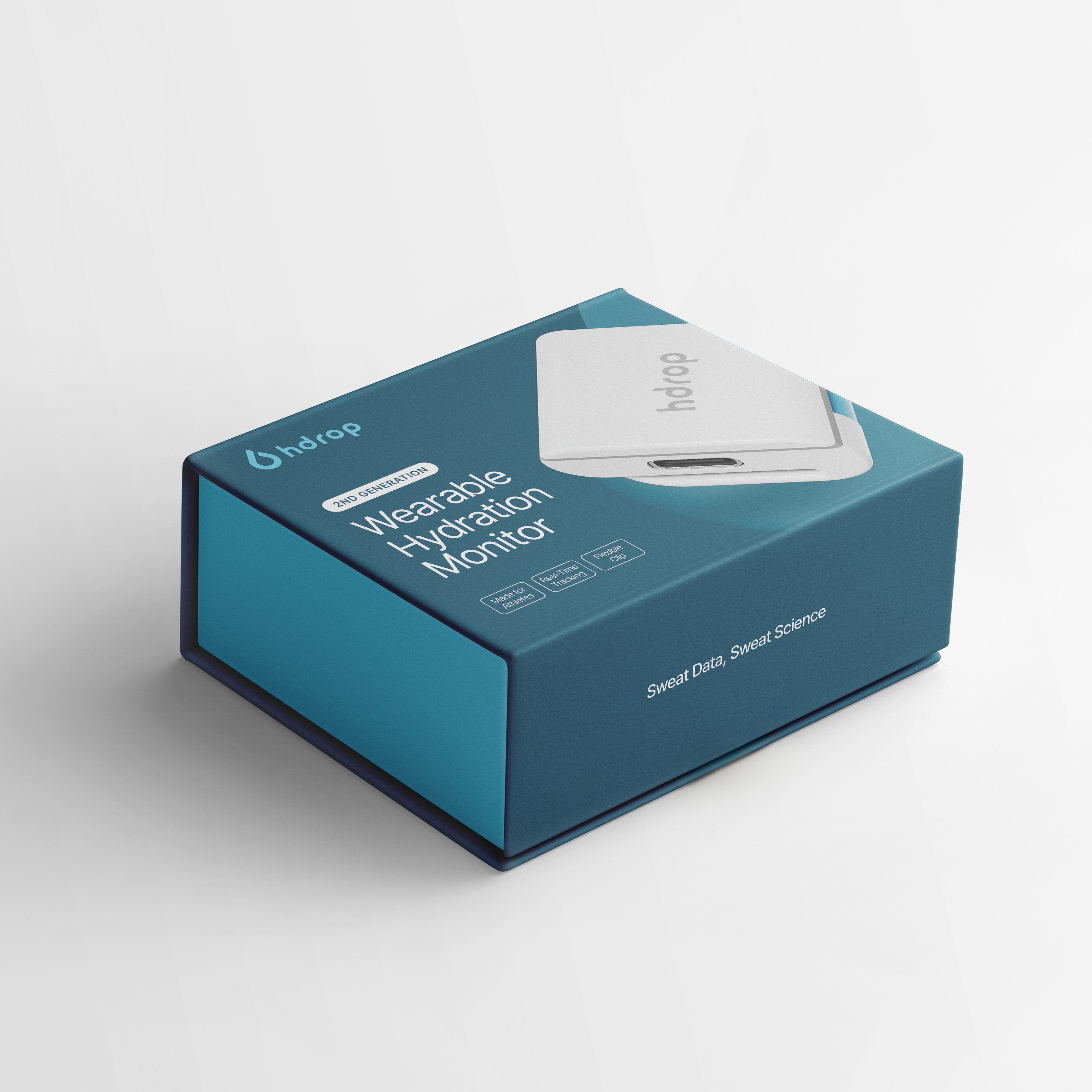
Sweat is rude data. It arrives late, pools unevenly, evaporates, picks up sunscreen and salt, and changes its mind when the weather, pace or athlete changes. hDrop Technologies built a company around making that mess legible. Its white, thumb-sized Gen 2 sensor sits against the upper arm or clips to a heart-rate strap, samples sweat and sends an app estimates for fluid loss, sweat rate, sodium, potassium and near-skin temperature. The pitch is tidy: stop drinking by folklore and start learning what your own body loses.
The company began in 2019 as a Harding University student venture. Co-founder and chief executive Adria Abella Villafranca has traced the idea to his own experience as a college tennis player. He and fellow mechanical-engineer founders Michael A. Cruz and Amine Mehdi Mansouri built the early product with help from VentureWell, whose customer-discovery coaching delivered the kind of sentence founders usually learn after wasting much more money: “Entrepreneurs must focus on meeting customer needs. Without customers, you're without a business.”
That lesson moved hDrop away from a laboratory novelty and toward a specific customer with an expensive problem: runners, cyclists, triathletes, coaches and teams training long enough, hot enough or salty enough that generic hydration guidance becomes a bad bargain. A recreational runner can guess. An Ironman athlete staring at six hours of heat needs a repeatable plan.
01 / What the box actually does
It turns one wet patch of skin into a decision
During a session, hDrop's electrochemical and temperature sensors take frequent readings at the skin. The app uses those local signals, the athlete's profile, conditions and calibration to estimate whole-body losses. It presents the result through live metrics, post-workout totals and three “Sweat Zones” - concentrated, target and diluted. It can compare an athlete's sweat sodium concentration with the sodium in common sports drinks, making the output more practical than a lonely milligram-per-liter number.
The differentiator is reuse. Nix and Gatorade's Gx have used disposable sensing patches; FlowBio competes in reusable monitoring. hDrop made its commercial bet on a rechargeable device that can be wiped, clipped and used again. That removes the recurring patch bill and reduces waste, but it also changes the burden of proof. A reusable sensor must survive sweat, motion, charging, Bluetooth handoffs and months of impatient fingers. The $249.99 purchase only becomes economical when the owner collects enough good sessions to build a personal pattern.
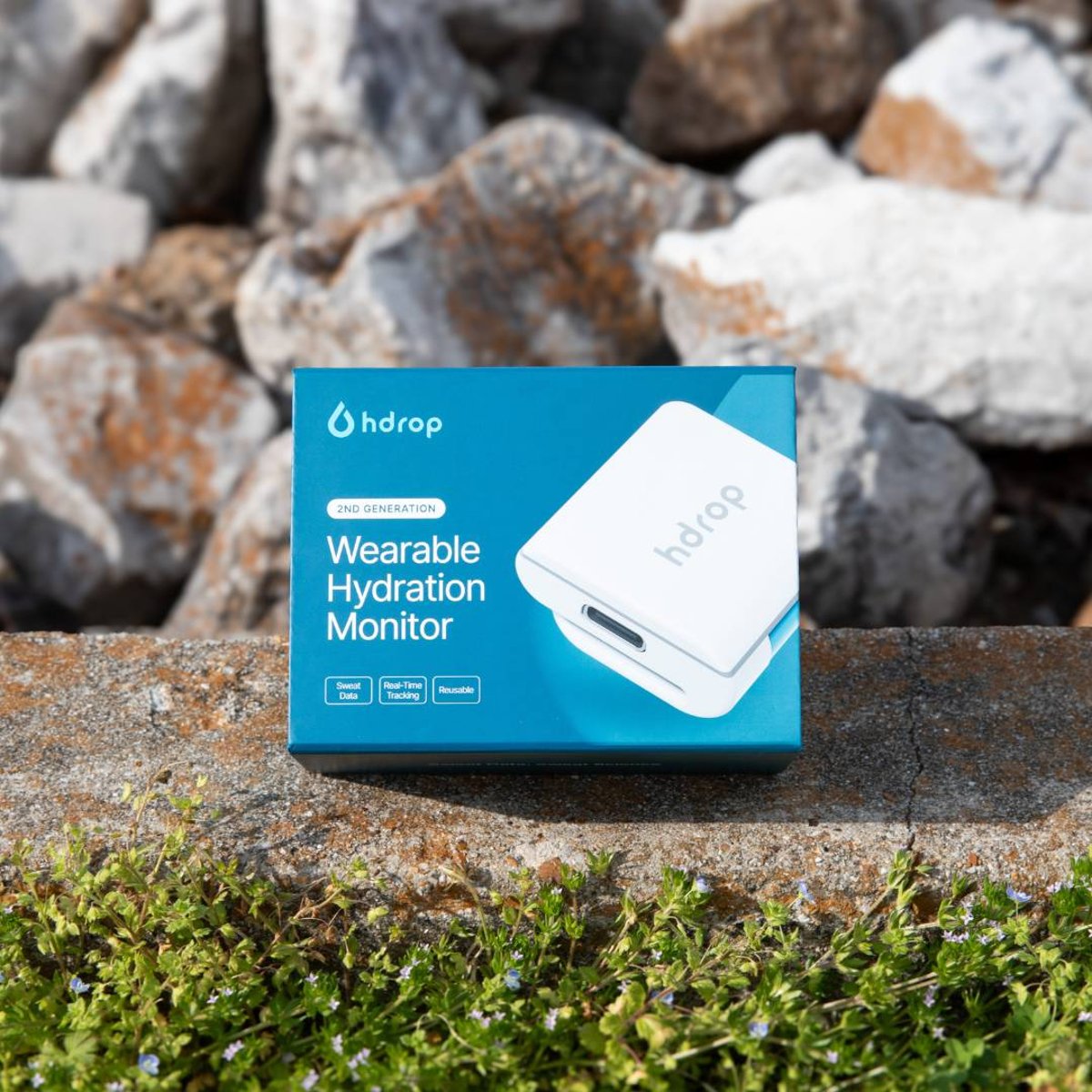
This is consumer hardware with a second, quieter business inside it. hDrop sells direct online and through endurance retailers, while teams and coaches can use multiple athletes' readings to set individualized protocols. An optional hDrop Lab subscription adds deeper analysis and export tools. Integrations with Apple Health, Android Health Connect, TrainingPeaks, Garmin workflows and Wahoo ELEMNT computers place the data beside pace, power and heart rate, where an athlete is already looking.
02 / The first public fault line
Heavy sweaters found the edge of the model
The first substantial public independent field test was not a victory lap. Precision Fuel & Hydration put hDrop through 57 running and cycling sessions with nine usable participants over six months. Against pre- and post-exercise nude body-mass change, the device underestimated sweat rate by an average 0.58 liters per hour, or 36 percent. It slightly overestimated sweat sodium concentration by 177 milligrams per liter, or 15 percent, compared with the tester's sweat analyzer.
One participant, measured at 2.75 L/h, was estimated by hDrop at 1.16 L/h across 12 trials. That is not a rounding error; it is the kind of miss that matters to the person most motivated to buy a sweat sensor. A device sampling one arm must extrapolate to an entire body whose sweat distribution is not uniform. Fit, local airflow, residue, sunscreen and movement add noise. The physics does not care how clean the dashboard looks.
“Athletes who lose more than ~1.5 L/h present a tougher challenge for any wearable sensor.”hDrop, responding to independent field testing
What changed? The testing and customer feedback became product work. hDrop added an adaptive calibration feature in July 2025 for athletes above roughly 1.5 L/h. Later independent reviewers reported that correctly calibrated post-session fluid and sodium totals became useful, even while criticizing the app's calibration flow and Bluetooth handoff. App releases in 2026 explicitly targeted upload reliability, calibration UX, data-loss bugs and connectivity. The company did not discover that calibration was necessary; it discovered that calibration had to be understandable enough for a sweaty person finishing a workout.
That is a copyable lesson for biometric founders. Accuracy is not only a sensor specification. It is the entire chain from placement and pairing to calibration, storage, upload and interpretation. If a user can choose the wrong activity mode or cannot retrieve the workout, the laboratory precision of the electrode is irrelevant.
03 / The habit worth stealing
Do not buy a verdict. Build a baseline.
The most convincing hDrop use case comes from athletes who treat the gadget as one witness, not the judge. Professional triathlete Lionel Sanders showed a ride with 4.05 liters of estimated fluid loss, a 1.88 L/h sweat rate and sodium concentration of 1,300 mg/L. The useful detail was not the size of the number. Sanders compared it with three earlier lab tests, which he recalled landing between 1,200 and 1,500 mg/L, and planned to check total fluid loss against the change in his body mass.
Repeat one session
Use a familiar route, duration and effort. Record heat, humidity, clothing and whether it was indoors.
Standardize placement
Use the recommended upper arm and the same side. Clean the skin and keep sensor pressure consistent.
Check the total
Compare fluid loss with pre/post body mass, adding drink intake and subtracting urine where relevant.
Change slowly
Collect several comparable trials before changing sodium or fluid targets, then test the new plan in training.
Anyone can steal that protocol without buying hDrop. The company simply makes the repetition easier and the electrolyte signal visible in real time. Start with a stable session. Weigh carefully. Track what you drink. Repeat in another condition. Look for a range, not a sacred number. Then test an intake the stomach can tolerate. Total loss is a description of what left the body, not an order to replace every milliliter and milligram while moving.
The same operating logic explains hDrop's partnerships. RCD Espanyol can use individual profiles rather than one bottle recipe for an entire football squad. Professional triathlete Matt Hanson can compare bike and run demands under race-specific heat. TrainingPeaks can put hydration totals next to the workout plan. Wahoo can move the number onto a bike computer during the ride. Each partnership embeds the data in an existing decision rather than asking athletes to admire another app after dinner.
04 / The market boundary
Useful in the heat. Excessive on a cool 5K.
hDrop sits between occasional lab testing and mass-market fitness tracking. A lab can provide a controlled snapshot; a scale can estimate whole-body sweat loss cheaply; a watch can record the workout. hDrop's place is continuous field context - how loss changes with heat, intensity, duration and sport - without a new patch for every session. Its customers pay to replace averages with their own history.
It fits when...
- training lasts long enough for fluid strategy to matter
- heat, salt loss or cramping makes generic advice inadequate
- an athlete or coach will repeat and compare sessions
- live data can change a practiced plan
It does not fit when...
- workouts are short and temperate
- the sport is swimming
- one reading will be treated as medical truth
- a heavy sweater will not validate the estimate
The medical boundary matters. hDrop calls itself a fitness tracker, not a medical device, and tells users not to make critical decisions from its data. It is also a poor match for anyone who expects effortless reliability in remote places. Current app-store and community reports still include failed uploads, Bluetooth trouble and the need for an internet connection to start some sessions. Those complaints are not side notes. For a trail runner beyond cell service, the workflow is the product.
The company's path has nevertheless been unusually capital-efficient for connected hardware. Public records show early convertible funding, VentureWell grants, a Kickstarter that raised $28,719.90 from 249 backers, a later seed round, a U.S. patent and FCC approvals for two generations. In 2023, Gen 2 won a European Product Design Award. In 2025, hDrop entered Europe through distributor From Minus Zero and announced RCD Espanyol as an early club user. In 2026, it joined the Arkansas Global Cycling Accelerator and expanded the training stack.
The company is not selling certainty. Its credible product is narrower and more interesting: a reusable instrument for forming a better personal hypothesis. If the same route, weather and effort keep producing similar sodium and fluid patterns, the athlete can build a bottle around evidence. If the readings wander, that is evidence too - check placement, calibration, conditions and body mass before doing anything dramatic.
That restraint is where hDrop is different from the usual wearable theater. The screen can flash a score, but the valuable move happens off-screen: compare, repeat, question, adjust. Sweat remains rude data. hDrop's opportunity is to make it useful without pretending it has become polite.