A crumpled shirt is a small rebuke to the dream of artificial intelligence. It has no fixed shape. Its sleeves hide inside one another. Turn it over and the problem changes. A person folds it while thinking about dinner; a robot has to work out what, exactly, a shirt is doing today. For 1X, the Norwegian-founded robotics company now based in Palo Alto, this domestic nuisance is a business opportunity and a curriculum.
- 1X builds NEO for households, following its earlier wheeled EVE enterprise robot.
- Early Access ownership is advertised at $20,000; a later subscription is $499 a month.
- Unknown chores can involve a scheduled remote human expert.
- The wager: everyday homes will supply the experience needed for more capable robot intelligence.
The house is the curriculum
Bernt Øivind Børnich founded the company as Halodi Robotics in 2014. Its early work went into the machinery that makes a robot move. In 2018 came Revo1, a motor developed for low gear ratios and flexible mechanics. The ambition required a body that could operate near people, rather than require people to keep their distance.
EVE, the wheeled humanoid, reached customer facilities in 2022. Enterprise work offered a sensible starting point: industrial tasks, logistics and guarding. Then came a more peculiar conclusion. In its own history, 1X dates its turn toward the home to 2023, explaining that machine intelligence needed a broader view of the world. Factories could provide work; homes could provide variety.
That is the distinctive argument behind NEO. A home is an environment designed for human bodies, filled with objects whose locations and uses keep changing. A general-purpose machine needs more than a repeatable routine. It needs to cope when the routine has been interrupted by ordinary life. Someone moved the chair. Someone left the cupboard open. Someone means a different thing by “tidy.”
“If androids are going to work in our world, they need to experience our world.”
Bernt Børnich, 2023
A robot dressed for company
NEO Beta appeared publicly in 2024; Gamma followed in 2025. In October 2025, 1X opened consumer preorders for the subsequent NEO Home Robot. Its proposed work is deliberately domestic: fetching objects, organizing shelves and handling laundry. The sales pitch concerns the hours that disappear between arriving home and finally sitting down.
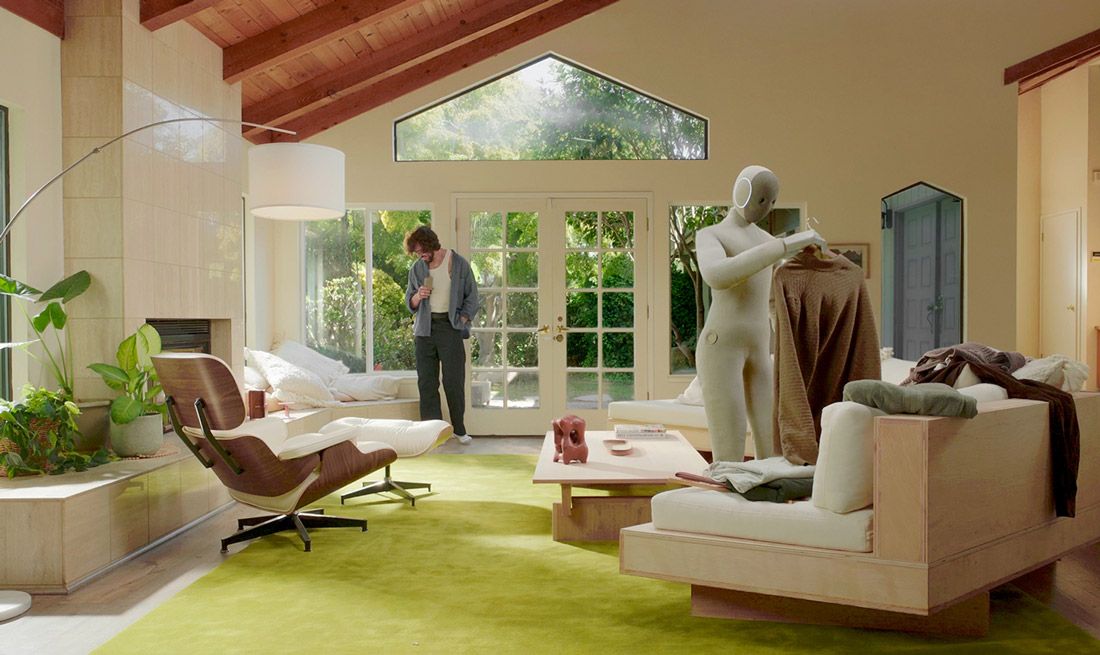
The wardrobe extends to the robot. NEO comes in muted colors, with a knit suit and shoes. Its soft outer body uses a deformable lattice to cushion internal components. Tendon-driven actuation is intended to produce compliant movement. These details make sense for a machine entering rooms where people lean, reach and wander without announcing a trajectory.
In July 2026, 1X announced new hands with 25 degrees of freedom, intended to ship on every NEO. The engineering argument concerns touch as much as dexterity. A hand can press, feel resistance and change its grip. A robot that merely sees a cup has different information from one that feels it begin to slip. For a household helper, the difference may eventually be measured in crockery.
The help desk inside the house
The revealing feature on NEO’s order page is Scheduled Expert Mode. Early owners are promised basic autonomy. For complex tasks the robot does not know, an expert from 1X can remotely supervise its actions at an arranged time. Owners can also pilot NEO through the mobile app and a VR device.
This makes the customer relationship unusually intimate. The household buys assistance, while some of the assistance helps teach the machine. A prospective owner should understand which chores run independently, which require scheduling and what remote participation involves. A demo of a completed task cannot answer those questions by itself.
- 01A household asksA task in a changing room
- 02NEO attemptsIts available autonomous skills
- 03Help when neededA scheduled expert guides unfamiliar work
- 04Experience informs learningData, training and evaluation
Conceptual diagram. Learning does not guarantee immediate mastery of a task.
Redwood, introduced in June 2025, connects vision, language and the robot’s own joint information to actions. Its training includes teleoperated and autonomous episodes from EVE and NEO, collected in offices and employee homes. It also learns from failed attempts. That choice is useful: a machine needs information about the awkward positions it reaches when things go wrong, not only the tidy sequence that worked.
The air fryer had other ideas
Failure becomes particularly entertaining when the robot is imagining it. In 2024, 1X described a world model trained to generate possible futures from robot observations and proposed actions. The published examples included objects changing appearance or vanishing, a plate suspended in the air and a failure to reproduce EVE’s behavior correctly in a mirror. Physics was still negotiating its contract.
The June 2025 research supplied a more practical example. With insufficient interaction data, the model treated an air fryer’s tray and body as a single unit. More relevant data helped it model the removable tray. The error concerned a mundane physical relationship, precisely the sort of thing a person barely notices until a machine gets it wrong.
By January 2026, 1X had extended the approach into a video-to-action policy. A world model generates an intended future; an inverse dynamics model translates the changes between frames into robot actions. The system is grounded with human-perspective data and NEO sensorimotor logs. In June, the company launched a World Model Lab led by Sam Sinha.
The practical lesson travels well beyond robotics: test the troublesome interaction. A convincing picture of success is a weak substitute for handling the object. For builders, the air fryer is a useful reminder to preserve failure cases and evaluate the situations that training data has overlooked.
A cup, two hands, one kitchen
In March 2025, 1X and NVIDIA described a collaboration in an employee’s home. Their demonstration taught NEO Gamma to grasp a cup, transfer it between hands and put it into a dishwasher. The teams spent a week developing the model and comparing technical choices.
Before scaling the work, they checked that a baseline could learn a small demonstration set and that images and actions stayed synchronized from recording to execution. It is a wonderfully unglamorous detail. A robot-learning system can fail because its observations and movements disagree about the time. The first useful experiment was therefore a compatibility check, conducted in a kitchen.
1X’s competition extends into that kitchen. Figure 03 also targets home use, with soft materials and a manufacturing strategy for general-purpose robots. Agility’s Digit has a clearer industrial focus, including commercial work at GXO. 1X’s consumer pricing and household learning strategy give it a distinct proposition, but the home is becoming contested ground.
The price of a useful hour
NEO’s advertised Early Access offer includes ownership, premium support, priority delivery and a three-year warranty. The later subscription includes a starter productivity package and standard delivery. A refundable $200 deposit reserves an order. These are different offers, with different timing and support, so a simple price comparison has limits.
This compares sticker prices only, not identical benefits or total lifetime costs.
The household calculation is harder. How many tasks get finished? How much supervision remains? Does the machine handle the chores this particular household dislikes? A cleaner or a specialist appliance may be the more useful purchase when the job is narrow and dependable completion matters immediately. NEO makes more sense as an early-adopter proposition for someone willing to participate in a developing product.
A home that cannot accommodate scheduled remote assistance, or expects every unfamiliar chore to work immediately, is a poor match for that proposition. The relevant measure is useful work completed with an acceptable amount of attention. Height, hand joints and a handsome knit suit are inputs to that result.
The machine behind the machine
Funding has supported the journey: a disclosed $23.5 million Series A2 led by the OpenAI Startup Fund in 2023, followed by a $100 million Series B in January 2024 with EQT Ventures participating. In 2025, 1X acquired Kind Humanoid, bringing Christoph Kohstall and his team into the company.
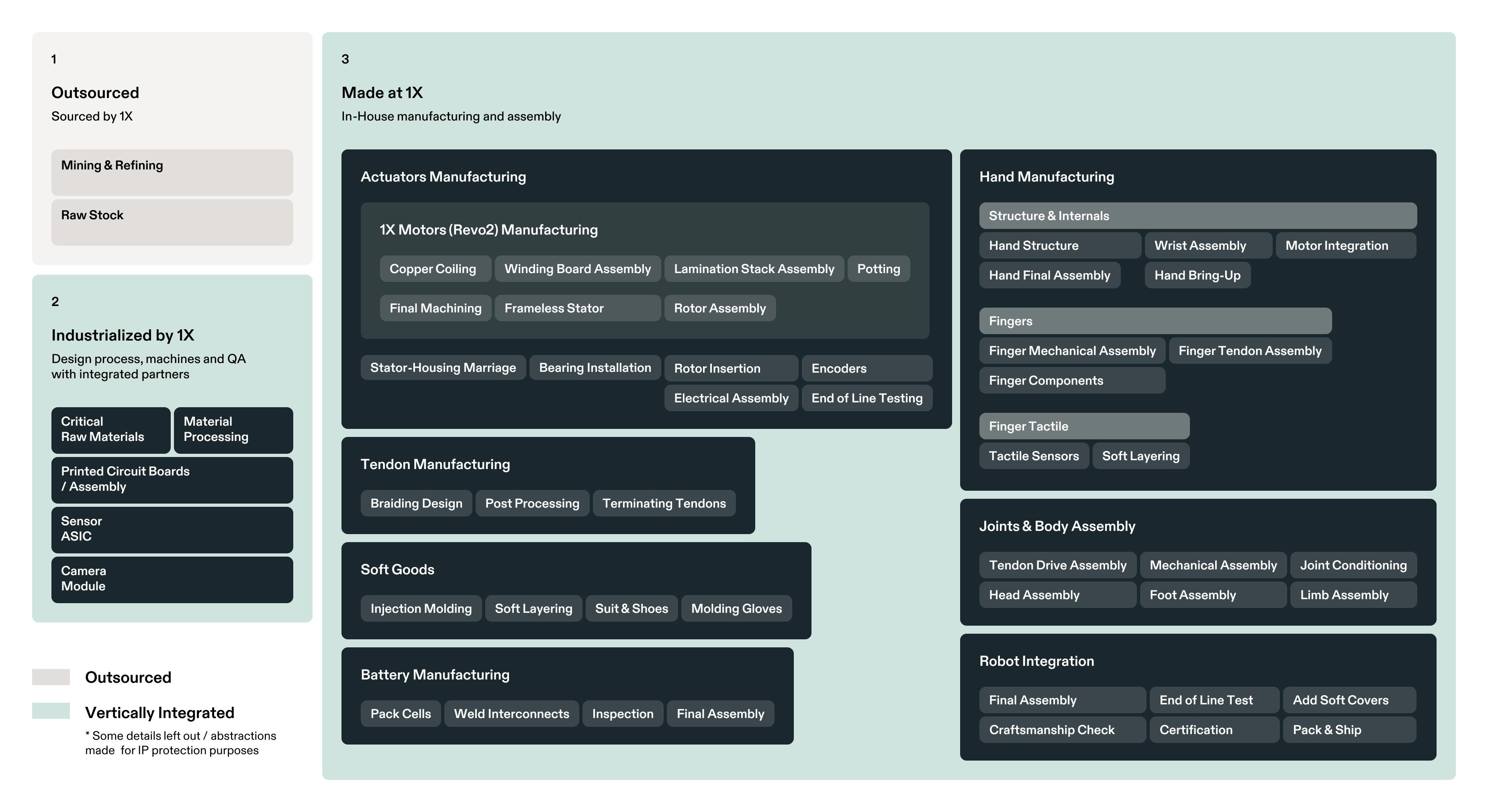
In April 2026, 1X presented its 58,000-square-foot Hayward factory. It said reservations had filled planned annual capacity of 10,000 robots within five days. That is a company-reported demand signal, not an installed fleet. Its factory account described in-house component production, employee-home testing and phased consumer delivery plans, with some buyers receiving robots later.
The company also distinguishes assembly checks from end-of-line discovery: verify parts as functionality is added, so mistakes surface while they are still local. That is another practice readers can borrow. A fault found at the next station is usually easier to understand than one found in a finished machine.
1X has chosen a demanding customer and an unforgiving classroom. The household wants its time back. The robot needs experience. Whether the exchange works will be settled by small, repeated acts: a cup put away, a door opened, a shirt folded without becoming someone else’s problem. The laundry basket will be keeping score.
Meet NEO, then watch it work
NEO product details · Pricing and reservations · Robot-learning research · Company stories
NEO launch film · Inside the factory · NVIDIA kitchen collaboration · The new hands · Børnich interview: Relentless
Website · LinkedIn · X · Instagram · Facebook · GitHub research · YouTube · TikTok