A towel is an awkward teacher. It folds differently after each wash. One corner vanishes under another; a sleeve becomes a small conspiracy. A robot that succeeds once has learned something, but the more interesting question is whether that lesson can help a different robot, in a different room, with a different towel. Quan Vuong has spent years working around that question. His path runs from research on reinforcement learning to a collaboration among dozens of laboratories, and then to Physical Intelligence, the company he co-founded in 2024. Across those settings, the recurring problem is transfer: how to keep a machine's hard-earned experience from being trapped inside one machine.
It is an easy ambition to say aloud and a difficult one to make useful. Robots live with friction, gravity, camera angles, and objects that refuse to stay put. A model that recognizes a shirt in an image has further work to do before it can lift, orient, and fold one. Vuong's work sits in that gap between naming a thing and handling it.
A student of useful uncertainty
Long before the Greek-letter model names, Vuong's own account of his education was unusually wide-ranging. At the University of California San Diego he pursued PhD research in deep reinforcement learning, computer vision, and robotics, advised by Henrik Christensen and Hao Su. He also names undergraduate mentors in reinforcement learning, computational geometry, synthetic biology, and spectral clustering. It is a list with the restless quality of someone testing where mathematics might touch the world.
A less expected detail sits beside those papers. An undergraduate team he joined built a smart driving assistant and won a UAE national innovation competition for university students, with a $250,000 prize. He trained as a debater and served as vice president of student government. Those facts do not make a neat origin myth, which is why they are useful. Before robot foundation models became his professional vocabulary, he was making an assistive device, practicing argument, and learning how a group gets something finished.
“I am fortunate to have incredible and supportive research mentors.”Quan Vuong, reflecting on his education
He used that sentence to introduce his teachers, not to decorate a founder biography. The names matter because robot learning is profoundly collective. A student can write an algorithm. A lab can run experiments. A field learns more slowly unless people compare results, share code, and expose a promising idea to machines they did not build themselves.
Three internships and a larger machine room
During his PhD years, Vuong spent 2019 at Microsoft Research, 2020 at Google Research, and 2021 with the robotics team at Google Brain. In 2020 he received a research grant of $20,000 in Microsoft Azure credits. His early publications dealt with policy updates, exploration, and reinforcement learning - work concerned with how an agent chooses actions and improves from feedback. A NeurIPS 2019 paper on optimistic actor critic and a NeurIPS 2020 paper on constrained deep reinforcement learning each received a spotlight presentation.
The academic phrasing can hide the stakes. If a robot must learn from experience, somebody must decide what experience is worth collecting, how to learn without wasting it, and how to know whether the result survives outside the training setup. Those were research questions before they became the sales pitch of an industry. Vuong's papers and internships show a researcher moving toward physical machines while keeping the learning problem in view.
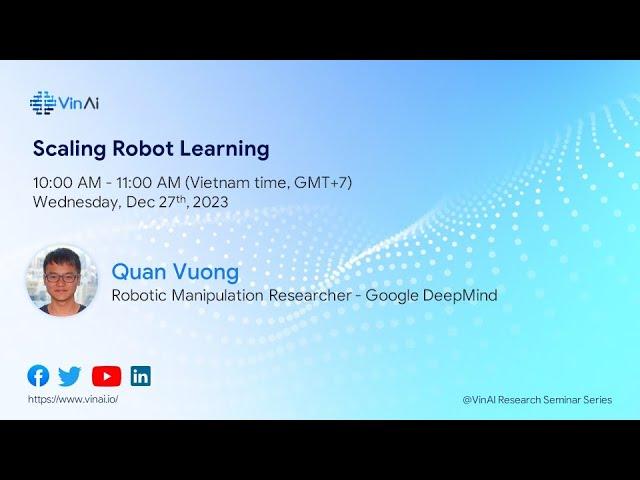
By late 2023 he was introduced at that VinAI seminar as a robotic manipulation researcher at Google DeepMind. The talk promised a tour of the robot transformer line: RT-1 for learning actions from robot experience, RT-2 for bringing vision-language knowledge closer to physical control, and RT-X for pooling lessons across hardware. Each step made the problem broader. Each also made the old dream of a robot learning from another robot somewhat less fanciful.
The number was twenty-two
Open X-Embodiment, published in 2023, brought together researchers from 21 institutions and data from 22 robot types. Vuong was among its authors. The collaboration tested a question whose ordinary wording masks its scale: could one model benefit from the behavior of many differently built robots? A gripper, an arm, and a mobile manipulator do not share a body's geometry. Nor do different labs share lighting, tasks, cameras, or habits of recording data. To combine their demonstrations is to treat variation as a resource instead of an inconvenience.
The significance was methodological as much as numerical. A clever policy on a single robot can be hard to compare with a clever policy on another. A shared dataset and shared training effort let researchers ask what actually travels. It also exposes failure. A model may generalize to a new object yet stumble when the camera moves; it may learn a motion that one gripper can make and another cannot. The point of the collaboration was to put those mismatches in the open.
Vuong did not arrive at this work alone, and the paper's very long author list is part of its story. Robot learning had reached a point where useful scale required institutions to cooperate. A field that once prized the ingenious machine in one lab was beginning to ask what all its machines might teach a common model. The answer was incomplete, but the question had changed.
How a shared robot lesson travels
A company built around the transfer
Physical Intelligence was founded in 2024 by a team that includes Vuong, Karol Hausman, Sergey Levine, Chelsea Finn, Brian Ichter, Lachy Groom, and Adnan Esmail. Its stated aim is general-purpose AI for the physical world: learning algorithms that can control many robots and many tasks. The company has published a sequence of models, beginning with π0 in 2024 and extending through later versions that address open-world behavior, speed, learning from experience, and steerability. Vuong is a co-author of the π0 paper.
The names can feel like a private alphabet. The public question behind them is plain. Today, a team that wants a useful robot often has to build controllers, gather data, and train models for its own machine and workplace. Physical Intelligence wants a reusable layer that specialist builders can adapt. In a 2026 conversation with Y Combinator, Vuong discussed the prospect of cloud-run models and a wider range of robotics startups built on a common base. That is a strategic view of the same transfer problem he investigated as a researcher.
There is a delicious asymmetry in the idea. One company may be interested in laundry, another in packing orders, and a third in a task no lab thought to stage. Their machines and business routines differ, but some of the intelligence needed to see an object, move toward it, and recover from a poor grasp may be shared. General models are an attempt to make those shared parts available before every new builder has to rediscover them.
The unglamorous examination
In February 2026, Physical Intelligence described partner deployments that brought its models into a San Francisco laundromat and customer warehouses. Weave used them for folding clothes; Ultra used them for packing ecommerce orders. The partners reported improvements with newer models and with their own data included in pretraining. Weave reported fewer missed grasp sequences and interventions. Ultra showed a continuous run of order packaging at 96.4% autonomy in a customer setting. These are company and partner measurements, useful because they concern work outside a staged tabletop, though each remains specific to its setup.
Laundry is a particularly stern examiner. Fabric is deformable; the next shirt is not a rigid duplicate of the last. Packing orders introduces a different kind of variation: changing items, bags, boxes, and machinery. Neither application yields to a single elegant motion repeated forever. The work rewards a system that can recognize the situation, choose a move, and continue after a small mistake. It also rewards human operators and application teams who know the task well enough to improve the model's data.
This is where Vuong's research history becomes more than a résumé. The researcher who helped gather experience from many labs now works at a company trying to make a shared model useful to teams in particular workplaces. The technical arc is continuous. The daily evidence comes in stubborn physical details: whether a corner was caught, whether a package was placed correctly, whether the robot needed help to finish.
A future with room for specialists
Vuong's public comments point toward a robotics ecosystem in which general models lower the cost of beginning, while individual companies handle the machines, environments, and customers they know. In his Y Combinator appearance he spoke about an explosion of vertical robotics companies. It is an aspiration, not a prediction with a date attached. The physical world is too varied to grant one. A model that does well in a warehouse has more examinations waiting in kitchens, factories, and unfamiliar homes.
There is also a human version of the same idea in his career. He has thanked mentors across disciplines; his research papers carry long author lists; his company works with partners who bring different hardware and operational knowledge. A shared model is possible only because the learning came from somewhere. Robots may inherit skills, but the inheritance is assembled by people who build machines, collect demonstrations, test failures, and argue over what the results mean. Vuong has worked in each of those conversations.
His X biography adds a small, appealing aside: he is “perpetually trying to find a quiet place to read.” That sounds like a sensible wish for someone working in a field that moves from a paper to a machine room to a customer floor and back again. The larger question remains lively. When one robot finishes a task, what exactly did it learn - and who, or what, can use that lesson next?