A robot in a familiar room can make the future look surprisingly tidy. Give it a shirt, let it fold, and cut the clip before anything awkward happens. Then move the shirt, change the table, or send the robot to a house it has never visited. The difficult part begins where the video usually ends. Karol Hausman has made a career of that moment: the gap between a machine performing a task once and knowing enough to keep going when the world rearranges itself.
Hausman is the co-founder and CEO of Physical Intelligence, a San Francisco company building AI models for robots. He arrived there by way of mechatronics, a doctorate about perception and action, years at Google’s robotics research groups, and teaching at Stanford. The through line is unusually steady. He wants robots to acquire skills that travel: between objects, tasks, rooms, and even different machines. It sounds simple only until one asks a robot to pick up a cup it has never seen.
The droids from Koszalin
As a boy in Poland, Hausman was a Star Wars fan. He read the books and watched the films repeatedly. In a 2026 conversation, he remembered enjoying the variety of robots in that universe: their different jobs, personalities, and ways of interacting with people. It was a more interesting cast than the single-purpose machine a factory might keep behind a safety fence. The early attraction seems to have been less about metallic glamour than about robots having a place in ordinary life.
He grew up in Koszalin, a city near the Baltic coast, and later followed a curriculum with room for both gears and questions. At Warsaw University of Technology he studied mechatronics, earning bachelor’s and master’s degrees. He also completed a year of philosophy coursework at the University of Warsaw. The pairing has a certain logic. Engineering asks how a device moves; philosophy is free to keep asking what it means for that device to know what it is doing. Hausman later went to the Technical University of Munich for a master’s in robotics, where his thesis examined object recognition through interaction.
An object is more than the pixels it offers a camera. A mug can look like a small bowl from one angle; turning it or lifting it reveals the handle, weight, and use. This was the territory of “interactive perception,” the subject Hausman pursued at the University of Southern California. His 2018 PhD thesis was titled Rethinking Perception-Action Loops via Interactive Perception and Learned Representations. The central idea in that title is easy to grasp: a robot can act in order to see and understand better, then use what it learns to choose its next action.
During the PhD, a lecture by researcher Sergey Levine helped change his research direction toward deep learning. It was a consequential detour. Hausman’s doctoral adviser was Gaurav Sukhatme; his research trail also crossed labs at Google DeepMind, Qualcomm, NASA’s Jet Propulsion Laboratory, and Bosch. That is a lot of institutional geography for one question. The research itself was moving from carefully designed representations toward systems that could learn useful ones from experience.
A larger classroom for machines
In 2018 Hausman joined Google Brain. He eventually became a staff research scientist and robot manipulation lead, working on a team that brought many machines, researchers, and datasets to bear on robot learning. At Stanford he served as an adjunct professor and co-taught a class on deep reinforcement learning. The classroom and the lab shared a premise: a capable agent should improve through feedback from what it does. In a robot, the feedback arrives through cameras, motors, collisions, missed grasps, and the endless indignity of a shirt corner slipping from a gripper.
His publication list reads like a map of robotics trying to escape its narrowest demonstrations. SayCan linked language instructions to actions a robot could actually perform. RT-2 connected web-scale visual and language knowledge to robot control. Open X-Embodiment pooled work across more than 170 authors, 34 institutions, and over one million robot episodes. Hausman was one of many contributors to each effort. The scale matters because robot experience is expensive to gather and hard to share. A webpage can be copied; a physical attempt takes time, hardware, space, and someone willing to reset the table.
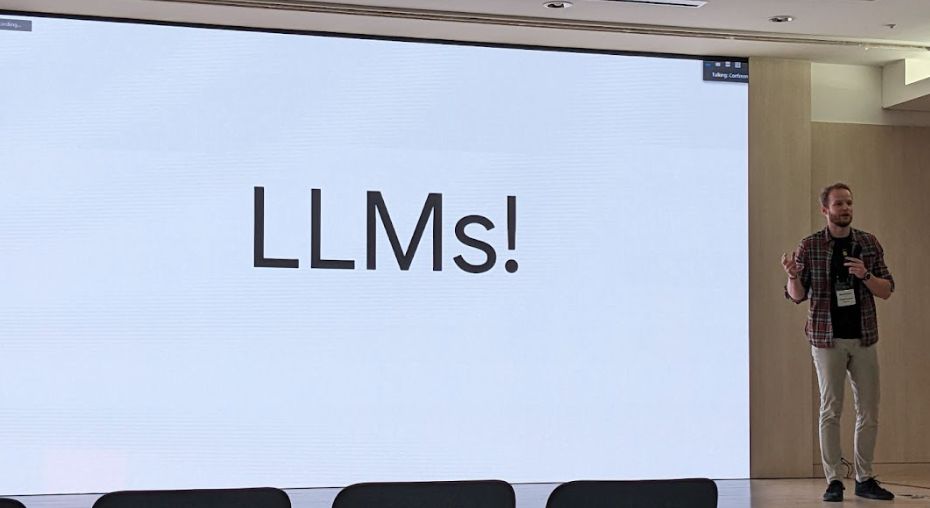
That slide’s comic brevity captures a serious turn. Language models showed what broad pretraining could do for text. The robotics question was whether a model could make comparable use of images, instructions, and motor experience. A machine has to learn what an instruction means while the scene changes under it. “Put the dishes in the sink” is a sentence on a screen; in a kitchen it becomes a sequence of searches, grasps, paths, releases, and corrections. Every dish is a little argument with gravity.
Why Pi began with the brain
Physical Intelligence was founded in 2024 by a team that includes Hausman, Levine, Chelsea Finn, Brian Ichter, Lachy Groom, Adnan Esmail, and Quan Vuong. Its premise is that robot hardware has often been capable of more than autonomous software could reliably command. Hausman has pointed to teleoperated robots: put a human mind behind a machine, and it can do far more than the same hardware acting alone. The company therefore works on the part between a request and a motor command, an intelligence layer that can be reused across tasks and machines.
That choice has an appealing symmetry with his earlier work. Interactive perception argued that action helps a robot understand the world. Physical Intelligence asks whether experience from many such actions can help a shared model understand new situations. The ambition is larger, the mathematics and datasets are different, and the failures can be more public. But the stubborn question remains familiar: what does the machine learn from touching the world?
The company’s first public generalist policy, π0, arrived in October 2024. It combined images, text, and robot actions and was designed to work with a variety of robots. In 2025, π0.5 tested whether a model could work in homes it had never seen. The tasks included putting away dishes, making a bed, and cleaning a bedroom floor. These are domestic errands with a research paper’s worth of hidden difficulty. A different countertop, an unfamiliar object, or a spill in the wrong place can break a system trained on a narrow script.
The team’s later π*0.6 work brought reinforcement learning from robot experience into the picture. The robot tries, sees what happens, and can improve through feedback. Hausman has described this as the beginning of learning on the job. The April 2026 π0.7 release then focused on steerability and broader generalization. Each paper is a team effort, and each is a research result rather than a promise that a household robot is ready for every household. Their sequence does show how the questions changed: first, can one model do many things; then, can it cope with new places; then, can it improve and be directed with greater flexibility?
The problem with a perfect take
Hausman has a useful skepticism about robot videos, including his company’s. A team can record a task until it gets a clean take. That clip proves something happened, but it says little by itself about how often it would happen again. In a conversation about Pi’s work, he separated three hurdles: capability, generalization, and performance. A model may have the skill in one setting, fail when the setting changes, or work so slowly and unevenly that the skill has little practical use. The distinctions make progress less glamorous and much easier to judge.
They also explain his attention to data. “Data is one of those things that’s actually fairly nuanced,” he has said. “It’s not just a matter of quantity.” Repeating the same demonstration many times can produce a plateau. Varied objects, spaces, and kinds of correction may teach more than another pile of near-duplicates. At Google, the Open X-Embodiment collaboration made a case for sharing experience across institutions. At Pi, new environments and robot experience have become tests of whether a common model can turn variation into knowledge.
This is where the old Star Wars fascination meets an uncinematic discipline. Fictional droids walk into a scene already fluent in it. Real robots must learn the scene, operate within physical limits, and recover when a grasp goes wrong. Hausman’s career has advanced by staying with the less photogenic parts of that challenge. The famous problems of intelligence tend to sound abstract. Here they are embodied in a cup sliding on a counter and a robot deciding what to do next.
He still speaks about the project with a researcher’s openness to surprise. In a discussion of model progress, he said the fact that broad learning systems work at all remains “mind blowing” to him. That is a useful quality in a CEO whose product is still being invented: fascination without pretending every demonstration is deployment. Physical Intelligence has opened some of its models and published detailed research, inviting other teams to test what the machines can and cannot do. The public record is less a victory lap than a sequence of harder questions.
The next decisive scene may look dull on camera. A robot arrives at a new place, finds a task amid unfamiliar clutter, tries an action, adjusts, and finishes. Later it uses something from that experience elsewhere. No swelling score, no droid quip. Just a machine that has learned enough to carry on when the room changes. For the boy from Koszalin who liked robots with lives in the world, that would be a satisfying plot development.