The bicycle had a problem familiar to anyone who has ever learned to ride one: it needed to stay upright. Peng Zhihui decided to give it the parts to do that without a rider. He fitted his build with sensors, controls and the machinery required to steer itself, then showed the result online. A bicycle is a wonderful object for this kind of experiment. Everyone understands what it is supposed to do. When it moves on its own, the engineering needs no translation.
Online, Peng went by Zhihui Jun. His videos made a modest workshop feel like a place where the next unlikely object might already be taking shape. The bicycle was one of several elaborate builds. There was an Iron Man-inspired robotic arm called Dummy, and there were smaller devices whose appeal lay in the details of how they worked. People came for the reveal. They stayed to see the gears, boards and code that got it there.
Today Peng is co-founder, president and chief technology officer of AgiBot, the Shanghai robotics company he helped start in 2023. A robot company is a very different workshop. The bicycle only had to satisfy one obsessive builder and the people watching his video. A commercial humanoid has to make sense to engineers, production staff, customers and the person who eventually has to fix it.
The education of a builder
Peng was born in Ji’an, in China’s Jiangxi province. At the University of Electronic Science and Technology of China, he studied biomedical engineering and later information and communication engineering. The degree titles suggest distinct disciplines. His projects kept bringing them together: sensing, control, electronics and the stubborn physics of moving objects.
In 2013, while still an undergraduate, he entered a national electronic design contest with a smart temperature control system and won first place. He went on to enter many more competitions. The projects offered something a transcript cannot: an immediate answer to whether an idea survived contact with parts, deadlines and other people’s scrutiny.
He was entrepreneurial early, too. In 2015 he and a classmate started a small 3D printing company that secured investment, though he left after graduating. During his master’s study he built a bipedal robot that could avoid obstacles and navigate to a target. It won an innovation award at the 2018 World Robot Olympiad. That robot already contained a version of the question that would later occupy AgiBot: can a machine perceive a place, decide what to do and move through it reliably?
The public workshop
After university, Peng joined OPPO as an algorithm engineer. In 2020 he moved to Huawei through its Genius Youth program, working on AI-related engineering. His maker projects continued outside the usual description of a corporate job. That double life matters. One audience knew him for technical work inside major companies. Another knew him as the person willing to spend his own time making an object that seemed slightly unreasonable until it worked.
Dummy, his robotic arm, made that identity especially clear. The 2021 Bilibili video attracted 2.5 million views and 10,000 comments in a day. The Iron Man connection gave viewers a quick point of recognition, but the appeal was practical. Peng had built an arm people could watch move. In robotics, the distance between a model on a screen and a thing that grips is immense.
His GitHub offers another window into the habit. Project pages for the self-driving XUAN-Bike, an electronic ink NFC card and the miniature ElectronBot contain hardware and software material for others to inspect. The small card is a useful counterpoint to the humanoids that came later. Peng described wanting to solve annoyances of everyday IC-card use, then added an ink display because, once one is building a thing, there is always room to make it more interesting. The projects are different sizes; the impulse is recognizable.
“It’s been my dream since childhood to build a humanoid robot.”Peng Zhihui, speaking to TIME
A maker video rewards a neat ending. The camera can stop when the bicycle keeps its balance or the arm completes a gesture. Peng’s eventual move into a robot company changed what counted as an ending. It replaced the question “Can this work?” with several less glamorous ones: Can the same thing be built repeatedly? Can it be delivered? Can it be useful in a place that was never designed as a stage?
A company in the making
In December 2022, Peng announced that he was leaving Huawei to pursue a new challenge. Two months later, he co-founded AgiBot in Shanghai with Deng Taihua. Peng became the company’s technical leader, while Deng served as chairman and chief executive. The partnership gave the public maker a larger organization around his ambition, and it gave the company an unusually visible engineer to explain its machines.
AgiBot unveiled its first humanoid prototype, the A1, in August 2023. It was a full-size machine intended to bridge manipulation and locomotion. The company then broadened the family. Yuanzheng machines addressed general-purpose tasks, the Lingxi line offered smaller robots, and Genie added wheeled systems with arms. The variety is telling: useful physical work does not always require two legs. Sometimes wheels are the sensible answer, however much less cinematic they look.
In 2024 the company introduced commercial models and moved toward mass production. In January 2025, it announced that its 1,000th general-purpose embodied robot had rolled off the line. These numbers deserve the discipline of a factory ledger rather than the breathlessness of a launch video. A production milestone says machines were built; it does not, by itself, say how much useful work they have done. The distinction is central to understanding the next phase of Peng’s career.
That practical threshold is one Peng seems keenly aware of. In an interview, he pointed to Shanghai’s manufacturing supply chains and universities as reasons to build there. He has also argued that good business begins with problems found in the real world. Those are revealing preferences for a person whose most famous early projects were made to be seen. They suggest the next audience he wants to convince is the one that has to live with the machine after the lights come up.
A robot beside its maker
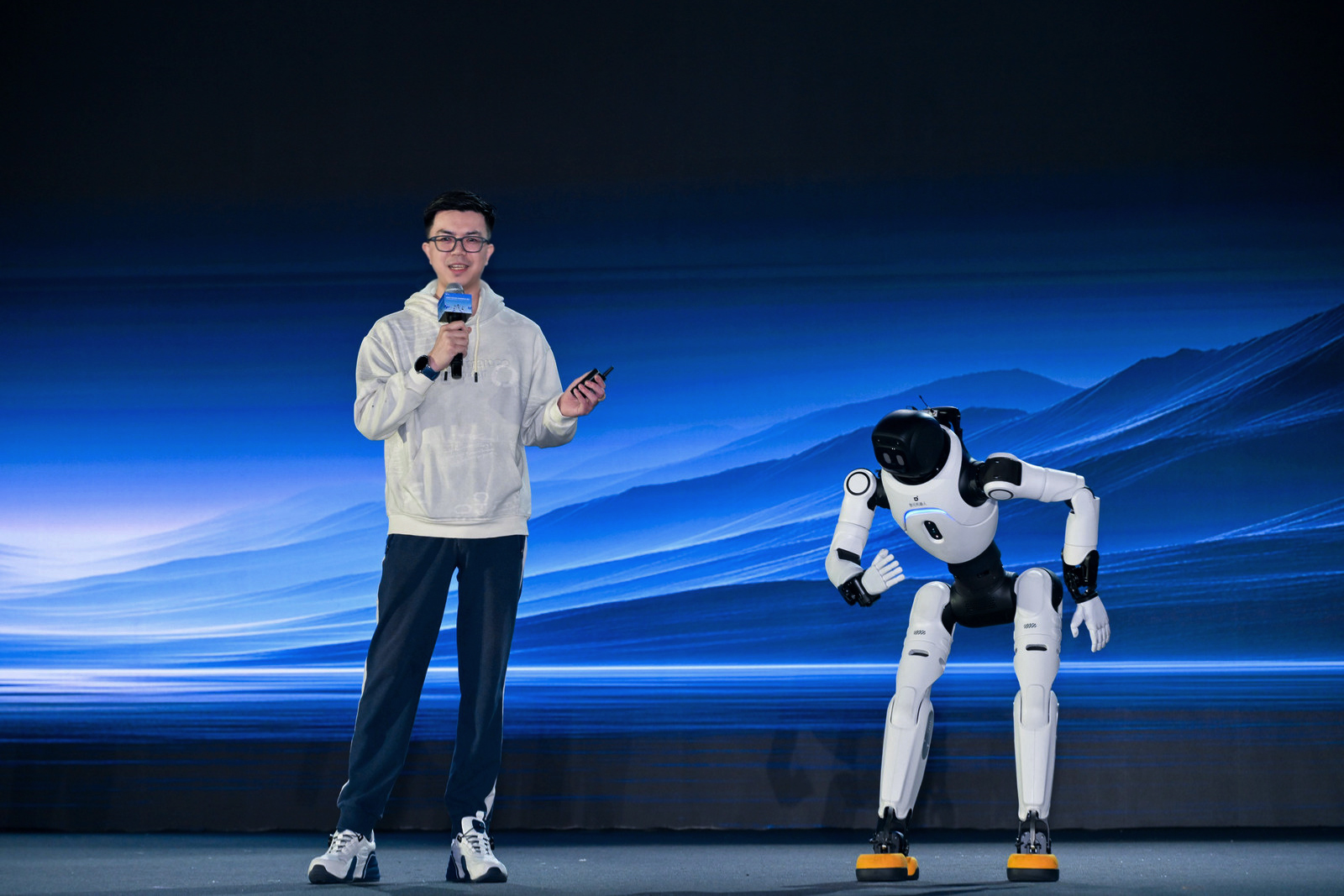
At AgiBot’s April 2026 partner conference, Peng stood beside an X2 humanoid to demonstrate interactive intelligence. The setting was theatrical: blue light, a large screen, a compact robot with rounded white limbs. Peng spoke about moving embodied intelligence into human workflows and making its value measurable. The staging and the message were a little at odds. Stages are perfect for showing what a robot might do. Workplaces ask what it will do tomorrow, and the day after that.
AgiBot says its 10,000th robot came off the production line in March 2026. Its newer platform work spans bodies, hands, models, data systems and software tools. That scope makes sense for a company selling embodied intelligence: no single clever algorithm can compensate for a hand that misses, a joint that fails or a workflow nobody needs. Peng’s role has expanded from solving one hardware puzzle at a time to coordinating many puzzles that have to fit together.
This is where his earlier work remains useful as a way of reading the person. The self-driving bicycle was an elegant answer to a clear physical problem. Dummy was a lesson in turning a science-fiction image into metal and motion. The contest projects and open hardware showed a taste for the unromantic middle of invention, where parts are selected and designs are revised. A company production line is that middle multiplied by thousands.
The range of the company’s machines also complicates the simple picture of a humanoid future. An upright robot can navigate spaces made for people and meet them face to face. A wheeled machine can carry arms into repetitive industrial work with a steadier base. A small robot may suit a classroom or demonstration where a full-size machine would be awkward. Peng’s technical brief is therefore less a single silhouette than a family of choices about movement, reach and control. Each choice has costs, and each becomes visible once a machine leaves the promotional film and meets an ordinary room.
After the applause
The story of Peng Zhihui is easy to summarize too quickly: talented maker leaves a prestigious job, starts a robot company, watches the machines roll out. The interesting part is slower. His public projects taught an audience to care about mechanisms. His corporate jobs gave him a view of algorithms and computing systems at scale. AgiBot has put both kinds of knowledge under pressure from manufacturing and use.
In a video, a bicycle that rights itself is the final shot. In a factory, a robot that balances is only the beginning. It has to pick up the right object, recover from mistakes and fit into someone else’s day. That may be a less amusing spectacle than a machine riding away on its own. For Peng, it appears to be the project he was moving toward all along.