The trouble with a shirt is that it never agrees to be the same shirt twice. A cuff slips under a sleeve. The fabric bunches at the shoulder. The light changes. To a person, folding laundry is the sort of work done while thinking about something else. To a robot, every small variation can be a fresh negotiation with physics. Chelsea Finn has built a career around that gap between a polished demonstration and an ordinary afternoon.
In 2025, she stood in a Stanford lab beside graduate student Moo Jin Kim as they demonstrated a robot learning to handle objects through human guidance. The cables, grippers, and careful setup looked nothing like the effortless fantasy of a household helper. That is part of the point. Real intelligence in a physical world has to cope with friction, missed grasps, and objects that refuse to sit politely where a training video left them.
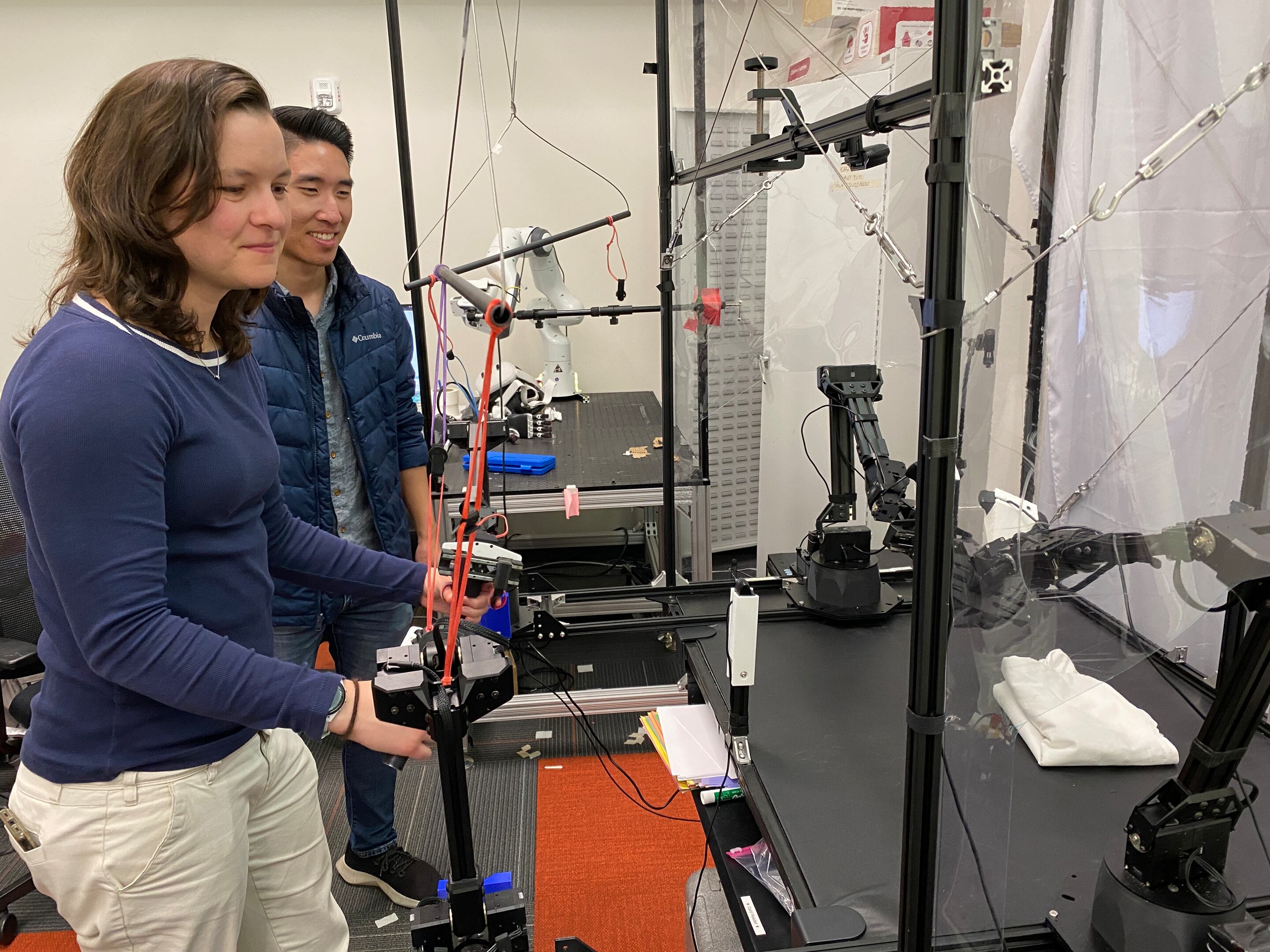
Finn now works in two settings that might appear to run on different clocks. She is an assistant professor in computer science and electrical engineering at Stanford, where her IRIS lab studies how intelligent behavior can emerge from interaction. She is also a co-founder of Physical Intelligence, a company developing general-purpose models for robots. The seminar room and the startup share a persistent question: how can a machine carry something useful from one experience into the next?
First, take apart the LEGO robot
Finn’s introduction to the field came in middle school through FIRST LEGO League. She has recalled the pleasure of building and programming a robot, then discovering that a promising design still needed debugging. The toy was a good tutor in the character of hardware. Ideas meet wheels, sensors, and the possibility that nothing moves when the program says it should. An engineer learns to watch closely, change one thing, and try again.
At MIT, she studied electrical engineering and computer science. She has said she liked the range that computer science offered: it could lead toward biology, robotics, systems, or other fields. Machine learning caught her attention, and robotics gave the abstract work a body. A robot could make a prediction about the world and then immediately test it with an arm. If the prediction failed, the evidence was sitting on the table.
This preference for open doors helps explain the arc of her research. A machine trained to screw one cap onto one bottle has learned a skill, but a narrow one. Change the bottle and the feat can evaporate. Finn became interested in the part that might survive the change: the habit of learning, the structure shared by many tasks, the experience that makes a new task less new.
The question beneath the research
An algorithm for the second try
At UC Berkeley, working with Pieter Abbeel and Sergey Levine, Finn published a 2017 paper called Model-Agnostic Meta-Learning for Fast Adaptation of Deep Networks. Its short name, MAML, sounds almost domestic. The idea is technical but its aim is familiar: train a model so that a little new information can change it quickly. Instead of teaching a network one task and testing it on more of the same, expose it to many tasks and prepare it to learn the next one from only a few examples.
Finn has explained the motivation in terms of robot chores. One machine could learn to hang a shirt; another experiment could teach it to fit a cap onto a bottle. Then the training would begin again, with too little carried over. The waste bothered her. A child who learns to hold a cup does not erase that lesson before picking up a spoon. Robot learning needed a better account of accumulated experience.
“I was frustrated by the fact that we would train every task independently from scratch.”
Chelsea Finn, recalling her doctoral work
The paper became part of her Berkeley dissertation, Learning to Learn with Gradients, which received the ACM Doctoral Dissertation Award for 2018. The prize recognized both the method and the wider promise of fast adaptation. Finn later worked as a research scientist with Google Brain and Google DeepMind, and joined Stanford’s faculty in 2019. The institutions changed; the irritation with starting over did not.
Her Stanford work has kept the problem concrete. IRIS stands for Intelligence through Robotic Interaction at Scale, a name with both a research agenda and a dose of engineering honesty. Interaction matters because a robot can learn things by touching, moving, and failing that a passive video cannot provide. Scale matters because an adaptable machine cannot be trained on a single immaculate table and expected to recognize the rest of the world.
A fridge with no obvious handle
One of Finn’s examples of adaptation is charmingly mundane. A robot faced a refrigerator without a clear handle and tried to open the wrong side. It failed, moved to the other side, and succeeded. The scene has the rhythm of a person in someone else’s kitchen. What matters is not the door itself but the change of plan. A capable robot must treat a failed attempt as information rather than a cue to repeat the same mistake with greater confidence.
Physical Intelligence, founded in 2024, takes that ambition into larger datasets and general robot models. The company’s first model, π0, was introduced in October of that year. π0.5 followed in 2025 with an emphasis on working in settings the robot had not seen. Later work used additional experience and reinforcement learning to improve performance on tasks including espresso making, laundry folding, and box assembly. Finn is one of many researchers named on these publications; the work is deliberately collective.
The shift from MAML to a large robot model is also a change of tools. MAML asks how to make a model easy to update from a little new data. A general-purpose robot model draws on broad training across tasks and robot bodies, then can be adapted further. They are separate methods, with a shared objection to wasted experience. Finn has resisted treating the next chore as an isolated island. Her research has kept looking for the bridge between what a machine already knows and what an unfamiliar room asks it to do.
There is a useful distinction between a robot that performs a task once and a robot that can keep doing it. In a 2026 talk, Finn stressed long stretches of autonomous operation and the need for fewer errors. Her company’s π0.7 research, published that spring, reported early signs that one model could combine learned skills to handle new requests and work across different robot platforms. “Early signs” is the careful phrase. A folded shirt still has to survive the next shirt.
The company has also described partners putting its models to work in a San Francisco laundromat and in warehouse packing. Those are revealing settings. A video clip can be selected for success; a laundry load presents every towel, sleeve, and interruption. A warehouse order comes with a clock. The problem becomes less about whether the machine can make a move and more about whether it can be trusted to keep making useful ones.
The teacher stays in the room
Finn’s title at Stanford does not sit quietly beside the startup role. She has taught deep reinforcement learning and meta-learning, and her lab continues to train students who work on the same broad problem from different angles. She has also worked to widen participation in AI, including an outreach camp at Berkeley for high school students and a mentoring program for undergraduates from underrepresented groups. The person asking robots to learn has spent considerable time thinking about how people get a first chance to learn, too.
She once made an algorithm to give students feedback on programming assignments. There is a small symmetry there: one teacher trying to make feedback travel further, while refusing to pretend that one answer fits every student. The same caution suits robot learning. A good general method must remain alert to particulars. The problem with the shirt is precisely that it is particular.
Her public talks make clear that robot data cannot be conjured from text alone. Videos of people and images of rooms can help a model understand a scene, but the machine still has to learn what happens when its own gripper meets an object. “There’s no substitute for the robot experience itself,” she has said. It is a tidy line for a stubborn fact. The world will answer a robot’s guess, and it does not grade on intention.
The child with the LEGO machine and the professor watching a robot misread a fridge door are separated by years, awards, papers, and a company. They are connected by the same act: notice what happened, keep the lesson, try the next thing. If Finn’s work succeeds, that habit will become less remarkable in a robot. Then perhaps the folded shirt can be just laundry again.