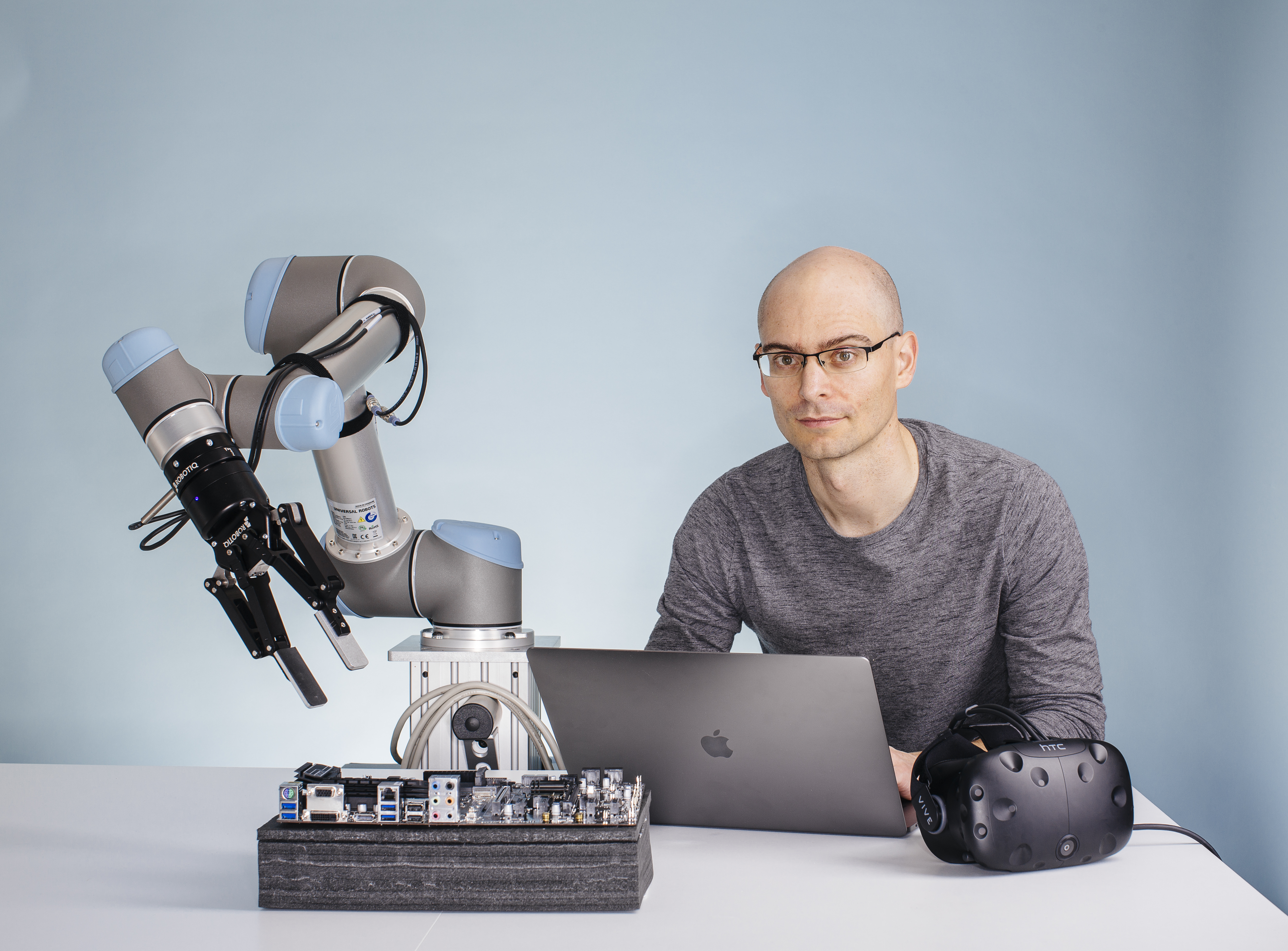
Andrew Ng's first PhD student wasn't supposed to change robotics. He was just supposed to finish a dissertation. But Pieter Abbeel, the kid from Brasschaat who played point guard at KU Leuven, had different plans. He taught a helicopter to fly itself by watching humans. Not with rules. Not with code. With learning.
That was 2008. The field barely existed.
Now it's 2026, and twelve companies founded by his students are worth billions combined. John Schulman left his lab to co-found OpenAI. Aravind Srinivas built Perplexity. Chelsea Finn and Sergey Levine started Physical Intelligence. Deepak Pathak launched Skild. The list doesn't stop. It compounds.
They call it the Abbeel School of AI entrepreneurship. He calls it Tuesday.
Here's what makes Abbeel strange: he never stopped teaching. Most people who co-found two companies (Gradescope, acquired by TurnItIn; Covariant, licensed by Amazon) quit academia. Most people leading Amazon's large language model efforts don't run a research lab at Berkeley. Most people directing the Berkeley Robot Learning Lab don't host a weekly podcast interviewing legends.
Abbeel does all four. Simultaneously.
The Belgian Who Taught Robots to Learn
Brasschaat is a suburb of Antwerp where nothing happens and everything starts. Abbeel grew up there with four sisters - Tine, Annelies, Karlien, and Sandrien - playing basketball and acing subjects he found equally engaging: math, science, history, languages, literature. The kid who couldn't pick a lane ended up building highways between all of them.
At Stanford, under Ng, he pioneered apprenticeship learning. The idea: robots learn by watching, not by being programmed. His autonomous helicopter became the stuff of legend in reinforcement learning circles. Not because it flew, but because it learned to fly.
Berkeley hired him in 2008. By 2014, he'd co-founded Gradescope with Arjun Singh, Sergey Karayev, and Ibrahim Awwal. The platform that helps professors grade homework now serves 500+ universities. It sold to TurnItIn in 2018.
By 2017, he'd done it again. Covariant, co-founded with his students Peter Chen, Rocky Duan, and Tianhao Zhang, built foundation models for robots. Not chatbots. Actual robots that pick items in warehouses with human-like dexterity. Amazon noticed. In 2024, they licensed the tech and hired the founders.
The Academic Family Tree That Built Modern AI
If you map Abbeel's PhD students and their ventures, you get a network diagram that looks like a conspiracy theory. Except it's real.
His research contributions read like a greatest hits of deep reinforcement learning: generalized advantage estimation (enabled the first 3D robot locomotion learning), soft actor-critic (one of the most popular deep RL algorithms), domain randomization (sim-to-real transfer), hindsight experience replay (sparse-reward environments). Each paper spawned subfields. Each student spawned companies.
The Berkeley Robot Learning Lab he directs isn't just publishing. It's an incubator disguised as research. The Berkeley AI Research Lab he co-directs isn't just advancing science. It's training the people advancing it everywhere else.
The Robot Brains Method
In 2021, Abbeel launched The Robot Brains podcast. Every week, he interviews the people building AI's future. Jitendra Malik on building AI from the ground up. John Schulman on ChatGPT's invention. Woody Hoburg fresh from the International Space Station.
The format is simple: let brilliant people talk. The insight: Abbeel doesn't just study AI pioneers. He raised half of them. When he asks about their journey, he's asking about paths he helped clear.
His intro to AI course has taught over 100,000 students through edX. His Deep RL and Deep Unsupervised Learning materials are standard references. He doesn't just advance the field. He scales the advancement.
The Amazon Promotion That Wasn't
In December 2025, Amazon made it official: Abbeel would head their large language model efforts within the AGI organization. He'd already joined in August 2024 when Amazon licensed Covariant's robotics foundation models. But this was different.
This was robots-to-language. Hardware-to-software. Embodied intelligence to abstract reasoning. The researcher who taught machines to learn from trial and error, now applying those insights to how models learn language.
He kept his Berkeley professorship. He kept running his lab. He kept hosting his podcast. He kept being Pieter Abbeel, the guy who never chose between academia and industry because someone forgot to tell him he had to.
The Awards Nobody Mentions
The ACM Prize in Computing (2021) for contributions to robot learning. The Presidential Early Career Award for Scientists and Engineers (2016). IEEE Fellow (2018). Sloan Research Fellowship. NSF CAREER Award. ONR Young Investigator. DARPA Young Faculty Award. MIT Technology Review TR35.
Abbeel collects them like stamps. Mentions them like footnotes. Focuses instead on what's next: advancing AGI through frontier models while training the next generation to do it better.
He joined AIX Ventures as Investment Partner in 2021. Now he helps founders the way he helped his students: by showing them what's possible, then getting out of the way.
What's Strange About Success
The kid who played point guard in Brasschaat is now running plays across three careers. The professor who taught 100,000+ students online still teaches the cohort in person. The researcher who pioneered robot learning is now leading the charge on language models.
Abbeel's Covariant robots don't just work in warehouses. They learn on the job. His students don't just graduate. They build the companies defining AI's commercial future. His research doesn't just advance the field. It creates the subfields his next students will master.
In May 2026, he's still a UC Berkeley professor. Still head of Amazon's LLM research. Still hosting The Robot Brains every week. Still answering emails at pabbeel@cs.berkeley.edu from the next Andrew Ng looking for their first PhD student.
The strange part isn't that he does it all. The strange part is he makes it look obvious.
Because when you teach machines to learn, and humans to build, and yourself to never choose, you don't optimize for balance. You optimize for impact. And impact, like his helicopter in 2008, doesn't follow rules.
It learns to fly.