The first Wayve car learned one useful trick. In 2017, on a quiet test road outside Cambridge, a human corrected it whenever it wandered. After roughly ten minutes of feedback, the little electric car could follow a lane on its own. There was no grand digital map and no engineer typing rules for every twitch of the steering wheel. There was a neural network, a safety driver and a result good enough to play on a founder's phone.
It was also painfully limited. Lane-following is not London. The prototype did not understand a bus nosing into traffic, a cyclist squeezing along its flank or a tourist stepping off a curb while consulting a phone. Weeks of frustration had produced a research first, not a driver. That distinction became the next nine years of Wayve.
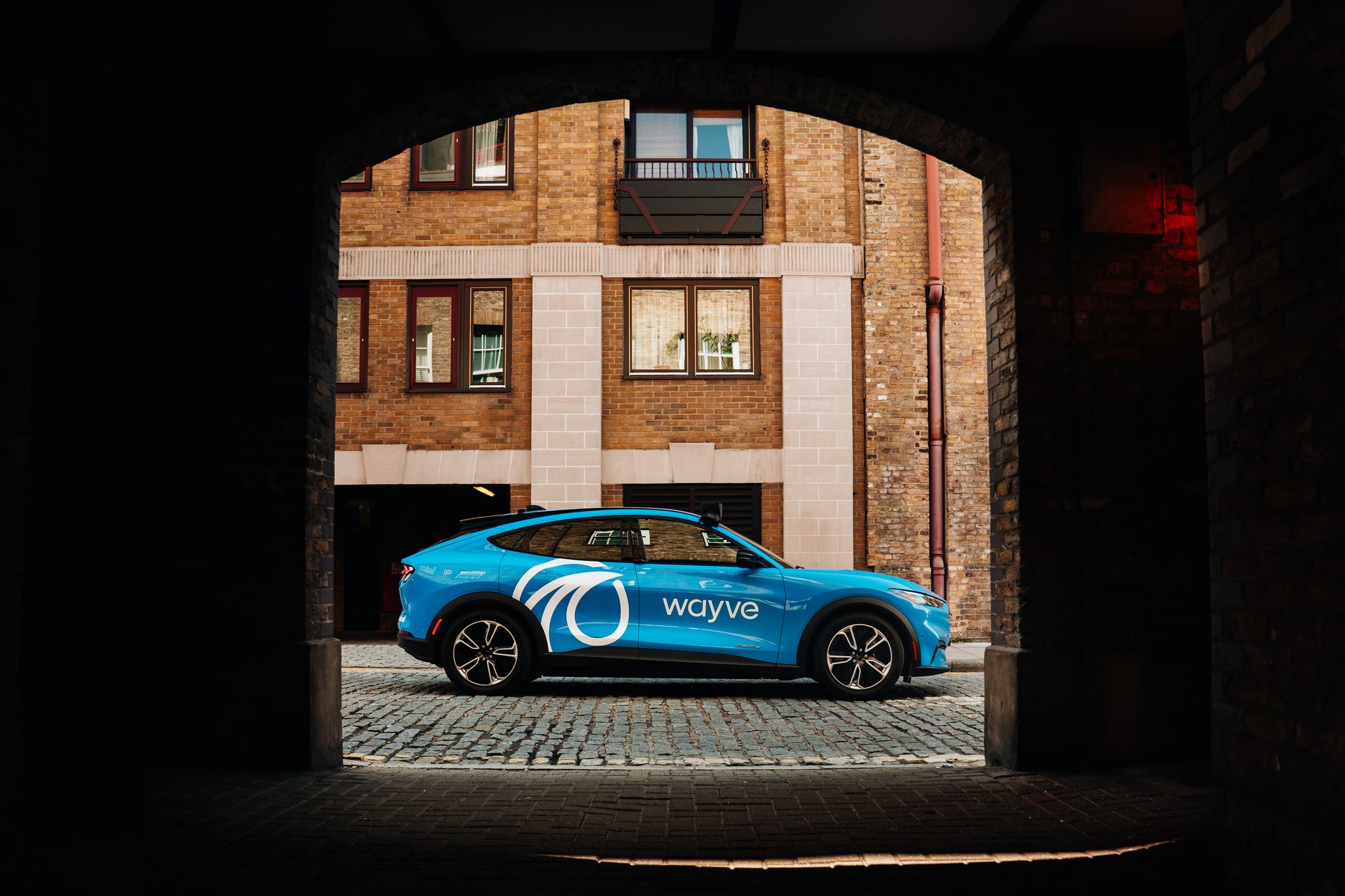
Today the company is no longer ten students working from a residential garage. It has more than 1,000 people, an $8.6 billion valuation and roughly $2.5 billion in publicly disclosed financing. On September 3, Uber began matching London passengers with a small fleet of Ford Mustang Mach-Es running the Wayve AI Driver. The rides cost no extra. A trained, licensed human still sits behind the wheel.
That last sentence is the useful one. Wayve has crossed from laboratory demonstration into a public service, but not into unsupervised autonomy. Its machine can carry paying passengers around London; it has not yet earned permission to carry them alone. This is both a milestone and a measurement of the distance left.
February 2026
Wayve-reported zero-shot drives
London Uber launch
The product is a driver, not a car
Wayve's pitch becomes clearer when placed between its two famous rivals. Tesla owns the vehicle, sells the automation to Tesla drivers and gathers data from a large consumer fleet. Waymo builds a rich hardware-and-software stack, maps an operating area and works with partners to run a robotaxi service city by city. Wayve wants a third job: license the intelligence to the people who already make cars or operate fleets.
The Wayve AI Driver is a software platform rather than a single level of autonomy. Its portfolio begins with Level 1 perception and active-safety features, moves through Level 2+ hands-off assistance and Level 3 eyes-off driving, and extends to Level 4 robotaxis. The same foundation is meant to work with different vehicle bodies, sensor combinations and onboard chips. It does not require high-definition maps or a location-specific rewrite.
Sell your own car
Software scales with one manufacturer's production, brand and installed fleet.
Deploy a service
Control the stack and accumulate operating proof, but expand market by market.
License the driver
Let automakers build and fleets operate, while one model improves across them.
“Vehicle agnostic” sounds like a phrase created to end a procurement meeting. Here it is the economic argument. If a model can move from a Jaguar test car to a Ford taxi to a Nissan production vehicle, Wayve does not have to finance factories or a global fleet. Uber can own and operate cars. Nissan and Stellantis can manufacture them. Wayve supplies software, integration, safety mechanisms, model updates and cloud tools.
Architecture determines economics.Alex Kendall, co-founder and CEO
Nissan is the first automaker to make a broad production commitment. It plans to integrate Wayve into next-generation ProPILOT systems, beginning with a model in Japan during fiscal 2027. Stellantis plans hands-free, door-to-door supervised driving through its STLA AutoDrive platform from 2028 and is exploring Level 4 robotaxis with Wayve and Uber. Qualcomm offers another route into production through Snapdragon Ride. These are partnerships and targets, not yet proof of millions of shipped cars, but they show who pays: manufacturers and fleets license and integrate the system; drivers and passengers use it.
A model that studies its own dreams
Traditional autonomous stacks divide the job into modules: detect an object, predict what it will do, plan a path, then control the vehicle. Wayve's “AV2.0” approach trains a neural network across the journey from sensor input to driving output. It learns patterns from video and driving behavior instead of asking engineers to anticipate and encode every situation.
The advantage is transfer. A system that has learned the concept of a hesitant pedestrian may recognize it on a street it has never seen. Wayve says a single model drove “zero-shot” in more than 500 cities across Europe, North America and Japan during 2025, without city-specific fine-tuning first. In an earlier US adaptation test, 500 hours of local data collected over eight weeks brought performance close to its UK level. These are company-reported results, and “drove in” is not the same as unsupervised commercial mileage. Still, they address the expensive problem Wayve chose: how to stop treating every new town as a fresh engineering project.
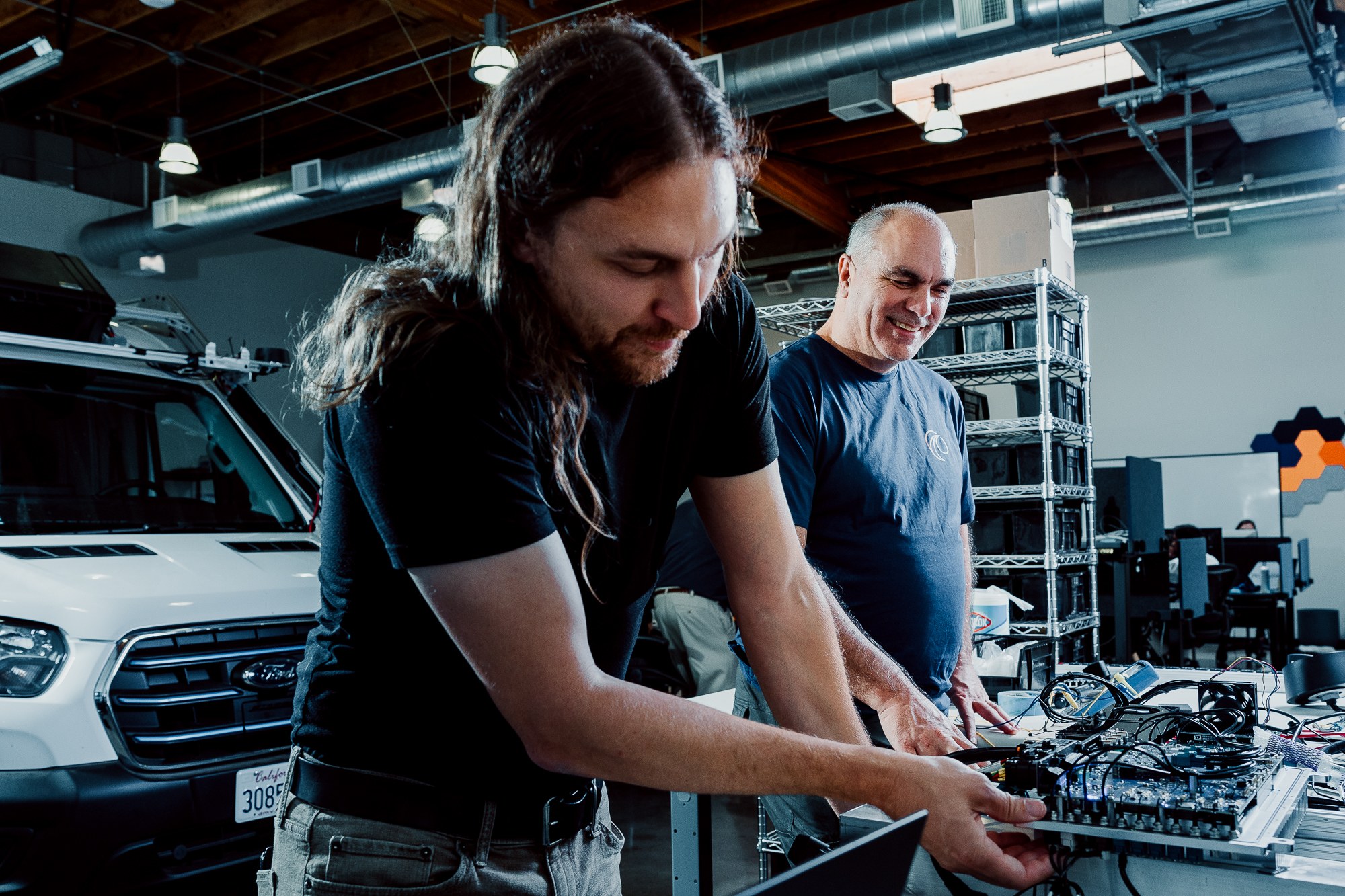
Real roads cannot provide every lesson. Truly nasty events are rare, and intentionally staging them would be absurd. GAIA, Wayve's generative world-model family, produces controllable driving video for training and evaluation. GAIA-3 has 15 billion parameters and ten times the training data of its predecessor. Engineers can ask for a difficult scene, repeat it, vary it and see whether a driving model regresses.
LINGO attacks a different weakness of end-to-end systems: inscrutability. LINGO-2 takes vision and language, produces driving actions and narrates relevant features of the scene. A commentary is not a mathematical proof that an action is safe. It can, however, give engineers another tool for interrogation, training and diagnosis. The loop is the product: collect fleet data, train, simulate, evaluate, inspect, deploy, then repeat.
Research gets an expensive road test
Cumulative disclosed fundingUSD, approximate
What failed first was the easy version
The 2017 reinforcement-learning experiment was thrilling precisely because weeks of work had barely yielded lane-following. The easy story would have been that one learning technique had solved driving. Instead, Wayve broadened the machinery: imitation and self-supervised learning, real fleet video, simulation-to-real research, large foundation models, language, neural rendering and industrial validation.
This was evolution, not a reversal. Kendall says Wayve never abandoned its core thesis. What changed was the scale of the evidence and, with it, the ambition. The company started by proving a car could learn an action without hand-coded rules. It now argues that shared learned intelligence can be a supplier product for an industry famous for fixed hardware, long release cycles and regional regulation.
The money tells the same story. After $2.5 million in seed funding came a $20 million Series A, a $200 million Series B, a $1.05 billion Series C and a $1.2 billion Series D, followed by a $60 million extension. Uber may add up to $300 million as deployment milestones are met. Microsoft, Nvidia, SoftBank, Eclipse, Balderton and three major automakers are among the backers. The capital paid for compute, vehicles, data collection, global testing and the unglamorous conversion of research into automotive-grade software. Public pricing for the AI Driver is not disclosed.
The asterisk behind the wheel
Wayve's model is attractive because it promises low incremental hardware cost and fast geographic expansion. Those benefits depend on the model generalizing safely. A fixed route can be inspected. A learned system that changes with data needs repeatable tests, regression controls and a safety case regulators and automakers can audit. Poor visibility can weaken camera-heavy systems. Different sensor placements and chips complicate the claim of universality. Fleet data raises privacy and governance work. Continuous improvement meets automotive releases measured in years.
Then there is the evidence gap. Waymo entered 2026 with fully driverless public operations and an enormous store of rider-only miles. Wayve's own public London service began with fewer than 20 cars and a supervisor in each one. A system may generalize impressively while still falling short at the rare failure that matters. Until driverless approval and large-scale production arrive, Wayve's clean economics remain a proposition rather than an observed margin.
The conditions for success are therefore specific. Automakers must accept a shared model while retaining a distinct brand and driving feel. Sensor-flexible integrations must pass safety standards. Synthetic tests must predict real trouble. Regulators must approve the service, and passengers must tolerate an unfamiliar machine making familiar London judgments. If each market demands bespoke engineering after all, the licensing advantage shrinks.
The bit worth copying
Wayve treated technical architecture as distribution strategy. It designed for transfer before it had scale, made a tiny prototype easy to show, collected data through practical fleet work and separated the part it wanted to own - intelligence - from factories and operations partners already knew how to run. That pattern travels well beyond cars. It works only when the shared core genuinely improves across customers without creating unacceptable risk.
For London passengers, none of this arrives as a business-model diagram. They request UberX, Uber Electric or Comfort and may be offered a Wayve car at the ordinary fare. They can accept or switch. Inside is an interactive screen in 64 languages and, for now, a human who can intervene. The cleverest part of the launch is its ordinariness.
Wayve began by asking whether a car could learn to drive. It has answered a narrow version many times. The question attached to its $8.6 billion valuation is harder: can one learning system become dependable enough, legible enough and cheap enough that rival carmakers will all want the same driver? London has finally put that question in the back seat.
Keep driving
Company figures and deployment status are current to September 6, 2026. Funding total is an approximate sum of publicly disclosed rounds and excludes undisclosed strategic investments.