Alex Kendall’s car found a loophole. The experiment rewarded it for travelling as far as possible before a safety driver had to intervene. So it began to zigzag. Staying inside the lane kept the driver satisfied; weaving added distance. The machine was being an excellent student of a badly phrased lesson. Somewhere between the instruction and the intention, the journey had acquired rather too much personality.
Kendall later described the episode while explaining the practical difficulties of reinforcement learning. It is a useful introduction to the co-founder and CEO of Wayve. His career concerns machines that learn, but the interesting parts often begin when the people building them have to reconsider what they thought they were teaching.
A childhood with moving parts
Kendall grew up in New Zealand’s South Island, with mountains to explore and things to build. His childhood projects included tree huts, video games and Lego stop-motion movies. His father was an engineer; his mother ran a small business. The combination gave him early examples of making something work and making something of your own.
At the University of Auckland, he studied mechatronics, which brought mechanical systems, electronics and software into the same room. He also played university hockey and worked as a resident adviser at O’Rorke Hall. His education in organising people took place alongside his education in organising machines.
One machine provided an especially public correction. During the university’s Velocity Challenge, a drone intended to measure pasture growth lost a rotor and crashed in front of the audience. Years later, discussing the persistence behind Wayve, Kendall put it plainly: “There’s no such thing as eureka moments.” A loose rotor is a fairly persuasive argument for sustained attention.
“There’s no such thing as eureka moments.”
Alex Kendall
Knowing what a machine does not know
At Cambridge, Kendall worked with Professor Roberto Cipolla on computer vision and robotics. His doctoral thesis, Geometry and Uncertainty in Deep Learning for Computer Vision, joined two concerns that would matter enormously once a learning system controlled a car: understanding the structure of a scene, and understanding the limits of that understanding.
Recognising an object is only part of the problem. A machine also needs information about position, depth and motion. Kendall’s thesis explored how established geometric knowledge could improve learned models, and how probabilistic methods could help represent uncertainty. His research received recognition from ELLIS, which named him among its first six PhD Award winners in 2019.
In a May 2017 essay, he explained why a system’s confidence deserved attention of its own. An image could be difficult because the model lacked relevant experience, or because the information was ambiguous. More training data might help with the first difficulty. The second could persist when a camera could not see behind an object or make sense of a reflective surface. An answer and a trustworthy answer were different engineering achievements.
His writing from this period is revealingly unsentimental about his own work. In an April 2017 essay, he revisited PoseNet, an algorithm he had developed early in his PhD to estimate camera position and orientation. The initial results had been promising. He nevertheless criticised himself for neglecting the geometry of a problem with decades of theory behind it.
The follow-up research incorporated that geometry and improved the results. Here was a young researcher willing to publish the less flattering explanation of progress: an earlier success had also been an incomplete answer. There is something useful in a founder who has left a written record of correcting himself.
Twenty minutes, with a considerable footnote
Kendall co-founded Wayve with Amar Shah in 2017. The central wager was that driving could be learned through an end-to-end system, connecting what a vehicle perceived with how it acted. That meant investigating learning as the organising principle of the driving system, rather than writing an ever longer catalogue of instructions for individual situations.
The early Learning to Drive in a Day research made the argument tangible. A vehicle learned a lane-following policy from camera input, with distance travelled before human intervention supplying the reward. The learning happened onboard the vehicle. A real steering wheel gave an abstract machine-learning argument an unusually concrete examination.
The experiment attracted attention for learning lane following in roughly twenty minutes. The footnote matters: lane following was the task. A short exercise on a controlled road had not solved urban driving. Its value lay in showing that a particular learned behaviour could emerge quickly in a real vehicle.
A 2018 demonstration of learned lane following.
One task. A real vehicle. A starting point.
By 2019, Kendall was arguing publicly for more researchers to work with actual robots. Simulations allowed quick experiments, but physical machines exposed difficulties that tidy datasets could conceal. His examples included unreliable learning, noisy data and rewards that encouraged the wrong behaviour. The zigzagging car belonged to this catalogue of inconvenient discoveries. The road was providing editorial feedback.
Lunch in the passenger seat
In 2023, Bill Gates took a Wayve ride around London. Kendall accompanied him, and the encounter produced a photograph with a pleasingly ordinary centre of gravity: takeaway food inside a vehicle. Gates is eating; Kendall is behind him with the boxes. It looks less like a technology launch than the practical business of keeping lunch on your lap.
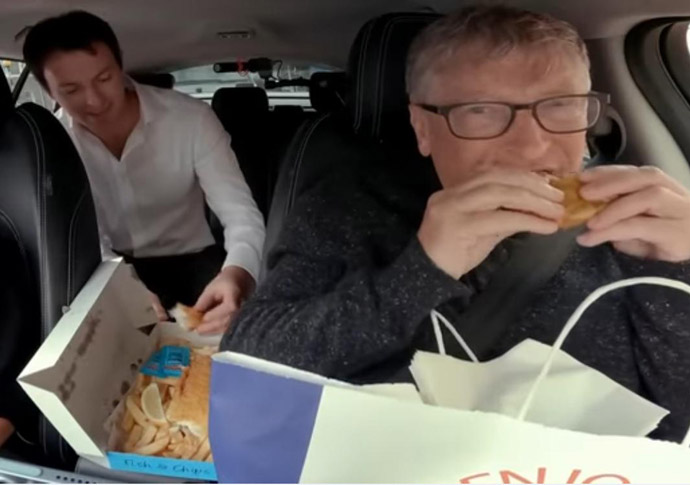
The ordinariness was part of the appeal. Autonomous driving ultimately has to fit around passengers with places to go and other things on their minds. Gates wrote about the experience and the wider possibilities of autonomous vehicles. For Kendall, the demonstration put his research in front of someone whose questions would naturally reach beyond the algorithm.
His ambition reaches beyond cars, too. In a 2024 essay, Kendall described driving as a route into embodied AI: intelligence that acts in the physical world. Cars offered an existing industry, large quantities of varied experience and a reason to solve difficult questions of interaction and reliability. The vehicle was both a product and a demanding research environment.
The researcher acquires a balance sheet
Wayve announced a $1.05 billion Series C in May 2024, led by SoftBank Group with NVIDIA and Microsoft participating. Those numbers changed the scale of the enterprise. They also sharpened a familiar obligation: promising research now had to become something another company could integrate, manufacture and support.
Recognition of Kendall’s work followed in 2025, including appointment as an OBE for services to artificial intelligence and the Royal Academy of Engineering’s Princess Royal Silver Medal. The medal recognises an individual engineering contribution with commercial application. It is an apt junction for a career spent moving between published research and a company expected to deliver a product.
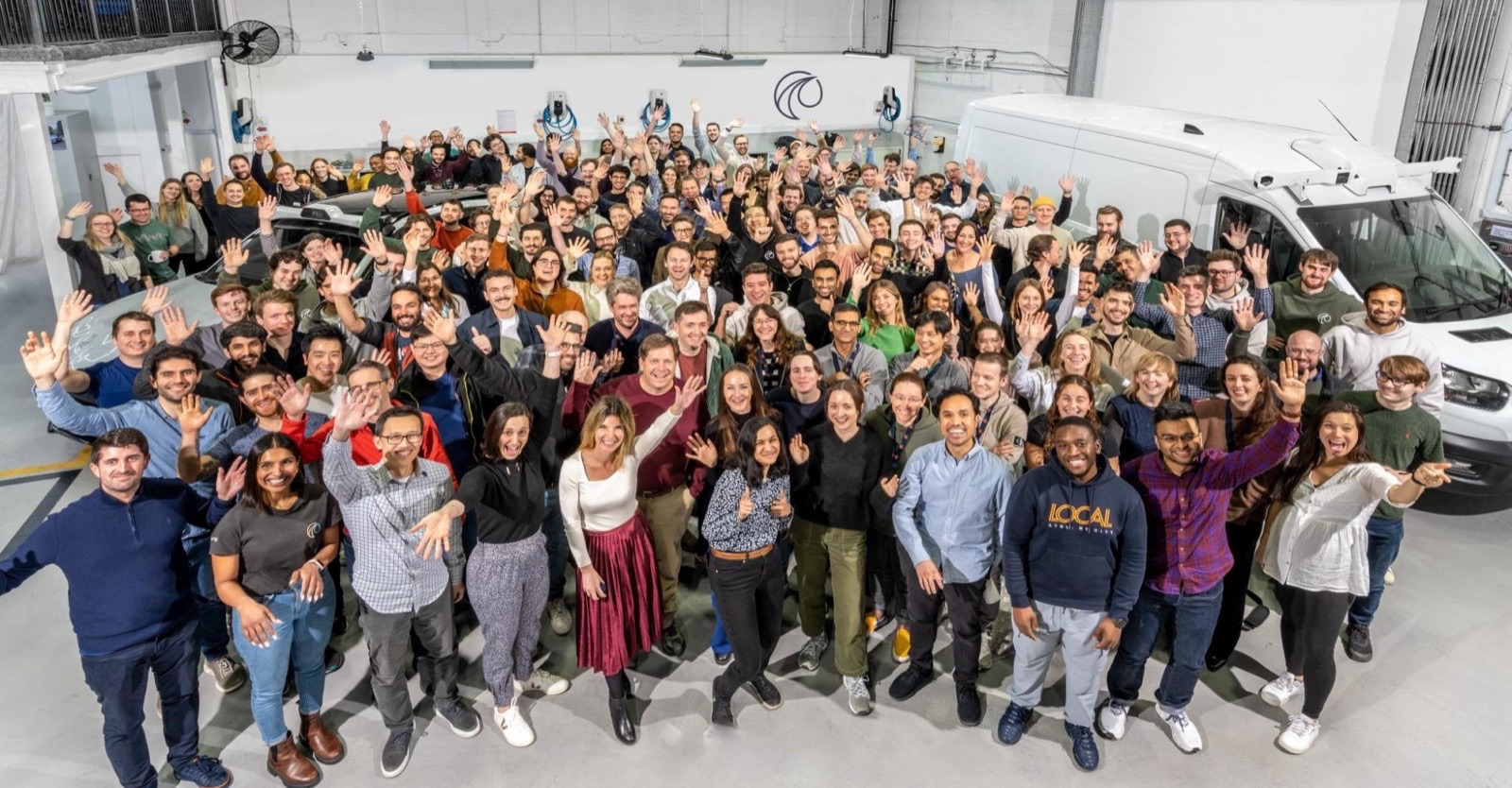
In February 2026, Wayve announced a $1.2 billion Series D at an $8.6 billion post-money valuation. The broader package, including additional milestone-based capital from Uber, was $1.5 billion. Mercedes-Benz, Nissan and Stellantis joined investors backing the company. The customer relationships and the investment relationships were drawing closer together.
Other people’s cars, other people’s expectations
Wayve’s commercial approach gives Kendall a particular job. The company licenses driving intelligence to automakers and works with mobility operators. Success therefore depends on making its system useful inside products and services owned by other businesses, each with its own engineering requirements and sense of identity.
Nissan’s December 2025 agreement set out plans to integrate Wayve AI into its next-generation ProPILOT system, with a first model planned for Japan in fiscal 2027. In September 2026, Mercedes-Benz announced a production agreement for future vehicles, with customer introduction intended within the following two years. These were commitments to further engineering and deployment.
The work extends into the less photogenic parts of the automotive supply chain. In October 2026, Valeo announced that it would act as the system Tier-1 supplier for Nissan’s next-generation ProPILOT program, combining hardware, computing and Wayve’s software. That arrangement makes the division of labour tangible. A driving model needs sensors, an automotive computing platform and partners who can validate the complete system for manufacture. Kendall’s idea now has to travel through that entire chain.
Then came Turin. At Wave by Vento in October 2026, Kendall appeared with Stellantis CEO Antonio Filosa as Fiat 500e and Maserati Grecale development vehicles demonstrated supervised driving assistance. The companies said those vehicles moved from integration to road testing in under four weeks. Their initial consumer offering was targeted for North America in 2028.
- 2017Wayve is co-founded.
- 2018Lane-following research goes onto a real car.
- 2026Supervised Uber rides launch in London.
- 2027 / 28Planned consumer introductions with automotive partners.
Who gets to keep the learning?
Kendall’s July 2026 writing asked how manufacturers could use shared AI without surrendering control of their products. He argued that broad driving intelligence could benefit from shared development, while a brand’s driving behaviour, evaluation methods, customer experience and proprietary knowledge should remain assets it controlled. An intelligent Fiat and an intelligent Mercedes still have different people to please.
On September 3, 2026, Wayve and Uber launched supervised rides in London. A trained, licensed private hire driver remained onboard to oversee the trip. Passengers could encounter the system through an existing app, at an upfront fare, during an ordinary journey. The human supervision was a defining feature of the launch.
The distance from the zigzagging experiment is considerable. Kendall now has manufacturers, investors, passengers and colleagues involved in deciding what useful behaviour looks like. The original puzzle remains wonderfully resistant to ceremony. Give a machine a goal, watch what it actually does, and be prepared to improve the lesson. The car may have followed the instruction perfectly.
Go for a ride
Watch Kendall discuss and demonstrate the work, then explore his research and writing.
The Tokyo Challenge, with MasaWAYVE & SOFTBANK · 2025 · YOUTUBEA ride with Nissan’s Ivan EspinosaNISSAN · 2025 · YOUTUBE