The story in five beats
- Wearhaus made Arc, a $199 Bluetooth headphone that could broadcast synchronized audio to other Arcs nearby.
- Richie Zeng and Nelson Zhang founded the company in Berkeley in 2013 after meeting as engineering students.
- Two crowdfunding campaigns brought in more than $322,000; a 2016 Series A added $4 million.
- Early reviewers found touch-control friction, and backer durability reports delayed a 2015 production run.
- The central constraint was social: Arc's best feature required another Arc owner in the same place.
There is a small, familiar ceremony between friends who want to hear the same song. One person removes an earbud. The other accepts it. Two heads lean toward one phone, each person getting one channel and a dubious lesson in intimacy. Richie Zeng and Nelson Zhang thought consumer electronics could do better. They also thought the solution should not be a speaker, because a speaker recruits every stranger within range.
Their answer was the Wearhaus Arc: an on-ear Bluetooth headphone that behaved normally when it was alone and unusually when it found another Arc. One wearer could start a broadcast. Another could join. The same music would arrive in sync, privately, with no cable splitter and no allegiance to a particular music service. Spotify, SoundCloud, Pandora, YouTube - the Arc shared the audio, not the app.
That distinction was smart. It made Wearhaus less like a music platform and more like a local radio protocol wearing memory-foam cushions. The companion app found nearby listeners and controlled the color rings around the earcups. A touch panel handled volume and playback. A 3.5 millimeter cable kept the music playing when the battery died. Even the box earned a second job as a headphone stand and charging dock.
The private object with a public ambition
Zeng and Zhang met as electrical engineering and computer science students at UC Berkeley. They bonded over concerts and record-store trips, then noticed something odd: music helped them make friends, while the device used to hear it announced a desire to be left alone. In 2013, Zhang assembled an audio-sync proof of concept while visiting China. The pair later turned it into a wearable prototype at a hackathon. Zeng joked that it looked like a bomb strapped to his head.
The crude object entered Highway1, PCH International's hardware accelerator, and became more considered with every pass. The company's own product book counted more than 20 versions in roughly a year. Angles from the Wearhaus logo - two intersecting play buttons - migrated into the industrial design. Curves gave the product its name. The rings of light were not merely nightclub trim: when headphones joined a broadcast, color made the invisible connection visible.
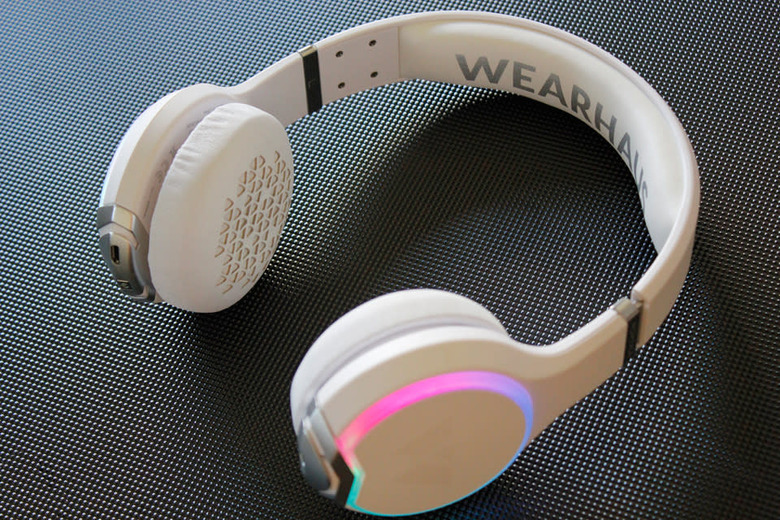
The pitch traveled. Wearhaus reached a $75,000 goal on its own crowdfunding site in June 2014, then collected $247,379 from 1,240 Kickstarter backers later that year. The earliest direct preorder was $149.99. It moved to $179.99, then settled around $199 at retail. That was standard premium-headphone money, and contemporary reviews generally found the Arc credible as an ordinary listening device. The bass leaned warm. The cushions were comfortable. The design attracted glances.
The price of admission
The second-pair tax
Here was the elegant trouble: the Arc's most memorable feature did not exist inside one box. It appeared in the air between two boxes. A solo buyer received a respectable Bluetooth headphone with lights and gestures. A pair of buyers received the future. The real price of the demo, therefore, was not $199. It was roughly $398, plus a friend in the room at the right time.
broadcasts
one phone's audio
joins nearby
in sync
The technology closes the distance. Adoption must first put two compatible objects within it.
This is the physical version of a cold-start problem. A messaging app becomes useful as people join. A social headphone becomes useful as people join and buy inventory. Geography matters too. Ten thousand customers scattered across a country do less for a nearby-sharing feature than 200 students on one campus. Wearhaus aimed at the right sorts of dense places - festivals, schools, planes, apartments - but density is not a marketing slogan. It is part of the product specification.
“We understand that a lot of people prefer to listen to music by themselves, but we also want to give them the option to enjoy their music with others.”Richie Zeng, co-founder
The company knew the escape route. Zeng said the long-term goal was to put Wearhaus technology inside other Bluetooth headphone brands. Licensing could have made an Arc talk to a much larger installed base. Yet the public record documents an aspiration, not a completed licensing network. Meanwhile, alternatives were brutally simple: a splitter, a small speaker, or JBL headphones with a similar sharing feature.
What broke before the dream did
The first visible cracks were mundane. A 2014 hands-on found the touch controls finicky and the power button hard to locate. A later reviewer liked the sharing but recommended leaving the orientation sticker on the earcup until the gestures became familiar. Another found the app connection annoying. These are small complaints until the product's promise depends on somebody tapping, holding, swiping, pairing, and joining in the proper order.
Then came the more expensive feedback. Wearhaus had promised a July 2015 shipment to preorder customers. Early Kickstarter recipients reported durability problems, and the company postponed the next units. A team member went to China to oversee final production. The founders' stated reasoning was plain: spend more time making the Arc durable instead of rushing out hardware they knew was imperfect.
Firmware became the other repair bench. Wearhaus planned fixes for sharing, lower latency, battery reporting, microphone support, station selection, and active noise cancellation. This was a useful division of labor. Plastic, hinges, and cushions had to be right before the box closed. Software could continue moving afterward. The lesson was not that firmware rescues hardware. It was that a team should know which promises can still move after manufacturing and which ones become freight.
By mid-2015, Wearhaus said it had shipped more than 2,600 units; Engadget put the early population around 3,000 pairs. In November 2016, Tellus International and China Media Capital invested $4 million to increase production and support retail orders. Arc reached Fry's Electronics stores by April 2017. An Unbox Therapy demonstration eventually drew more than 1.6 million views. The company had crossed the distance from lab bench to shelf, a trip that kills plenty of hardware companies before customers ever find the power button.
Two Berkeley engineers turn synchronized audio into a company and join Highway1.
A direct campaign reaches $75,000; Kickstarter later adds $247,379.
Thousands of pairs go out, while durability reports and firmware work reshape production.
A $4 million Series A precedes placement in brick-and-mortar electronics stores.
The useful remains
Wearhaus is worth studying because the central idea was neither foolish nor fake. Shared listening is a real behavior. Later device ecosystems would make it easier by controlling phones, operating systems, chips, and enormous installed bases at once. Wearhaus had to manufacture its own network one headset at a time.
There are five things to copy. Make the connected product useful before the network arrives. Prototype the group behavior with real groups, not a staged pair of employees. Preserve a low-tech fallback; the Arc's AUX cable mattered. Let early customers expose failure modes before a larger production run. And measure local density, not just total sales, when proximity is part of the feature.
The conditions are equally clear. The approach weakens when compatible owners rarely meet, when setup takes longer than passing an earbud, when a standalone product cannot compete at its price, or when a platform owner can make the same feature appear through software. Arc made a fine case for social headphones. It also demonstrated that some products are not sold one customer at a time. They are sold one relationship at a time.