The important object in a Framework laptop box is not the laptop. It is the screwdriver. The computer is handsome, silver and familiar; the tool is small, black and yellow, with a bit that flips between Phillips and Torx. One is a product. The other is permission.
Nirav Patel has spent his career around devices that people desire and rarely dare to open. At Apple, where he worked as a software development engineer after graduating from Carnegie Mellon, he saw consumer electronics built through exacting integration. At Oculus, which he joined in 2012 as one of its earliest employees, he started and led the hardware team. The Quest 2 was the final product whose architecture he led before leaving Facebook in 2019.
Then he set out to make a computer that expected to be opened.
The switch was less a rejection of polish than a quarrel with its usual price. Modern laptops grew thinner while batteries were glued down, memory was soldered in and useful ports disappeared. A minor failure could condemn a major device. An upgrade to one component could require purchasing all the others again. The owner received an immaculate object and a surprisingly narrow set of rights.
A childhood spent undoing screws
Patel was born in the United States to immigrant parents. His father is an electrical engineer. Curiosity was encouraged at home, even when it arrived carrying a risk to the furniture. Patel has recalled taking household objects apart as a child and hearing the occasional complaint from his parents. Usually, he managed to put things back together. He jokes that there are “screws flowing through my blood.” The phrase is theatrical. The habit is plainly genuine.
The teenage evidence remains online. As a high-school freshman in 2002, he started a SpongeBob fan site, first called Spongezone.net. At Carnegie Mellon, where he studied electrical and computer engineering from 2005 to 2009, he participated in Google Summer of Code for One Laptop Per Child and wrote a webcam interface library. The project’s attempt to rethink the cost and form of computing stayed with him. So did the pleasure of making things that had both software and a physical presence.
Joins Apple as a software development engineer.
Joins the founding team at Oculus and builds its hardware organization.
Leaves Facebook and writes the plan for a long-lived electronics company.
Framework ships its first modular Laptop 13.
Apple taught Patel the rewards and costs of a powerful system. He has criticized the company’s strict internal silos, which he believes make work less pleasant and products worse than they might otherwise be. Oculus offered the opposite education. Patel was roughly the eighth person to join. The young company shipped its first developer kit in about six months, proof that a small group aligned around one mission could compress a hardware schedule without asking a committee for the privilege.
Facebook acquired Oculus in 2014. Several years into life inside the larger company, Patel felt the drag of bureaucracy. He wanted urgency again. More than that, he wanted to point it at a problem he had watched worsen across the industry: electronics were becoming harder to repair and easier to discard. In late 2019 he drafted a plan. Framework began in the San Francisco Bay Area in early 2020, with a second foothold in Taiwan, where the practical knowledge and supply chain for personal computers live.
The difficult trick: sell longevity
A repairable laptop is easy to admire and difficult to finance. The familiar hardware business earns another sale when the old device becomes undesirable or unserviceable. Framework proposed to earn trust by delaying that moment. Its answer was not abstinence. Customers could keep buying, but the new purchases would be batteries, screens, keyboards, port modules, graphics modules and faster mainboards. The relationship would continue while the chassis, display and other working pieces stayed in service.
That logic reaches into the design. Expansion Cards let the owner choose and rearrange ports. Memory and storage remain accessible. Parts carry labels and QR codes. Guides explain the work. Framework publishes hardware documentation, 3D-printable designs and open-source firmware where it can. A mainboard removed during an upgrade can become the center of a desktop, a home server or a project that nobody at the company thought to authorize.
This is not merely a moral arrangement. It is a marketplace strategy. A useful platform attracts third-party modules and community projects. Old components can circulate rather than wait in drawers. More choices give enthusiasts reasons to return. Framework gets recurring commerce without needing the entire laptop to become waste. The environmental claim, in other words, depends on the financial machinery working.
The first Laptop 13 shipped in 2021. A year later, Framework offered a new processor generation as a mainboard upgrade for the existing machine. That mundane-sounding compatibility was the promise made physical. In 2023 came an AMD option and the Laptop 16, whose graphics bay and input deck made modularity more ambitious. A $17 million financing round followed in April 2024. By Framework’s fifth anniversary in January 2025, Patel reported seven laptop versions shipped, 32 countries across four continents and a team of 60.
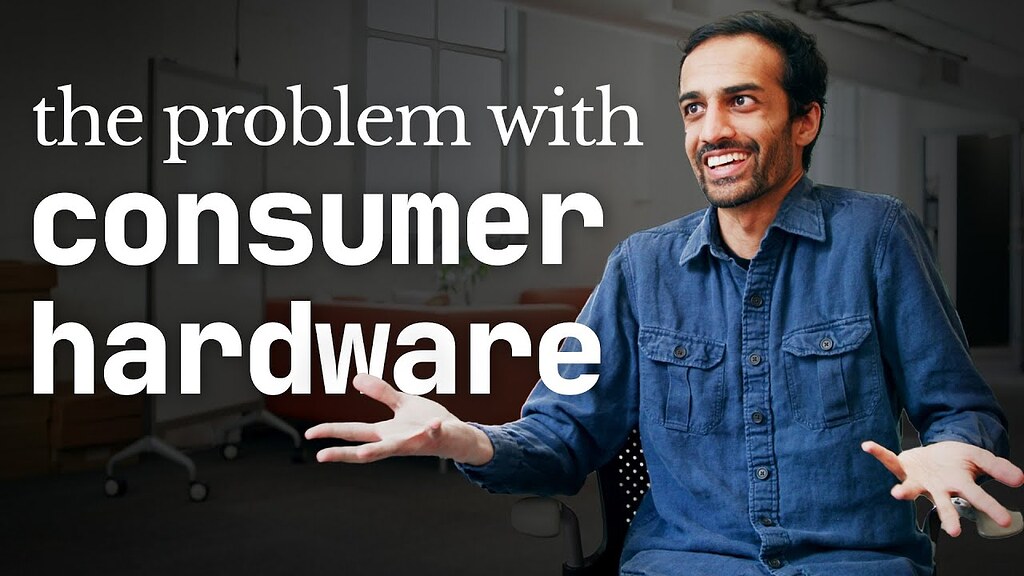
The founder as chief tinkerer
Patel’s public manner helps the argument. Asked for a personality type, he once replied that Myers-Briggs called him INTP, but “indefatigable” was closer. His personal biography describes a “hobbyist and hacker turned engineer turned suit,” then back again, then a suit once more. He writes that he dreams more than he acts, “but I spend much of my life realizing the dreams.” These are grand sentiments softened by a man who will also list his calipers.
His preferred tools include a Fluke multimeter, a modest Rigol oscilloscope, a Pace soldering station and a Prusa 3D printer. His GitHub projects include a parametric printable PC case, a spherical projection system and schematics for a belt-mounted computer. In 2023, he was still using an iPhone 12 that had already been repaired with replacement parts. His headphones were made from old whisky barrels. Even the accessories appear to have résumés.
He also dogfoods products in the literal Silicon Valley sense of the word. Before launches, he moves onto the forthcoming Framework machine. Because many Framework engineers use Linux, he has sometimes run Windows so someone in the company is living with that version’s irritations. The point is less personal purity than contact with the product. Patel’s authority comes from moving between circuit boards and spreadsheets without pretending either can be wished away.
Ownership after the cloud
By 2025, Framework had moved beyond its original 13-inch notebook. The colorful, convertible Laptop 12 aimed repairability at students and entry-level buyers, a part of the market too often offered machines designed down to a short life. Framework Desktop put the company’s modular instincts into a compact computer. The 16-inch laptop gained upgradeable graphics. The catalog began to resemble a system rather than a single act of dissent.
In 2026, Patel widened the argument. At Framework’s Next Gen event, he warned that memory, storage and silicon were being pulled toward data centers by an AI economy that sells compute by the hour or token. Cloud services can be immensely useful. They can also turn capability into rent. For Patel, a personal computer now represents more than a repair policy. It is compute that a person possesses at the deepest level and may use without continuing permission.
The claim contains a useful irony. Framework is a venture-backed company selling things. Its mission succeeds only if the things are good enough to desire, affordable enough to buy and profitable enough to support years of spare parts. Moral satisfaction will not rescue a mediocre keyboard. Repairability will not excuse late shipments. A platform is only open while its maker remains alive to stock the shelves and answer the support tickets.
Patel appears to understand the trap. Framework laptops do not look like workshop equipment or educational penance. They look like laptops, because virtue that demands ugliness rarely leaves the niche. The company’s most persuasive moments are consequently rather boring: a new mainboard fits an old case; a customer replaces a screen; a port moves from one side to the other. Longevity is made from small compatibilities honored repeatedly.
The original 2019 plan ended with a joke of a distant milestone: “IPO. Take over the world.” Five years later, Patel republished it, including the parts that had not happened on schedule. The frankness is part of the charm. Framework has not repaired consumer electronics. It has established a working counterexample.
A screwdriver cannot settle the politics of ownership. It can, however, loosen a screw. Then another. Soon the sealed object is open on the table, its pieces named, its logic visible, and the person who paid for it is permitted to begin.