The sentence sounds harmless. “Let me get back to you.” Somebody needs a number. Somebody else has the spreadsheet. A third person knows why the spreadsheet is wrong. By the time the answer arrives, the meeting has ended. Haptiq has put those six words at the center of its pitch. Behind the sales line is a recognizable business problem: information can move through a company much more slowly than the events it describes.
- Orion connects a company’s operating data and workflows.
- Olympus connects the investment process, from deals to portfolio oversight.
- Pantheon supplies the people who integrate, deploy, and support the technology.
Consider the anonymous national sports governing body in Haptiq’s institutional case study. Sponsorship money, media rights, and event costs lived in separate systems. Its account describes a business unable to see its own obligations together. Haptiq says it connected those systems and added signals for revenue variance and contract risk. The instructive detail is the separation: each department could possess useful information while leadership lacked a complete picture.
The deal behind the new name
Haptiq’s own history begins with bespoke enterprise software. Building for different clients, the company says, exposed the same recurring difficulties: disconnected data, backward-looking reporting, and work dependent on individual employees. Repetition supplied a product thesis. If the same problem kept arriving under different company names, perhaps some of the answer could be reused.
Then came a consequential piece of corporate plumbing. In April 2022, Pearl Street Equity and affiliates acquired Webonise, Haptiq’s predecessor. The announcement also outlined the integration of affiliated Olympus Fintech. A software-development business was being brought together with investment analytics. The combination helps explain the company Haptiq would become.
The new name arrived in March 2024, accompanied by an explicit narrowing toward financial organizations and their portfolios. CEO Alon Tvina framed the business around profitable growth. Today, ZCG identifies Haptiq as its technology affiliate and a Pearl Street holding. This places its software close to the people evaluating investments as well as the people running the underlying businesses.
The factory and the fund
The product names suggest somebody has a well-thumbed book of Greek mythology. Their division of labor is more prosaic. Orion is aimed at operations: the systems, sites, suppliers, and teams that must coordinate to keep a business moving. Its advertised foundation includes data integration, governance, AI agents, visual workflows, notifications, and performance monitoring.
A warehouse manager might use that connected environment to follow inventory and fulfillment. A finance leader might examine performance across systems. The underlying proposition is to bring existing tools into a common operating layer. That gives Haptiq a place among integration platforms, workflow software, and business-intelligence vendors, with custom engineering available when a standard connection is insufficient.
Olympus approaches the same economic activity from the investor’s side. Its modules cover deal management, credit analysis, fundraising, portfolio management, investor relations, and diligence documents. An investment team can begin with one module. The larger pitch is continuity: information gathered while considering an acquisition should remain useful when overseeing it and eventually preparing an exit.
Haptiq markets the two platforms as complementary, with data flowing between them. That is its most interesting competitive argument. A portfolio report is more useful when it reflects operating reality; an operating intervention is easier to assess when its financial consequences are visible. Connecting those perspectives is the company’s bet.
The release notes tell on the software
The company’s May 2026 updates offer a useful antidote to abstract AI language. Orion gained connectors for Zoho and Sage X3. Users could delete connections, separate inactive ones, and resume interrupted authorization. Authentication was revised for people with access to many applications. There were security-related library upgrades, too.
These are small, revealing details. Enterprise software encounters abandoned logins, cluttered connection lists, and permissions that become awkward as organizations grow. A sophisticated agent still needs a functioning connection. The release notes make visible the maintenance underneath the promise of coordinated action.
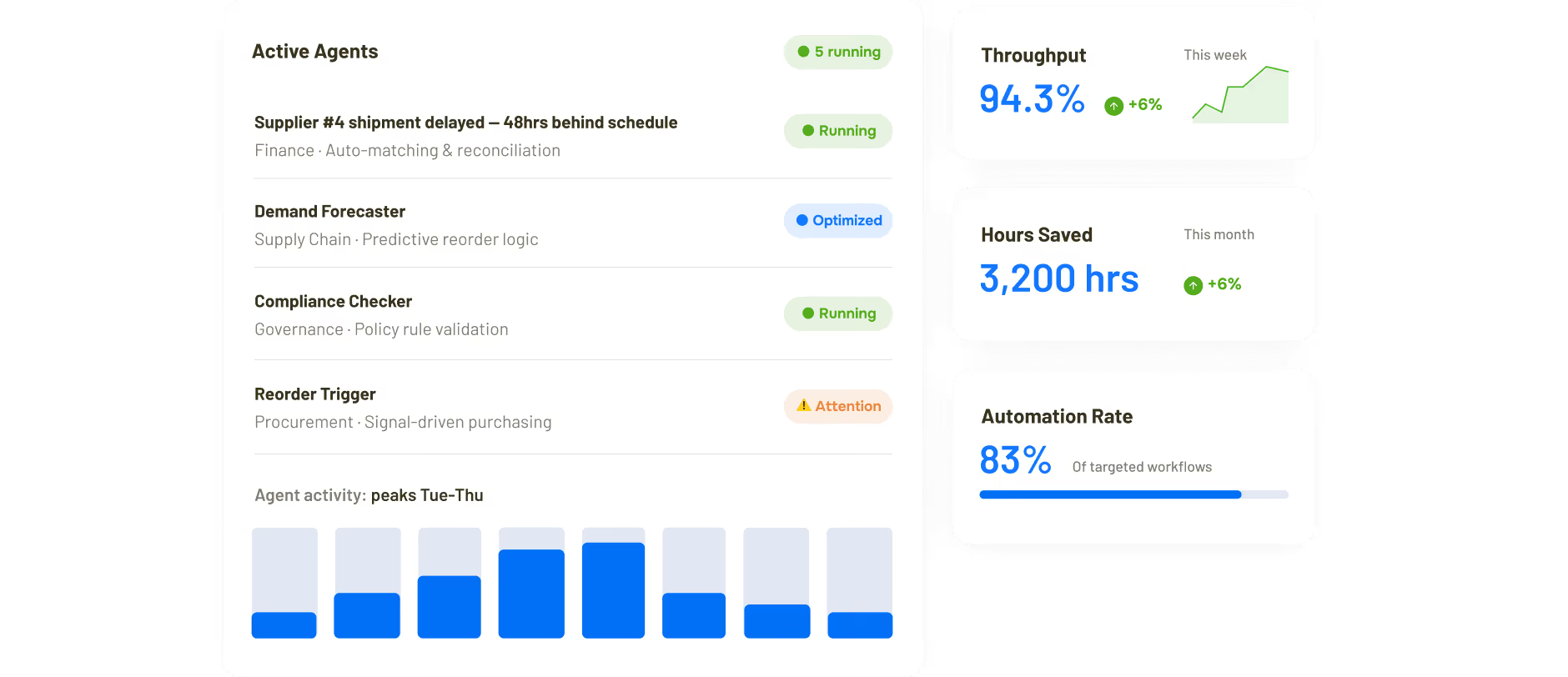
On the investment side, the same update described a credit compliance dashboard, a rules interface, and implementation and validation of 19 concentration tests. Credit AI had launched that March, combining borrower information, exposures, external inputs, and internal models. The practical purpose is earlier attention to changing risk, with analytical support for underwriting and scenarios.
Somebody still has to connect it
Pantheon is the service offering beside the software. It includes fractional technology executives, product leadership, integration, deployment, workflow redesign, and training. The business model combines proprietary cloud platforms with hands-on services. For a buyer, that means evaluating an implementation relationship alongside the product demonstration: which systems will connect, which processes will change, and who remains accountable afterward?
That human work appears in Haptiq’s employer-published associate interviews. One data engineer describes onboarding a financial entity with multiple sources, different fiscal years, and reports requiring exact agreement. Mentoring and production assignments feature in those accounts. They offer a more concrete glimpse of the work than the company’s values list: somebody has to investigate the mismatched number.

The useful lesson can be copied without buying anything. Pick one recurring exception. Identify when it becomes visible, who can authorize a response, and what proves completion. Haptiq’s own guidance emphasizes explicit workflow states, decision rights, and traceability. Those requirements also define the limits: ambiguous ownership and unreliable inputs will frustrate automation. A connected system needs an organization prepared to make decisions.
The useful question is how long a warning waits for an owner.AN OPERATING QUESTION
That question gives the product pitch a practical test. Walk a real exception through the demonstration. Follow the signal, the handoff, the approval, and the evidence that work finished. Then ask whether the people responsible have gained time to act. Haptiq’s ambition becomes meaningful at precisely that moment: when an answer arrives early enough for somebody to use it.
Follow the work
Explore Haptiq, Orion, Olympus, and Pantheon.
The Acropolis blog · May product notes · LinkedIn · GitHub · X (legacy) · Facebook (legacy)